Sugar Creek Trading Company
Schisandra Berry
Schisandra Berry
Impossible de charger la disponibilité du service de retrait
Schisandra chinensis
Schisandra Berry — Wu Wei Zi, the Five-Flavor Fruit of Longevity
Botanical Identification
Species: Schisandra chinensis (Turcz.) Baill.
Family: Schisandraceae
Common Names: Schisandra Berry, Wu Wei Zi (Five-Flavor Berry), Magnolia Vine Berry, Chinese Magnolia Vine Fruit
Plant Part Used: Ripe dried fruit
Form: Whole dried berries
Origin: Northern China, Korea, Russia (Far East), Japan
Schisandra chinensis is a deciduous woody vine that climbs to heights of 25 feet or more in the mixed forests of northeastern Asia. The plant produces pendulous clusters of small, bright red berries, each containing one to two kidney-shaped seeds. The species name and its famed Chinese designation, Wu Wei Zi, both point to the berry's remarkable quality: it simultaneously expresses all five fundamental tastes recognized in Chinese medicine — sweet, sour, salty, bitter, and pungent. This convergence of flavors is not merely a sensory curiosity but reflects the berry's extraordinarily broad phytochemical profile and its traditional classification as a substance that nourishes all five yin organs (liver, heart, spleen, lungs, kidneys).
This listing is for Schisandra berry under its standard modern botanical spelling, representing the whole dried fruit in its traditional form.
Cultural and Historical Use
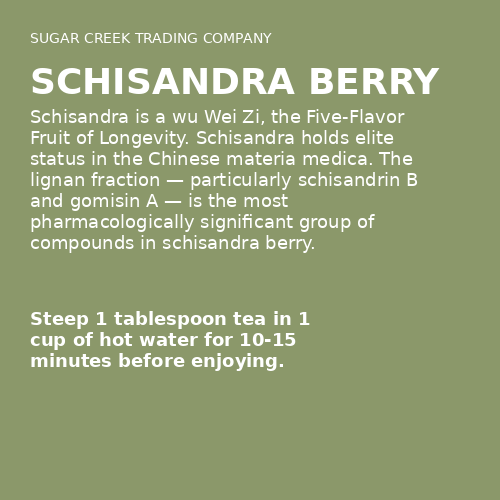
Schisandra holds elite status in the Chinese materia medica. First recorded in the Shennong Bencao Jing (Divine Farmer's Classic of Materia Medica, circa 200 CE), it was classified as a superior-grade herb — one safe for long-term use and capable of prolonging life. Taoist masters prized it as a tonic for spiritual vitality, claiming it sharpened the mind, brightened the eyes, and enabled practitioners to endure prolonged meditation and physical exertion.
In traditional Chinese medicine (TCM), schisandra is prescribed to astringe leaking Qi, generate fluids, calm the spirit, and tonify the kidneys. It appears in classical formulas for chronic cough, night sweats, insomnia, spermatorrhea, and diarrhea. Russian folk medicine independently adopted the berry, where Nanai hunters of the Far East carried dried schisandra on long expeditions, consuming the berries to combat fatigue, sharpen night vision, and endure cold. Soviet-era scientists, notably Dr. Israel Brekhman and Dr. Nikolai Lazarev, studied schisandra extensively in the 1950s and 1960s, and it was during this research that the term adaptogen was formally coined — a classification that schisandra helped define.
Key Bioactive Compounds
| Compound Class | Notable Examples | Primary Activity |
|---|---|---|
| Lignans (Schisandrins) | Schisandrin A, B, C; Schisandrol A, B; Gomisin A, N | Hepatoprotective; antioxidant; adaptogenic |
| Organic Acids | Citric acid, malic acid, tartaric acid | Astringent action; fluid generation |
| Essential Oils | Sesquiterpenes (ylangene, chamigrene), monoterpenes | Aromatic; mild antimicrobial |
| Vitamins | Vitamin C, Vitamin E | Antioxidant |
| Polysaccharides | Schisandra polysaccharides (SCP) | Immunomodulatory; anti-fatigue |
| Phytosterols | Beta-sitosterol, stigmasterol | Anti-inflammatory |
How It Works in the Body
The lignan fraction — particularly schisandrin B and gomisin A — is the most pharmacologically significant group of compounds in schisandra berry. These dibenzocyclooctadiene lignans exert powerful hepatoprotective effects by stabilizing liver cell membranes, stimulating hepatic glutathione production, and enhancing Phase I and Phase II detoxification enzyme activity. In animal and in vitro models, schisandrin B has demonstrated the ability to protect liver cells from damage caused by carbon tetrachloride, acetaminophen, and other hepatotoxins.
As an adaptogen, schisandra modulates the hypothalamic-pituitary-adrenal (HPA) axis, helping normalize cortisol output under both acute and chronic stress. Soviet military studies documented improvements in work capacity, mental clarity, and stress tolerance among soldiers and pilots given schisandra preparations. The berry also enhances nitric oxide-mediated vasodilation, improving blood flow to working tissues and supporting cardiovascular function under exertion.
The astringent quality of the berry — driven by its high organic acid content — gives schisandra its traditional "leakage-preventing" action. In practical terms, this translates to reduced excessive sweating, improved fluid retention in cases of chronic diarrhea, and a tonifying effect on the urinary system. The sour taste stimulates salivation and digestive secretions, aiding nutrient absorption.
Dose Guidelines
| Preparation | Amount | Frequency | Notes |
|---|---|---|---|
| Dried Berries (decoction) | 3-6 grams | Simmered 10-15 min, 1-2 times daily | Lightly crush berries before simmering |
| Dried Berries (chewed) | 1-3 grams (about 10-20 berries) | 1-2 times daily | Traditional Nanai hunter method |
| Tincture | 1:5 in 50-60% alcohol | 2-4 mL, 2-3 times daily | 4-6 week maceration |
| Powdered Berry | 1-3 grams | 1-2 times daily | Mix into smoothies, honey, or warm water |
Preparation and Uses
- Decoction: Lightly crush 3-6 grams of dried berries and simmer in 2 cups of water for 10-15 minutes. Strain and drink. The resulting tea is tart, slightly sweet, and pleasantly complex. Adding a small amount of honey complements the flavor well.
- Chewing: Simply chew 10-20 dried berries slowly, allowing the full spectrum of five flavors to unfold. Swallow the pulp and seeds. This method was used by Siberian hunters for quick energy and mental clarity on the trail.
- Tincture: Fill a jar one-third full with crushed berries and cover with 50-60% alcohol. Macerate for 4-6 weeks, shaking regularly. Strain and bottle. An excellent long-term tonic preparation.
- Infused Honey: Combine crushed berries with raw honey at a 1:4 ratio. Allow to infuse for 2-4 weeks. Take 1-2 teaspoons daily as a pleasantly tart, adaptogenic honey.
- Culinary: Schisandra berries can be simmered into syrups, jams, and fruit leathers. In Korean cuisine, the berries are used to make omija-cha, a traditional five-flavor tea served cold in summer.
Optimal Context for Use
- Stress Adaptation: Individuals experiencing chronic stress, mental fatigue, or burnout. Schisandra helps normalize the stress response rather than simply stimulating or sedating.
- Liver Support: Those seeking to support hepatic detoxification, including people recovering from illness, medication use, or environmental toxin exposure.
- Physical Performance: Athletes and physical laborers looking for sustained endurance, improved oxygen utilization, and faster recovery without stimulant-related side effects.
- Cognitive Function: Students, professionals, or meditators seeking enhanced focus, memory, and mental clarity over extended periods.
- TCM Formulation: Commonly combined with reishi mushroom, astragalus, and goji berry in longevity tonics, or with ophiopogon and ginseng in Qi-generating formulas.
Sustainability and Ethical Harvesting
Schisandra chinensis grows abundantly across its native range in northeastern China, Korea, and the Russian Far East, and is also commercially cultivated in China. Wild populations remain robust, though local overharvesting has been reported in some Russian provinces. Cultivated schisandra, grown on trellised vines much like grapes, represents the most sustainable sourcing option. Ethical wild harvesting involves collecting only ripe berries, leaving a portion of each cluster for wildlife and seed dispersal, and avoiding harvest from young or stressed vines. We prioritize sourcing from suppliers committed to sustainable harvesting and cultivation practices.
Safety and Cautions
- Generally safe for long-term use. Classified as a superior-grade herb in TCM, indicating an excellent safety profile with extended consumption.
- Pregnancy: Traditionally avoided during pregnancy due to its stimulating effect on uterine contractions. Do not use if pregnant or planning to become pregnant.
- Gastroesophageal reflux: The high acidity of the berries may aggravate acid reflux or peptic ulcer symptoms in sensitive individuals.
- Drug metabolism: Schisandra lignans influence cytochrome P450 enzymes (particularly CYP3A4). This may alter the metabolism of certain pharmaceutical drugs. Consult a healthcare provider if you take prescription medications.
- Epilepsy: Some sources caution against use in epilepsy due to potential CNS-stimulating effects. Seek medical guidance.
- Acute infection with high fever: TCM tradition advises against using astringent herbs during the acute phase of infectious illness, as they may "trap" the pathogen.
This product is not intended to diagnose, treat, cure, or prevent any disease. Consult a qualified healthcare provider before use, especially if you have a medical condition or take medications.
References
- Panossian, A., and Wikman, G. "Pharmacology of Schisandra chinensis: An overview of Russian research and uses in medicine." Journal of Ethnopharmacology, 2008.
- Ip, S.P., et al. "Schisandrin B protects against hepatic oxidative damage." Free Radical Biology and Medicine, 2000.
- Hancke, J.L., et al. "Schisandra chinensis: A review of its phytochemistry and pharmacology." Fitoterapia, 1999.
- Chen, J.K., and Chen, T.T. Chinese Medical Herbology and Pharmacology. Art of Medicine Press, 2004.
- Brekhman, I.I., and Dardymov, I.V. "New substances of plant origin which increase nonspecific resistance." Annual Review of Pharmacology, 1969.
Final Note
There is perhaps no single berry in the world's herbal traditions that embodies complexity quite like schisandra. Its five simultaneous flavors are not a parlor trick but a reflection of a phytochemistry so broad and balanced that it defies simple categorization. Where most herbs excel in one domain, schisandra quietly serves the liver, the lungs, the kidneys, the mind, and the spirit in a single handful. The Taoist sages who placed it among the supreme tonics of longevity understood what modern pharmacology is only now confirming: this small red fruit from the northern forests is one of nature's most complete medicines. Crush a few berries, let all five flavors bloom across your palate, and taste what centuries of healers already knew.
Share