Sugar Creek Trading Company
Shatavari
Shatavari
Impossible de charger la disponibilité du service de retrait
Asparagus racemosus
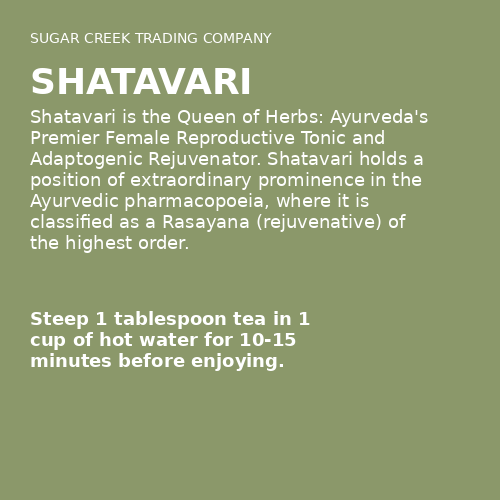
Shatavari - The Queen of Herbs: Ayurveda's Premier Female Reproductive Tonic and Adaptogenic Rejuvenator
Botanical Identification
Asparagus racemosus is a climbing, thorny undershrub belonging to the family Asparagaceae. Native to the tropical and subtropical regions of India, Sri Lanka, the Himalayas, and parts of Southeast Asia and Africa, this perennial plant thrives in gravelly, rocky soils at elevations up to 1,500 meters. The plant produces delicate, pine-needle-like cladodes (modified stems that function as leaves), small fragrant white flowers arranged in racemes, and bright red berries when mature. The medicinally prized portion is the tuberous root system — a cluster of dozens of fleshy, spindle-shaped roots that can reach 30-100 cm in length, pale white to yellowish in color when fresh. The Sanskrit name Shatavari translates to "she who possesses a hundred husbands," a poetic reference to the plant's legendary capacity to support female vitality and fertility.
Cultural and Historical Use
Shatavari holds a position of extraordinary prominence in the Ayurvedic pharmacopoeia, where it is classified as a Rasayana (rejuvenative) of the highest order. Referenced in the foundational Ayurvedic texts — the Charaka Samhita, Sushruta Samhita, and Ashtanga Hridayam — Shatavari has been prescribed for over 3,000 years as the primary tonic for female reproductive health across all stages of life. In traditional Ayurvedic energetics, it is classified as madhura (sweet) and tikta (bitter) in taste, sheeta (cooling) in potency, and guru (heavy) and snigdha (unctuous) in quality. It pacifies Vata and Pitta doshas while nourishing Ojas, the essence of immunity and vitality. Beyond Ayurveda, Shatavari appears in Siddha medicine, Unani practice, and numerous indigenous healing traditions across South Asia. It has also been used traditionally as a galactagogue (to promote breast milk production), a digestive tonic, and a remedy for ulcers and inflammatory conditions.
Key Bioactive Compounds
| Compound / Class | Concentration | Primary Activity |
|---|---|---|
| Steroidal saponins (Shatavarins I-IV) | 4-8% | Hormonal modulation, galactagogue, adaptogenic |
| Sarsasapogenin | Major aglycone | Anti-inflammatory, estrogenic activity |
| Isoflavones (racemofuran, racemosol) | Trace-moderate | Antioxidant, phytoestrogenic |
| Polysaccharides | Variable | Immunomodulatory, prebiotic |
| Mucilage | Significant | Demulcent, gastrointestinal soothing |
| Racemosides A, B, C | Trace | Antioxidant, anti-stress |
| Asparagamine A (alkaloid) | Trace | Immunostimulant |
| Minerals (zinc, manganese, copper) | Trace | Cofactors for enzymatic processes |
How It Works in the Body
Shatavari exerts its wide-ranging effects through multiple interconnected mechanisms. The steroidal saponins, particularly Shatavarin IV, demonstrate phytoestrogenic activity by binding estrogen receptors, which helps modulate hormonal balance throughout the menstrual cycle, during perimenopause, and postmenopause. This gentle estrogenic influence supports endometrial health, cervical mucus production, and follicular development. As a powerful adaptogen, Shatavari modulates the hypothalamic-pituitary-adrenal (HPA) axis, helping normalize cortisol output under chronic stress — a mechanism that indirectly supports reproductive and thyroid function. The polysaccharides and mucilage provide significant demulcent action, coating and soothing irritated mucous membranes throughout the gastrointestinal and urinary tracts, while also acting as prebiotics to nourish beneficial gut flora. Research has demonstrated Shatavari's capacity to upregulate prolactin production, substantiating its traditional use as a galactagogue. Its immunomodulatory effects operate through macrophage activation, enhanced natural killer cell activity, and regulation of inflammatory cytokines including TNF-alpha and IL-1beta.
Dose Guidelines
| Form | Low Dose | Standard Dose | High/Therapeutic Dose |
|---|---|---|---|
| Dried root powder | 1-2 g/day | 3-6 g/day | 6-12 g/day |
| Decoction (simmered tea) | 3-5 g in 2 cups water | 5-10 g in 2-3 cups water | 10-15 g in 3-4 cups water |
| Tincture (1:5, 45% ethanol) | 2-3 mL/day | 3-5 mL, 2-3x/day | 5-8 mL, 3x/day |
| Shatavari Kalpa (with sugar/ghee) | 5 g/day | 10-15 g/day | 15-25 g/day |
Traditional Ayurvedic preparation involves cooking the powder in milk or ghee to enhance bioavailability of fat-soluble saponins. Begin with a low dose and increase gradually over 1-2 weeks.
Preparation and Uses
- Warm milk decoction (Shatavari Ksheerapaka): Simmer 3-5 g of Shatavari powder in 1 cup of milk and 1 cup of water until the water evaporates and only the milk remains. Add honey, cardamom, or saffron to taste. This is the most traditional and revered preparation method.
- Herbal decoction: Simmer 5-8 g of root pieces in 3 cups of water for 20-30 minutes. Strain and drink warm, 1-2 cups daily.
- Powder in ghee: Mix 3-5 g powder into warm ghee and consume before meals for enhanced absorption and deeper tissue nourishment.
- Smoothie or food addition: Blend 3-5 g of powder into smoothies, oatmeal, or warm porridge. The mildly sweet, slightly bitter flavor integrates well.
- Tincture: Use alcohol or glycerin extraction for convenient dosing. Take drops in warm water or juice.
- External application: Shatavari-infused oil is used in Ayurvedic massage (Abhyanga) for nourishing the skin and balancing Vata.
Optimal Context for Use
- Female reproductive support: Irregular menstruation, PMS symptoms, menopausal transition, fertility preparation, and postpartum recovery.
- Lactation enhancement: As a galactagogue for nursing mothers experiencing low milk supply.
- Digestive and gastric healing: Hyperacidity, gastric ulcers, irritable bowel, and conditions involving inflamed mucous membranes.
- Stress adaptation: Chronic stress, adrenal fatigue, burnout, and anxiety-related hormonal disruption.
- Immune modulation: Recurrent infections, immune depletion, and convalescence from illness.
- Urinary tract health: Recurrent UTIs, kidney irritation, and urinary discomfort due to its cooling, demulcent properties.
- Male reproductive health: Though primarily known as a female tonic, Shatavari is also traditionally used for male fertility, spermatogenesis, and libido.
Sustainability and Ethical Harvesting
Due to massive commercial demand and habitat destruction, wild Asparagus racemosus populations have declined significantly across India and are now listed as endangered or threatened in several Indian states. The Indian government and IUCN have flagged this species for conservation attention. Ethical sourcing requires prioritizing cultivated Shatavari from farms that employ sustainable agriculture practices. Responsible cultivation programs are expanding across India, particularly in Maharashtra, Rajasthan, and Karnataka. Roots are typically harvested from 2-3 year old plants, and sustainable farming leaves sufficient root mass to allow plant regeneration. When purchasing Shatavari, inquire about sourcing — farm-cultivated material is both more sustainable and often of superior quality to wild-harvested roots that may be stressed or over-mature.
Safety and Cautions
- Estrogen-sensitive conditions: Due to phytoestrogenic activity, use caution with hormone-sensitive cancers (breast, ovarian, uterine), endometriosis, and uterine fibroids. Consult a qualified practitioner.
- Asparagus allergy: Individuals with known allergy to asparagus family plants should avoid Shatavari.
- Pregnancy: Traditionally considered safe and even beneficial during pregnancy in Ayurveda, but high doses should be avoided in the first trimester without practitioner guidance. The herb's uterotonic properties warrant caution.
- Kidney disorders: The diuretic effect may require dose adjustment in those with kidney disease.
- Edema or fluid retention: Shatavari's hydrating, heavy quality may exacerbate Kapha-related congestion or water retention in some individuals.
- Drug interactions: May interact with diuretics, antidiabetic medications, and hormone replacement therapies. Consult your healthcare provider.
- This product is sold as a botanical specimen and herbal supplement ingredient. It is not intended to diagnose, treat, cure, or prevent any disease.
References
- Alok, S., et al. "Plant profile, phytochemistry and pharmacology of Asparagus racemosus: A review." Asian Pacific Journal of Tropical Disease, 3(3), 2013, pp. 242-251.
- Bopana, N., & Saxena, S. "Asparagus racemosus — Ethnopharmacological evaluation and conservation needs." Journal of Ethnopharmacology, 110(1), 2007, pp. 1-15.
- Pandey, A.K., et al. "Shatavari (Asparagus racemosus): A versatile female tonic." International Journal of Pharmaceutical and Biological Archives, 9(3), 2018, pp. 1-8.
- Sharma, K., & Bhatnagar, M. "Asparagus racemosus — A versatile plant: A review." Asian Journal of Pharmaceutical and Clinical Research, 4(Suppl 2), 2011, pp. 62-68.
- Botanical Safety Handbook, 2nd edition. American Herbal Products Association, 2013.
Final Note: Shatavari is one of Ayurveda's most treasured and time-honored botanicals — a nourishing, cooling, deeply rejuvenative root that has supported women's health for millennia while also offering profound benefits for digestion, immunity, and stress resilience in all people. Its sweet, grounding energy makes it a cornerstone of any holistic wellness practice rooted in the wisdom of traditional plant medicine.
Share