Sugar Creek Trading Company
Skullcap
Skullcap
Impossible de charger la disponibilité du service de retrait
Skullcap (Scutellaria lateriflora)
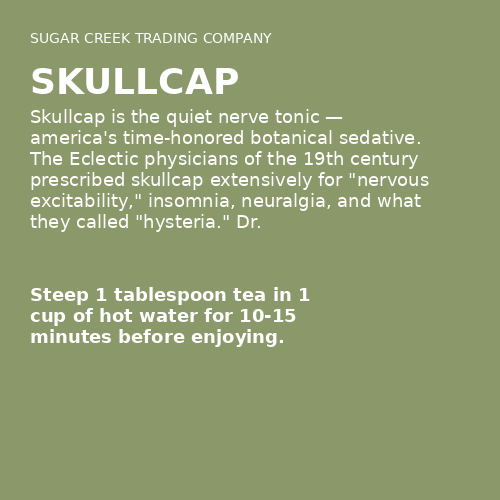
The Quiet Nerve Tonic — America's Time-Honored Botanical Sedative
Botanical Identification
Scutellaria lateriflora, commonly known as American skullcap, blue skullcap, or mad-dog skullcap, is a perennial herbaceous plant in the Lamiaceae (mint) family. It grows 30–80 cm tall with slender, branching square stems and opposite, serrated, ovate leaves. Small blue to violet tubular flowers appear along one side of the stem from July through September — the species name lateriflora means "flowers on the side." Native to moist meadows, stream banks, and woodland margins throughout North America, skullcap should not be confused with Chinese skullcap (Scutellaria baicalensis), which is a distinctly different species with different chemistry and therapeutic applications. The aerial parts (leaves and stems) are harvested during flowering for maximum potency.
Cultural and Historical Use
American skullcap has a long history of use among Indigenous peoples of North America, particularly the Cherokee, who employed it as a ceremonial herb and emmenagogue, and the Iroquois, who used it for kidney health and to "keep the throat clear." Its most prominent historical use, however, emerged in 18th- and 19th-century Euro-American herbalism, where it earned the name "mad-dog skullcap" after being promoted as a cure for rabies — a claim that was never validated but speaks to the plant's powerful reputation as a nerve-calming agent.
The Eclectic physicians of the 19th century prescribed skullcap extensively for "nervous excitability," insomnia, neuralgia, and what they called "hysteria." Dr. John King's American Dispensatory (1854) described it as "one of the most valuable nervines in the materia medica." By the early 20th century, it had become one of the most widely used botanical sedatives in Western herbalism, a position it continues to hold today.
In Appalachian folk medicine, skullcap tea was a standard household remedy for frayed nerves, sleeplessness, and tension headaches — brewed strong and sipped slowly before bed.
Key Bioactive Compounds
| Compound | Class | Primary Activity |
|---|---|---|
| Baicalin | Flavone glycoside | GABA-A receptor modulation, anxiolytic, anti-inflammatory |
| Baicalein | Flavone (aglycone) | Neuroprotective, antioxidant, anxiolytic |
| Scutellarin | Flavone glycoside | Cerebrovascular support, antioxidant |
| Wogonin | Flavone | GABA-A binding, sedative, anti-inflammatory |
| Chrysin | Flavone | Mild anxiolytic, aromatase inhibition |
| Oroxylin A | Flavone | Cognitive enhancement, dopaminergic modulation |
| Melatonin | Indoleamine | Circadian rhythm regulation, sleep onset support |
How It Works in the Body
Skullcap's calming effects are primarily mediated through its flavonoid compounds, which interact with the gamma-aminobutyric acid (GABA) system — the brain's primary inhibitory neurotransmitter network. Baicalin, baicalein, and wogonin bind to GABA-A receptors at the benzodiazepine site, enhancing the inhibitory action of GABA without producing the dependency, tolerance, or cognitive impairment associated with pharmaceutical benzodiazepines. This mechanism produces measurable anxiolytic and muscle-relaxant effects.
Beyond GABA modulation, skullcap flavonoids exhibit potent antioxidant and anti-inflammatory activity in neural tissue. Baicalein has demonstrated the ability to inhibit lipoxygenase enzymes, reduce neuroinflammation, and protect neurons from excitotoxic damage. Scutellarin supports cerebral blood flow and has shown neuroprotective effects in ischemic models.
Notably, skullcap contains naturally occurring melatonin, which may contribute to its traditional reputation as a sleep aid. The overall effect profile is one of calm alertness at lower doses transitioning to gentle sedation at higher doses — a quality that distinguishes it from more heavy-handed sedative herbs.
Dose Guidelines
| Form | Suggested Dose | Notes |
|---|---|---|
| Dried Herb (tea) | 1–2 teaspoons per cup, steeped 10–15 minutes | Cover while steeping to retain volatile compounds |
| Tincture (1:5, 40% alcohol) | 2–4 mL (40–80 drops), up to 3 times daily | Fresh plant tinctures are considered superior |
| Powdered Herb (capsules) | 1–2 grams, 1–3 times daily | Best taken with food |
| For Sleep | Double the daytime dose, 30–60 minutes before bed | Combine with valerian or passionflower for deeper sedation |
Skullcap's effects are cumulative. While some individuals notice immediate calming, optimal results often develop over 1–2 weeks of consistent use.
Preparation and Uses
- Nervine Tea: Steep 1–2 teaspoons of dried aerial parts in freshly boiled water for 10–15 minutes, covered. Strain and drink up to three times daily. The flavor is mildly bitter and herbaceous — honey and lemon complement it well.
- Sleep Blend: Combine equal parts skullcap, passionflower, and chamomile. Steep 1 tablespoon of the blend per cup for 15 minutes. Drink 30–60 minutes before bed.
- Tension-Relief Tincture: A fresh-plant tincture of skullcap taken in 2 mL doses provides rapid-onset nervous system support during acute stress or anxiety.
- Herbal Bath: Brew a strong infusion (4 tablespoons per quart of water) and add to a warm bath for whole-body nervous system relaxation.
- Smoking Blend Component: Dried skullcap is sometimes included in herbal smoking blends for its calming properties and smooth smoke character.
Optimal Context for Use
- Anxiety and Nervous Tension: Skullcap is a first-line nervine for everyday anxiety, worry, and mental restlessness — particularly when the mind "won't stop."
- Insomnia: Effective for sleep-onset difficulty driven by racing thoughts or nervous overstimulation, especially when combined with other sedative herbs.
- Muscle Tension and Spasm: Its antispasmodic action makes it useful for tension headaches, jaw clenching, and stress-related muscle tightness.
- Nervous System Recovery: Herbalists recommend skullcap for periods of nervous exhaustion, burnout, or recovery from prolonged stress.
- Withdrawal Support: Traditionally used to ease symptoms of withdrawal from alcohol, benzodiazepines, and other substances — under professional guidance.
Sustainability and Ethical Harvesting
Scutellaria lateriflora is not currently endangered but faces pressure from habitat loss and overharvesting as demand for botanical nervines increases. It grows readily in moist, semi-shaded conditions and is an excellent candidate for cultivation in home herb gardens and small-scale farms. Wild-harvesting should be limited to abundant stands, taking no more than one-third of any population, and avoiding harvest from riparian areas where the plant plays a role in bank stabilization. Supporting cultivated sources is the most sustainable choice. Adulteration with germander (Teucrium species), which can cause liver damage, has been documented in commercial products — purchase only from trusted suppliers who verify botanical identity.
Safety and Cautions
- Liver Concerns: Historical reports of skullcap-associated liver damage were later attributed to adulteration with germander, not to skullcap itself. Authentic Scutellaria lateriflora has not been shown to cause hepatotoxicity at normal doses. Purchase from reputable sources.
- Sedation: Higher doses may cause drowsiness. Exercise caution when driving or operating machinery until you understand your individual response.
- Drug Interactions: May potentiate the effects of sedative medications, benzodiazepines, barbiturates, and alcohol. Consult a healthcare provider if taking prescription sedatives or anxiolytics.
- Pregnancy and Nursing: Traditionally avoided during pregnancy due to its emmenagogue history. Insufficient safety data for use during breastfeeding.
- Excessive Doses: Very high doses may cause giddiness, confusion, or irregular heartbeat. Stay within recommended ranges.
References
- Wolfson, P., and Hoffmann, D. L. (2003). "An investigation into the efficacy of Scutellaria lateriflora in healthy volunteers." Alternative Therapies in Health and Medicine, 9(2), 74–78.
- Brock, C., et al. (2014). "American Skullcap (Scutellaria lateriflora): A Randomised, Double-Blind Placebo-Controlled Crossover Study of its Effects on Mood in Healthy Volunteers." Phytotherapy Research, 28(5), 692–698.
- Awad, R., et al. (2003). "Bioassay-guided fractionation of Scutellaria lateriflora using in vitro receptor binding assays for GABA." Journal of Pharmacy and Pharmaceutical Sciences, 6, 54.
- Gafner, S., et al. (2003). "Alkaloids and Flavonoids from American Skullcap." Planta Medica, 69(5), 462–464.
- Upton, R. (Ed.). (2009). Skullcap Aerial Parts: Scutellaria lateriflora L. American Herbal Pharmacopoeia.
Final Note
This product is sold as a raw botanical specimen for personal research and traditional use. It is not intended to diagnose, treat, cure, or prevent any disease. The information provided here is for educational purposes only and reflects historical use and available scientific literature. Always consult a qualified healthcare professional before adding any new supplement to your regimen, especially if you are pregnant, nursing, taking medications, or managing a chronic health condition.
Share