Sugar Creek Trading Company
Slippery Elm Bark
Slippery Elm Bark
Impossible de charger la disponibilité du service de retrait
Slippery Elm Bark (Ulmus rubra)
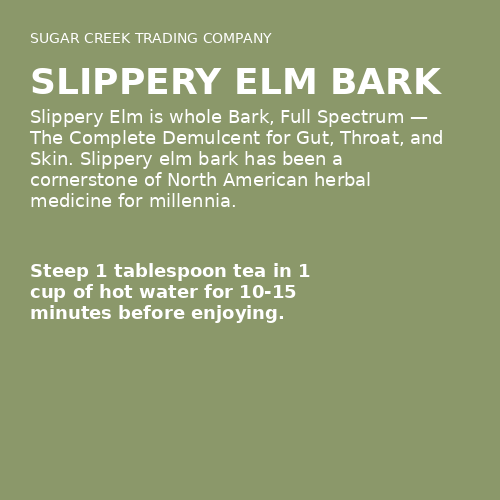
Whole Bark, Full Spectrum — The Complete Demulcent for Gut, Throat, and Skin
Botanical Identification
Ulmus rubra (syn. Ulmus fulva), commonly known as slippery elm, red elm, or moose elm, is a deciduous tree native to the central and eastern United States and southeastern Canada. It inhabits rich bottomlands, stream valleys, and lower slopes from southern Quebec to Florida and west to the Dakotas and Texas. The tree grows 12–20 meters tall and is identified by its rough, grayish-brown outer bark with deep furrows, large alternating leaves that are sandpaper-rough on the upper surface, and distinctive reddish-brown inner bark.
This product is slippery elm bark — comprising both the outer bark and inner bark layers processed together, providing the full spectrum of compounds found across all bark tissues. This distinguishes it from the pure inner bark product, which consists exclusively of the mucilage-rich cambium layer. The whole bark preparation retains higher concentrations of tannins, fiber, and certain minerals from the outer bark while still delivering significant mucilage content from the included inner bark fraction. It is available in cut-and-sifted, coarsely ground, or powdered forms.
Cultural and Historical Use
Slippery elm bark has been a cornerstone of North American herbal medicine for millennia. Indigenous nations including the Ojibwe, Menominee, Meskwaki, and Cherokee utilized the bark in multiple preparations — teas for coughs and sore throats, poultices for wounds and skin eruptions, and nutritive gruels during times of scarcity or illness. The Iroquois brewed bark tea for bowel complaints and used bark strips as natural bandages.
In early American settler medicine, slippery elm bark became arguably the single most versatile remedy in the domestic medicine chest. It appeared in the United States Pharmacopeia from 1820 to 1960 and was prescribed by regular physicians, homeopaths, and Eclectics alike. Dr. Wooster Beach, founder of the Reformed Medical movement, called slippery elm "the most valuable article in the botanic practice of medicine."
During the American frontier era, slippery elm bark lozenges were sold in every general store for throat and cough relief — a tradition that continues in commercial throat lozenges today. The whole bark was also used industrially for its mucilage as a binding agent in poultices and pill manufacture.
Key Bioactive Compounds
| Compound | Class | Primary Activity |
|---|---|---|
| Mucilage (hexose and pentose sugars) | Polysaccharide | Demulcent, tissue coating, moisture retention |
| Tannins (condensed and hydrolysable) | Polyphenol | Astringent, antimicrobial, anti-diarrheal |
| Starch | Polysaccharide | Nutritive, energy substrate |
| Beta-sitosterol | Phytosterol | Anti-inflammatory, immune modulation |
| Calcium | Mineral | Bone health, nerve signaling, muscle function |
| Dietary Fiber | Polysaccharide complex | Bowel regulation, prebiotic fermentation |
| Sesquiterpenes | Terpenoid | Anti-inflammatory, mild antimicrobial |
How It Works in the Body
Slippery elm bark operates through both mechanical and biochemical pathways. The mucilage fraction — present in significant though somewhat lower concentration than in pure inner bark preparations — hydrates into a viscous gel upon contact with water. This gel coats the mucous membranes of the mouth, esophagus, stomach, and intestines, forming a protective film that shields irritated tissue from acid, enzymes, and mechanical abrasion. This coating action is the basis of its classification as a demulcent.
The tannin content, which is proportionally higher in the whole bark than in pure inner bark, adds a complementary astringent action. While mucilage soothes and coats, tannins tighten and tone relaxed or weeping tissues, reduce excessive secretion, and provide mild antimicrobial activity. This dual action — demulcent plus astringent — makes the whole bark particularly useful for conditions involving both inflammation and excessive fluid loss, such as diarrhea with intestinal irritation.
The fiber content contributes to bowel regulation by adding bulk to stool and normalizing transit time. Beta-sitosterol and other phytosterols provide systemic anti-inflammatory effects when absorbed. The starch content makes slippery elm bark mildly nutritive, contributing to its traditional role as a food for the ill and convalescing.
Through reflex stimulation of the vagus nerve from the gut lining, slippery elm also promotes increased mucus production in distant mucosal surfaces, including the respiratory tract — explaining why an orally ingested bark tea can ease a dry cough.
Dose Guidelines
| Form | Suggested Dose | Notes |
|---|---|---|
| Cut-and-Sifted Bark (decoction) | 1–2 tablespoons per 2 cups water, simmered 15–20 minutes | Strain and drink warm; will be moderately thick |
| Powdered Bark | 1–2 teaspoons stirred into warm water or milk | Slightly less viscous than pure inner bark powder |
| Capsules | 400–800 mg, up to 3 times daily | Take with a full glass of water |
| Poultice (external) | Mix powder with warm water to form a paste | Apply to affected area; cover with cloth |
For digestive complaints, take 20–30 minutes before meals. For sore throat, sip slowly and allow the liquid to coat the throat fully before swallowing.
Preparation and Uses
- Decoction: Add 1–2 tablespoons of cut-and-sifted bark to 2 cups of cold water. Bring to a gentle simmer and maintain for 15–20 minutes. Strain through a fine-mesh sieve. The resulting liquid will be slightly thick and amber-colored. Drink warm, sweetened with honey if desired.
- Quick Gruel: Stir 1–2 teaspoons of powdered bark into a cup of warm water or warm milk. Whisk vigorously to prevent lumps. Season with cinnamon, nutmeg, or maple syrup for a nourishing porridge.
- Throat Gargle: Prepare a strong decoction (double the bark) and use as a gargle for sore throat, mouth ulcers, or gum inflammation. Gargle for 30 seconds, then swallow or spit.
- Skin Poultice: Blend powdered bark with warm water to make a thick paste. Apply to minor burns, insect bites, rashes, or slow-healing wounds. The combined mucilage and tannin content soothes while gently drawing out impurities.
- Blended into Foods: Add powdered bark to smoothies, oatmeal, or soup to increase their demulcent properties. The mild, slightly sweet flavor blends easily with most foods.
Optimal Context for Use
- Digestive Inflammation: Whole bark is well-suited for general digestive irritation, gastritis, and intestinal inflammation where both coating and astringent actions are beneficial.
- Diarrhea with Irritation: The tannin content in the whole bark provides astringent anti-diarrheal support that the pure inner bark lacks, making this form preferable when loose stools accompany gut inflammation.
- Sore Throat and Upper Respiratory Irritation: Effective for pharyngitis, post-nasal drip, and dry coughs. The thinner mucilage of the whole bark compared to pure inner bark makes it easier to prepare as a drinkable tea.
- Skin Conditions: External poultice application for minor wounds, rashes, eczema flares, and insect bites leverages both demulcent and astringent properties.
- General Daily Gut Maintenance: The prebiotic fiber and mild mucilage content make whole bark tea a gentle daily tonic for long-term digestive wellness.
Sustainability and Ethical Harvesting
Slippery elm is under increasing ecological pressure from Dutch elm disease, emerald ash borer damage to companion species, habitat conversion, and overharvesting for the herbal market. The United Plant Savers has placed Ulmus rubra on its "To Watch" list. Ethical sourcing requires bark harvested only from sustainably managed woodlots, storm-fallen trees, or trees being removed for legitimate land management. Never purchase bark from suppliers who cannot verify sustainable sourcing. Supporting nurseries that cultivate slippery elm and using the herb judiciously rather than as a daily staple are important steps for conservation. Where possible, consider marshmallow root (Althaea officinalis) as a cultivated demulcent alternative for routine use, reserving slippery elm for situations where its unique properties are specifically indicated.
Safety and Cautions
- Medication Interactions: The mucilage coating may slow absorption of oral medications. Separate dosing by at least 2 hours from any prescription or over-the-counter drugs.
- Pregnancy: Whole bark preparations that include outer bark should be used with caution during pregnancy. The outer bark of Ulmus rubra was historically associated with abortifacient use. Though the risk from a mixed bark product at normal doses is likely very low, pregnant individuals should consult a healthcare provider before use or opt for the pure inner bark product instead.
- Obstruction Risk: When taking powdered bark in dry form, always consume with adequate water to prevent esophageal or intestinal obstruction from the swelling mucilage.
- Allergic Reactions: Rare but documented. Discontinue use if itching, rash, or respiratory symptoms occur.
- Generally Recognized as Safe: Slippery elm bark has an extensive safety record. The FDA classifies it as a safe and effective oral demulcent for minor throat irritation.
References
- Watts, C. R., and Rousseau, B. (2012). "Slippery Elm, its Biochemistry, and use as a Complementary and Alternative Treatment for Laryngeal Irritation." Journal of Investigational Biochemistry, 1(1), 17–23.
- Hawrelak, J. A., and Myers, S. P. (2010). "Effects of two natural medicine formulations on irritable bowel syndrome symptoms." Journal of Alternative and Complementary Medicine, 16(10), 1065–1071.
- Langmead, L., et al. (2002). "Antioxidant effects of herbal therapies used by patients with inflammatory bowel disease." Alimentary Pharmacology and Therapeutics, 16(2), 197–205.
- Moerman, D. E. (1998). Native American Ethnobotany. Timber Press.
- Felter, H. W., and Lloyd, J. U. (1898). King's American Dispensatory. Ohio Valley Company.
- United Plant Savers. "Species At-Risk List." unitedplantsavers.org.
Final Note
This product is sold as a raw botanical specimen for personal research and traditional use. It is not intended to diagnose, treat, cure, or prevent any disease. The information provided here is for educational purposes only and reflects historical use and available scientific literature. Always consult a qualified healthcare professional before adding any new supplement to your regimen, especially if you are pregnant, nursing, taking medications, or managing a chronic health condition.
Share