Sugar Creek Trading Company
Soapwort Root
Soapwort Root
Impossible de charger la disponibilité du service de retrait
SAPONARIA OFFICINALIS
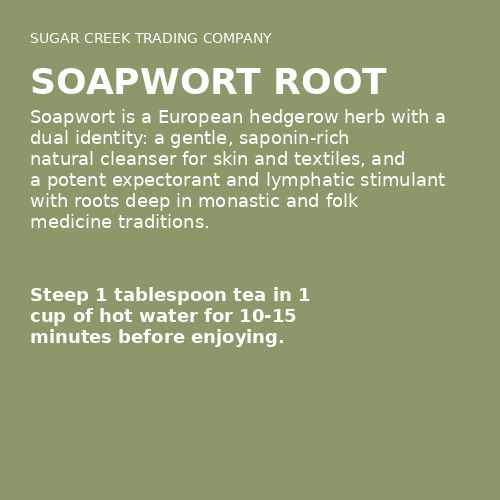
A European hedgerow herb with a dual identity: a gentle, saponin-rich natural cleanser for skin and textiles, and a potent expectorant and lymphatic stimulant with roots deep in monastic and folk medicine traditions.
BOTANICAL IDENTIFICATION
Scientific Name: Saponaria officinalis L.
Common Names: Soapwort, Bouncing Bet, Latherwort, Crow Soap, Sweet Betty, Wild Sweet William, Fuller's Herb
Family: Caryophyllaceae (Carnation/Pink family)
Saponaria officinalis is a robust, spreading perennial that grows 30 to 90 centimeters tall from a creeping rhizomatous rootstock. The stems are erect, smooth, and slightly swollen at the nodes. Leaves are opposite, broadly lance-shaped, 5 to 12 centimeters long, with three prominent veins and smooth margins. From midsummer through early autumn, the plant produces dense terminal clusters of five-petaled flowers, typically pale pink to white, with a sweet, clove-like fragrance that intensifies in the evening to attract moth pollinators. The root is the part used medicinally and for cleansing: it is cylindrical, branching, reddish-brown externally and pale yellow within.
Native to Europe and western Asia, soapwort has naturalized extensively across North America, where it escaped colonial-era gardens and now thrives along roadsides, riverbanks, railway embankments, and disturbed ground. It prefers moist, well-drained soils in full sun to partial shade and is remarkably hardy, tolerating poor soils, drought, and cold winters with ease.
CULTURAL AND HISTORICAL USE
Soapwort's history as a cleanser stretches back at least to ancient Rome, where it was used to prepare wool for dyeing, a process called "fulling" that required removal of natural lanolin oils. This earned it the name Fuller's Herb. Medieval European monasteries cultivated soapwort in their physic gardens for dual purposes: the monks used root decoctions to gently clean delicate illuminated manuscripts, tapestries, and ecclesiastical vestments, while the infirmary employed the same root as an expectorant, diuretic, and treatment for skin diseases. Museum conservators still use soapwort decoctions today to clean antique fabrics and paintings, trusting its gentle surfactant action where modern detergents would cause damage.
In European folk medicine, soapwort root was a standard household remedy for persistent coughs, bronchitis, and congested lungs. Country herbalists across England, France, and Germany prescribed the root decoction as a spring tonic to "cleanse the blood" and stimulate sluggish lymphatic drainage. It was also applied topically for chronic skin conditions including acne, eczema, boils, and psoriasis, where its combined cleansing and anti-inflammatory action proved particularly effective. In the Appalachian folk tradition of North America, settlers brought soapwort knowledge with them and continued using the plant for washing and medicine well into the 20th century.
The common name "Bouncing Bet" is thought to derive from the vigorous lathering action of the root when agitated in water, "bet" being an old English term for a washerwoman. The name captures both the plant's practical utility and its association with working-class domestic life. Despite its long history and documented efficacy, soapwort has been somewhat overshadowed in modern herbalism by more glamorous herbs, though practitioners of traditional Western herbalism continue to value it as a unique expectorant and lymphatic cleanser.
KEY BIOACTIVE COMPOUNDS & BENEFITS
| Compound/Class | Location in Plant | Human Benefit | Role in Plant |
|---|---|---|---|
| Triterpenoid saponins (saponaroside, saporubrin, saponarin) | Root (highest concentration), leaves | Expectorant; natural surfactant; antimicrobial; anti-inflammatory | Chemical defense against herbivores and soil pathogens |
| Saporubric acid and gypsogenin glycosides | Root | Mucolytic activity; membrane-disrupting antimicrobial action | Defense compounds and allelopathic agents |
| Flavonoids (saponarin, vitexin, isovitexin) | Leaves and flowers | Antioxidant; anti-inflammatory; hepatoprotective | UV screening and pollinator attraction |
| Saporin (ribosome-inactivating protein) | Seeds and root | Under research for targeted anti-cancer drug conjugates | Antiviral and antifungal defense |
| Resinous compounds and mucilage | Root | Emollient and soothing to mucous membranes; aids expectoration | Water retention and wound sealing |
The root of Saponaria officinalis contains 2 to 5 percent triterpenoid saponins by dry weight, making it one of the richest European sources of these natural surfactant compounds. The saponins are responsible for the root's characteristic foaming action in water and drive nearly all of its medicinal effects: thinning mucus, stimulating bronchial secretion, disrupting microbial membranes, and cleansing the skin without stripping protective lipids. Of particular scientific interest is saporin, a type I ribosome-inactivating protein that is being actively investigated as a component of immunotoxin therapies for cancer treatment.
HOW IT WORKS IN THE BODY
Soapwort root acts through several interconnected mechanisms, centered on the biological activity of its saponin fraction.
Expectorant and Mucolytic Action:
Soapwort saponins stimulate the vagal reflex when they contact the gastric mucosa, triggering a reflexive increase in watery secretions from the bronchial glands. This dilutes thick, sticky mucus in the respiratory tract, making it easier to cough up and expel. At the same time, the saponins have a direct surfactant effect on airway mucus, reducing its surface tension and breaking up the gel-like matrix that traps pathogens and irritants. This dual mechanism makes soapwort particularly effective for productive coughs with thick, difficult-to-expectorate phlegm.
Lymphatic and Metabolic Stimulation:
Traditional herbalists classify soapwort as an alterative, a category of herbs believed to gradually improve metabolic waste clearance and restore healthy tissue function. The saponins appear to stimulate lymphatic circulation and promote the excretion of metabolic byproducts through the kidneys and skin. This "blood-cleansing" action, while difficult to quantify in modern terms, aligns with observed clinical improvements in chronic skin conditions when soapwort is used over several weeks.
Antimicrobial and Antifungal Activity:
The saponins in soapwort root interact with cholesterol and other sterols in microbial cell membranes, forming pores that lead to membrane disruption and cell death. In vitro studies have demonstrated activity against gram-positive bacteria, several Candida species, and common dermatophytes. This supports the traditional topical use of soapwort for infected skin conditions and fungal disorders.
Anti-inflammatory Effects:
Soapwort saponins have demonstrated inhibition of pro-inflammatory enzymes and mediators in laboratory studies, including suppression of NF-kB signaling. This anti-inflammatory dimension complements the cleansing action, making soapwort root washes effective for irritated, inflamed skin conditions where both infection and inflammation are present.
DOSE GUIDELINES
| Preparation Type | Typical Dose | Purpose |
|---|---|---|
| Root decoction (internal) | 1-2 teaspoons dried root simmered in 1 cup water for 10-15 minutes; 1-2 cups daily | Expectorant for coughs and bronchitis; lymphatic cleanser |
| Tincture (1:5, 40% ethanol) | 1-3 mL, three times daily | Convenient liquid extract for respiratory and skin conditions |
| External wash (decoction) | 2-3 tablespoons dried root simmered in 2 cups water; applied topically | Skin cleanser; treatment for eczema, acne, psoriasis, dandruff |
| Poultice | Moistened root powder applied directly to affected area | Boils, abscesses, localized skin infections |
Soapwort root is best used in short courses of 2 to 4 weeks for internal purposes, followed by a break. It is not typically classified as a long-term tonic herb. The internal dose should be kept moderate, as high doses of saponin-rich herbs can irritate the gastrointestinal lining. For external use as a cleanser or skin treatment, soapwort can be used regularly without the same dose concerns.
PREPARATION AND USES
To prepare a medicinal decoction, add 1 to 2 teaspoons of dried soapwort root to a cup of cold water, bring to a boil, and simmer gently for 10 to 15 minutes. Strain and drink warm. The decoction will have a slightly bitter, faintly sweet taste and may foam lightly when stirred. For respiratory conditions, honey and a squeeze of lemon can be added to improve palatability and enhance the expectorant effect. A stronger decoction made with 2 to 3 tablespoons of root per pint of water serves as an excellent external wash for the skin and hair: it produces a gentle, non-stripping lather that cleanses while soothing irritation.
For tincture preparation, macerate the chopped dried root in 40 percent alcohol at a 1:5 ratio for 4 to 6 weeks, shaking daily. Soapwort root combines well with other expectorant herbs such as elecampane, mullein, and horehound in cough formulas. For skin conditions, it pairs effectively with calendula, chamomile, and burdock root. As a natural shampoo, soapwort root decoction can be enhanced with rosemary or nettle leaf for additional scalp-stimulating benefits. Historically, soapwort was also used to create the foamy head on traditional Middle Eastern halva and certain heritage beer styles, a culinary use that persists in artisanal food production.
OPTIMAL CONTEXT FOR USE
Soapwort root is especially well-suited for individuals experiencing:
Persistent, productive coughs with thick, tenacious mucus that is difficult to expectorate, particularly in bronchitis, post-nasal drip, or chronic respiratory congestion
Chronic skin conditions such as eczema, psoriasis, acne, or dermatitis, where a gentle, anti-inflammatory cleanser is needed that will not further irritate compromised skin
Sluggish lymphatic function, evidenced by recurrent skin eruptions, slow wound healing, or a general sense of metabolic stagnation, where traditional alterative therapy is appropriate
Sensitivity to commercial soaps, shampoos, and detergents, where a plant-based, sulfate-free cleanser offers a gentler alternative for hair and body care
Interest in heritage cleaning methods for delicate fabrics, antique textiles, or artisanal crafts where modern detergents are too harsh
Soapwort root works synergistically with mullein leaf and wild cherry bark for respiratory formulas, with cleavers and red clover for lymphatic support, and with oatmeal and calendula for soothing topical skin treatments.
SUSTAINABILITY AND ETHICAL HARVESTING
Soapwort is an abundant, vigorously spreading plant that is in no danger of overharvesting. In many parts of North America and Europe, it is considered a mild invasive species, colonizing roadsides, riverbanks, and abandoned lots with enthusiasm. Its rhizomatous growth habit means that root harvesting actually helps control its spread, and the plant readily regenerates from remaining root fragments. Wild harvesting of soapwort is straightforward and ecologically unproblematic in most regions.
Cultivated soapwort requires minimal inputs: no fertilizers, pesticides, or irrigation once established. It thrives in neglected soils and can serve as a useful ground cover in permaculture and agroforestry systems. The plant is also an excellent pollinator resource, providing nectar to moths, butterflies, and long-tongued bees throughout the summer months. Sourcing soapwort root supports a sustainable, low-impact botanical that gives back more to the ecosystem than it takes.
SAFETY AND CAUTIONS
Soapwort root is generally safe when used in recommended doses for appropriate durations. The following precautions should be observed:
High doses of soapwort root can cause nausea, vomiting, and diarrhea due to gastric irritation from the saponins. Keep internal doses moderate and do not exceed recommended amounts. If gastrointestinal discomfort occurs, reduce the dose or discontinue use.
Prolonged internal use at high doses has been associated with red blood cell hemolysis in animal studies due to the membrane-disrupting properties of saponins. Limit internal use to courses of 2 to 4 weeks, with rest periods between courses.
Pregnant and nursing women should avoid internal use of soapwort root, as saponins may have uterine-stimulating effects. External use as a cleanser is considered safe during pregnancy.
Soapwort may interact with medications that are affected by changes in intestinal permeability, as saponins can transiently increase gut membrane permeability. Consult a healthcare provider if taking prescription medications internally alongside soapwort.
The raw plant material should not be confused with or substituted for ornamental Saponaria species (such as S. ocymoides), which may have different chemical profiles and are not traditionally used medicinally.
REFERENCES
Jia, Z., Koike, K., & Nikaido, T. (1998). "Major triterpenoid saponins from Saponaria officinalis." Journal of Natural Products, 61(11), 1368-1373.
Damianakos, H., Kretschmer, N., Chinou, I., & Bauer, R. (2020). "Saponaria officinalis L.: Comprehensive review of its phytochemistry, biological activity, and traditional use." Phytochemistry Reviews, 19, 1415-1441.
Grieve, M. (1931). "Soapwort." In A Modern Herbal. London: Jonathan Cape. (Reprinted by Dover Publications, 1971.)
FINAL NOTE
Soapwort root occupies a uniquely practical niche in the herbal pharmacopoeia: it is simultaneously a medicine and a tool, capable of cleansing both the body's interior pathways and its external surfaces with equal gentleness. In an age of synthetic surfactants and chemical expectorants, this unassuming hedgerow herb offers a reminder that plants have been solving our most fundamental needs, breathing clearly, keeping clean, for far longer than any laboratory. The root in your hands carries the same chemistry that medieval monks trusted with their most precious manuscripts and their most stubborn coughs alike.
Share