Sugar Creek Trading Company
Solomon's Seal Root
Solomon's Seal Root
Impossible de charger la disponibilité du service de retrait
POLYGONATUM BIFLORUM / MULTIFLORUM
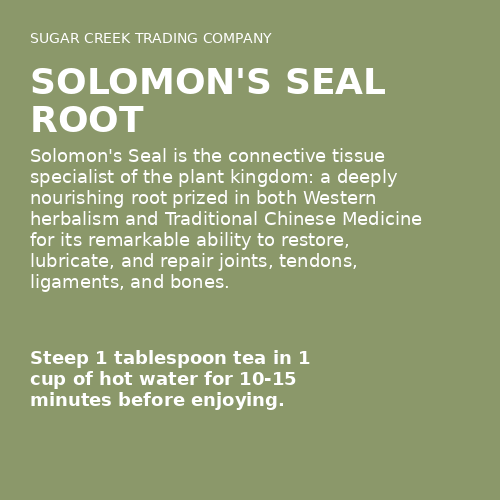
The connective tissue specialist of the plant kingdom: a deeply nourishing root prized in both Western herbalism and Traditional Chinese Medicine for its remarkable ability to restore, lubricate, and repair joints, tendons, ligaments, and bones.
BOTANICAL IDENTIFICATION
Scientific Name: Polygonatum biflorum (Walter) Elliott (North American species); Polygonatum multiflorum (L.) All. (European species); Polygonatum odoratum (Mill.) Druce and related species (East Asian)
Common Names: Solomon's Seal, King Solomon's Seal, Sealwort, Yu Zhu (Chinese), Huang Jing (related species), Lady's Seal, David's Harp
Family: Asparagaceae (Asparagus family; formerly Liliaceae)
Solomon's Seal is an elegant woodland perennial rising 30 to 120 centimeters from a thick, white, horizontally creeping rhizome marked with distinctive circular scars where previous years' stems emerged, the "seals" that give the plant its common name. The arching stems carry alternate, ovate to elliptic leaves arranged in two ranks, creating a graceful, ladder-like silhouette. Pairs of small, tubular, greenish-white, bell-shaped flowers dangle from the leaf axils in late spring, developing into blue-black berries by autumn. The rhizome is the part used medicinally: fleshy, segmented, starchy, and mucilaginous when fresh.
Polygonatum species are native to temperate woodlands across North America, Europe, and East Asia, where they grow in dappled shade on rich, moist, humus-rich forest soils. P. biflorum is the primary North American species found throughout eastern deciduous forests, while P. multiflorum and P. odoratum are their European and Asian counterparts. All share similar chemistry and traditional uses. The granule form offered here provides the dried, cut rhizome in a convenient size for decoction and extraction.
CULTURAL AND HISTORICAL USE
Solomon's Seal root holds a distinguished position in Traditional Chinese Medicine, where Polygonatum species have been used for over 2,000 years. Yu Zhu (P. odoratum) is classified as a sweet, slightly cold herb that nourishes yin, moistens the lungs, and generates fluids. It appears in foundational TCM texts including the Shen Nong Ben Cao Jing, where it is recommended for dry cough, thirst, wasting conditions, and exhaustion from chronic illness. The closely related Huang Jing (P. sibiricum) is considered a premier longevity tonic in Taoist traditions, with legends claiming that hermits who consumed it regularly could go without food and live to extraordinary ages.
In Western herbalism, Solomon's Seal root has a rich tradition rooted in the Doctrine of Signatures: the joint-like appearance of the rhizome's seal scars was taken as a sign that the plant was intended for healing joints and bones. While the Doctrine of Signatures is no longer considered a valid pharmacological theory, in this case the intuition proved remarkably prescient. Herbalists including Gerard, Culpeper, and Parkinson all recommended Solomon's Seal poultices and decoctions for broken bones, bruises, and joint injuries. Culpeper wrote in 1653 that the root "healeth broken bones, being stamped and laid thereon," and "taketh away the black and blue marks that come by blows or falls."
Contemporary Western herbalists, notably Matthew Wood and Jim McDonald, have revived and expanded the use of Solomon's Seal root as a premier musculoskeletal remedy. Wood describes it as a tissue "tightener or loosener," capable of restoring proper tension to connective tissues that are either too lax or too taut. This nuanced, bidirectional action on tendons, ligaments, and joint capsules distinguishes Solomon's Seal from most other musculoskeletal herbs and has made it a cornerstone of modern clinical herbalism for repetitive strain injuries, hypermobility, arthritis, and post-surgical recovery.
KEY BIOACTIVE COMPOUNDS & BENEFITS
| Compound/Class | Location in Plant | Human Benefit | Role in Plant |
|---|---|---|---|
| Steroidal saponins (diosgenin glycosides, polygonatum saponins) | Rhizome | Anti-inflammatory; connective tissue repair; hormonal precursor activity | Antifungal defense; allelopathic compounds |
| Mucilaginous polysaccharides (fructans, glucomannans) | Rhizome | Joint lubrication; gut soothing; yin-nourishing and moistening action | Water storage and frost protection in the rhizome |
| Flavonoids (kaempferol, quercetin glycosides) | Leaves and rhizome | Antioxidant; anti-inflammatory; vascular protective | UV protection and pathogen defense |
| Convallarin and convallamarin (cardioactive glycosides, trace amounts) | Rhizome and leaves | Mild cardiotonic activity at traditional doses (not a primary use) | Herbivore deterrent |
| Allantoin | Rhizome | Cell proliferation stimulant; wound healing; tissue regeneration | Nitrogen metabolism and storage |
The therapeutic profile of Solomon's Seal root emerges from the interplay between its steroidal saponins, which modulate inflammation and support connective tissue remodeling, and its abundant mucilaginous polysaccharides, which provide deep lubrication and moisture to tissues that have become dry, stiff, or degraded. The presence of allantoin, the same compound that makes comfrey famous for wound healing, adds a tissue-regenerative dimension. Together, these constituents create an herb uniquely suited to conditions involving worn, inflamed, or poorly functioning connective tissue.
HOW IT WORKS IN THE BODY
Solomon's Seal root acts through several complementary mechanisms that collectively support the repair, lubrication, and balanced tensioning of the musculoskeletal system.
Connective Tissue Restoration and Remodeling:
The steroidal saponins in Solomon's Seal appear to influence the activity of fibroblasts, the cells responsible for producing collagen, elastin, and the ground substance of connective tissue. Herbalists observe that Solomon's Seal has a normalizing effect on tissue tension: it helps tighten overly lax ligaments and tendons (as in hypermobility or chronic sprains) while simultaneously softening tissues that have become rigid, fibrotic, or adhered (as in frozen shoulder or post-surgical scarring). This bidirectional quality is one of the herb's most distinctive and clinically valuable properties.
Joint Lubrication and Synovial Support:
The mucilaginous polysaccharides in the rhizome are structurally similar to glycosaminoglycans such as hyaluronic acid, the primary lubricating molecule in synovial fluid. Regular internal use of Solomon's Seal decoction appears to support synovial fluid production and quality, reducing the grinding, clicking, and discomfort associated with cartilage degradation and osteoarthritis. This moistening action extends beyond the joints to benefit dry, irritated mucous membranes in the respiratory and gastrointestinal tracts.
Anti-inflammatory Modulation:
The saponins and flavonoids in the root inhibit several pro-inflammatory pathways, including COX-2 and NF-kB signaling. This helps reduce the chronic low-grade inflammation that drives cartilage degradation in osteoarthritis and the acute inflammation that follows sprains, strains, and overuse injuries. The anti-inflammatory effect is gentle and sustained rather than dramatic, making it well-suited to long-term use.
Bone and Fracture Support:
Traditional use for broken bones is supported by the presence of allantoin, which promotes cell division in connective tissue, and the steroidal saponins, which may support osteoblast activity. While clinical trials are lacking, the longstanding empirical tradition of using Solomon's Seal to accelerate fracture healing remains a valued application in clinical herbalism.
DOSE GUIDELINES
| Preparation Type | Typical Dose | Purpose |
|---|---|---|
| Decoction (granules) | 1-2 tablespoons granules simmered in 2 cups water for 20-30 minutes; 1-3 cups daily | Joint lubrication; connective tissue repair; musculoskeletal tonic |
| Tincture (1:5, 50% ethanol) | 2-5 mL, three times daily | Acute and chronic musculoskeletal conditions; convenient dosing |
| Topical liniment or oil infusion | Applied liberally to affected joints or injury sites, 2-3 times daily | Sprains, strains, bruises, repetitive strain injuries, joint stiffness |
| TCM decoction (Yu Zhu) | 6-15 grams daily as part of a formula, simmered 20-30 minutes | Yin nourishment; dry cough; thirst; exhaustion from chronic illness |
Solomon's Seal root is a slow-acting, deep tonic that delivers its most significant results with consistent use over weeks to months. For chronic joint conditions, a minimum commitment of 6 to 8 weeks of daily use is recommended before assessing results. The granule form is ideal for decoction, as the extended simmering time extracts both the saponins and the mucilaginous polysaccharides effectively. Combining internal decoction with topical application to affected areas enhances results.
PREPARATION AND USES
The granule form of Solomon's Seal root is specifically designed for decoction. Add 1 to 2 tablespoons of granules to 2 cups of cold water, bring to a boil, reduce heat, and simmer gently with a lid for 20 to 30 minutes. The resulting tea will be slightly sweet, mildly starchy, and pleasantly neutral in flavor. Strain and drink warm, 1 to 3 cups daily. The decoction can be refrigerated for up to 3 days. For enhanced musculoskeletal support, Solomon's Seal root is traditionally combined with comfrey leaf (external use only), horsetail, nettle leaf, and turmeric. In TCM formulas, Yu Zhu is commonly paired with mai men dong (ophiopogon), sha shen (glehnia), and sheng di huang (rehmannia) for yin deficiency patterns.
To prepare a topical oil infusion, fill a jar halfway with the granules, cover completely with olive oil or jojoba oil, and allow to infuse in a warm location for 4 to 6 weeks, shaking regularly. Strain and use as a massage oil for sore joints, sprains, old injuries, and repetitive strain conditions. For a tincture, macerate the granules in 50 percent alcohol at a 1:5 ratio for 6 weeks. Solomon's Seal root also makes an excellent addition to bone broth: add a handful of granules to the stock pot along with other tonic herbs and simmer for the full cooking duration.
OPTIMAL CONTEXT FOR USE
Solomon's Seal root is especially well-suited for individuals experiencing:
Osteoarthritis, cartilage degradation, or chronic joint stiffness with grinding, clicking, or reduced range of motion, where joint lubrication and connective tissue support are priorities
Repetitive strain injuries such as tendonitis, carpal tunnel syndrome, tennis elbow, or plantar fasciitis, where tendons and ligaments have become inflamed, thickened, or poorly functional
Hypermobility or joint laxity (including Ehlers-Danlos spectrum), where connective tissue needs toning and tightening rather than loosening
Recovery from bone fractures, sprains, torn ligaments, or orthopedic surgery, where accelerated tissue repair and reduced scarring are desired
Dry, depleted constitutions with chronic dryness of the lungs, throat, or digestive tract (TCM yin deficiency pattern), where deep moistening and nourishment are needed
Solomon's Seal pairs powerfully with mullein root for structural alignment work, with turmeric and boswellia for anti-inflammatory support, and with bone-building herbs such as horsetail and nettle for comprehensive musculoskeletal formulas.
SUSTAINABILITY AND ETHICAL HARVESTING
Wild Polygonatum species are slow-growing woodland plants that take several years to establish harvestable rhizomes. While they are not currently listed as endangered at the federal level, localized overharvesting has depleted populations in some areas, particularly in Appalachian forests where wild-crafting pressure is high. Ethical harvesting practices are essential: never harvest more than 10 to 15 percent of a wild population, replant a portion of each rhizome to ensure regeneration, and avoid harvesting from small or isolated colonies.
Cultivated Solomon's Seal is increasingly available and is the preferred sourcing method for commercial supply. The plant grows well in shade gardens, forest edges, and agroforestry understory plantings, though it requires patience, as marketable rhizomes take 3 to 5 years to develop. Supporting cultivated sources and habitat-responsible wildcrafters helps ensure that this valuable medicine remains available for future generations. United Plant Savers includes Polygonatum biflorum on its "To-Watch" list, recognizing the need for proactive conservation attention.
SAFETY AND CAUTIONS
Solomon's Seal root has a strong safety record in traditional use and is considered gentle and well-tolerated by most individuals. The following precautions should be noted:
The berries of Solomon's Seal are mildly toxic and should not be consumed. Only the rhizome (root) is used medicinally. Ensure correct plant identification if wild-harvesting.
Solomon's Seal root contains trace amounts of cardioactive glycosides related to those found in lily of the valley. At traditional doses, these compounds are present in amounts far too small to cause cardiac effects, but individuals on cardiac glycoside medications (such as digoxin) should consult a healthcare provider before use.
Pregnant and nursing women should use Solomon's Seal root only under the guidance of a qualified practitioner, as safety data for these populations is limited.
Do not confuse Polygonatum species with False Solomon's Seal (Maianthemum racemosum), which is a different plant with different properties. Polygonatum flowers hang downward from the leaf axils, while Maianthemum flowers form a terminal cluster at the stem tip.
Some individuals may experience mild digestive looseness when first beginning internal use due to the mucilaginous content. This typically resolves as the body adjusts.
REFERENCES
Wood, M. (2008). "Solomon's Seal." In The Earthwise Herbal: A Complete Guide to Old World Medicinal Plants. Berkeley, CA: North Atlantic Books.
Khan, H., Saeed, M., Gilani, A.H., et al. (2016). "Antipyretic and anticonvulsant activity of Polygonatum verticillatum: Comparison of rhizomes and aerial parts." Phytotherapy Research, 30(1), 44-49.
Bensky, D., Clavey, S., & Stoger, E. (2004). "Yu Zhu (Polygonati Odorati Rhizoma)." In Chinese Herbal Medicine: Materia Medica, 3rd ed. Seattle: Eastland Press.
FINAL NOTE
Solomon's Seal root is the herbalist's answer to the orthopedic surgeon's toolkit: a gentle but profoundly effective tissue restorer that works not by suppressing symptoms but by helping the body rebuild and rebalance its own structural framework. Its unique ability to both tighten lax tissues and soften rigid ones makes it nearly irreplaceable in the treatment of musculoskeletal conditions. In granule form, it is perfectly suited to the slow, deep decoction that extracts its full spectrum of mucilaginous and saponin-rich chemistry, delivering the kind of nourishment that worn joints and injured connective tissues are hungry for.
Share