Sugar Creek Trading Company
Stillingia Root
Stillingia Root
Impossible de charger la disponibilité du service de retrait
STILLINGIA SYLVATICA
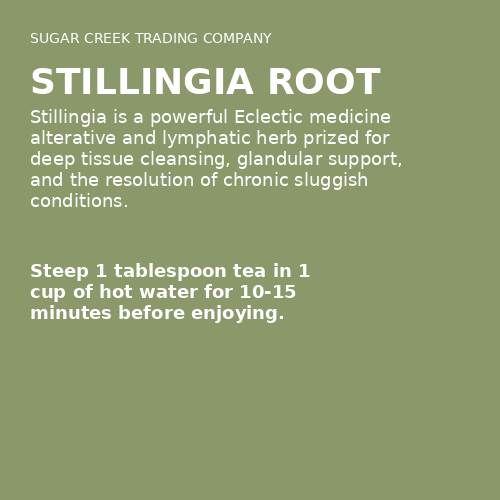
A powerful Eclectic medicine alterative and lymphatic herb prized for deep tissue cleansing, glandular support, and the resolution of chronic sluggish conditions.
BOTANICAL IDENTIFICATION
Scientific Name: Stillingia sylvatica L.
Common Names: Stillingia root, queen's root, queen's delight, yaw root, silver leaf, cockup hat
Family: Euphorbiaceae (Spurge family)
Stillingia sylvatica is a perennial herbaceous plant native to the sandy soils and pine barrens of the southeastern United States, ranging from Virginia south to Florida and west to Texas and Kansas. The plant grows 60 to 120 centimeters tall with smooth, erect stems bearing alternate, leathery, lanceolate leaves with finely toothed margins. Small, yellowish-green flowers appear in terminal spikes from late spring through summer. The thick, fibrous taproot is the primary part used in herbal medicine, and it exudes a milky, acrid latex when freshly cut.
The plant thrives in dry, sandy, acidic soils and open pine woodlands, preferring full sun to partial shade. It is well adapted to poor soil conditions and periodic disturbance, making it a characteristic species of fire-maintained longleaf pine ecosystems throughout its native range.
CULTURAL AND HISTORICAL USE
Stillingia root holds a distinguished place in the annals of American herbal medicine, particularly within the Eclectic medical tradition of the 19th and early 20th centuries. Indigenous peoples of the southeastern United States, including the Creek and Choctaw nations, employed the root as a remedy for syphilis, scrofula, and chronic skin eruptions long before European contact. The name "yaw root" derives from its traditional use against yaws, a tropical infectious disease.
The Eclectic physicians elevated stillingia to the status of a primary alterative, placing it alongside sarsaparilla, burdock, and poke root in their foundational formulas for chronic disease. John King, in his landmark King's American Dispensatory (1898), described stillingia as an alterative of "great power" with specific action on the lymphatic and glandular systems. The famous Compound Stillingia formula (also known as Hoxsey-type formulas) combined stillingia with other alteratives for deep-seated chronic conditions.
Finley Ellingwood, another prominent Eclectic, considered stillingia essential for conditions involving "morbid accumulations" in the blood and tissues, recommending it particularly for chronic syphilitic conditions, persistent skin diseases, and lymphatic congestion. The Eclectic tradition maintained that stillingia's virtue was in slowly but thoroughly transforming the terrain of chronic illness.
KEY BIOACTIVE COMPOUNDS & BENEFITS
| Compound/Class | Location in Plant | Human Benefit | Role in Plant |
|---|---|---|---|
| Stillingine (acrid resinous compound) | Root bark and latex | Lymphatic stimulation; promotes glandular secretion and tissue drainage | Herbivore deterrent |
| Diterpene esters (phorbol-related) | Root and latex | Immune-modulating activity; stimulates white blood cell function | Chemical defense against pathogens and herbivores |
| Volatile oils | Root | Mild expectorant and diaphoretic properties; supports respiratory clearance | Antimicrobial defense |
| Tannins | Root bark | Astringent action on mucous membranes; supports tissue integrity | Wound sealing and antifungal protection |
| Fixed oils and resins | Root | Mild laxative effect; supports elimination through the bowel | Energy storage |
The primary therapeutic action of stillingia is attributed to its unique acrid resinous complex centered on stillingine, which is most potent in the fresh root and diminishes significantly with prolonged storage. This compound drives the herb's powerful alterative effect by stimulating the lymphatic system, enhancing glandular secretion, and promoting the elimination of metabolic waste through the liver, kidneys, skin, and lungs. The Eclectics consistently emphasized that stillingia preparations must be made from fresh or recently dried root to retain therapeutic potency.
HOW IT WORKS IN THE BODY
Stillingia root operates through a classical alterative mechanism, gradually shifting the body's internal terrain from a state of congestion and accumulation toward improved flow and elimination. Its actions span multiple organ systems simultaneously.
Lymphatic Stimulation:
Stillingia exerts a direct stimulating effect on the lymphatic system, promoting the movement of lymph fluid through the nodes and vessels. This action helps clear stagnant metabolic debris, supports immune surveillance, and reduces the swollen, boggy glandular tissue that the Eclectics associated with chronic illness. It is particularly indicated when lymph nodes are enlarged, hard, or chronically swollen.
Hepatic and Eliminatory Support:
The herb gently stimulates bile production and liver detoxification pathways, enhancing the body's capacity to process and excrete waste products. This hepatic action works in concert with mild laxative and diuretic effects to open multiple channels of elimination simultaneously, preventing the "healing crisis" that can occur when toxins are mobilized but not efficiently removed.
Respiratory and Mucosal Action:
Stillingia has a secondary affinity for the respiratory mucosa, where its volatile oils and acrid resins act as a stimulating expectorant. This makes it useful in chronic bronchial conditions characterized by thick, tenacious mucus, and in chronic laryngitis or pharyngitis where secretions are stagnant.
Skin and Surface Tissue Effects:
By improving deep elimination through internal channels, stillingia indirectly benefits the skin. The Eclectic physicians noted marked improvement in chronic eczema, psoriasis, acne, and boils when stillingia was used consistently over weeks to months, reflecting its action as a systemic cleanser rather than a topical remedy.
DOSE GUIDELINES
| Preparation Type | Typical Dose | Purpose |
|---|---|---|
| Tincture (fresh root, 1:2, 60% alcohol) | 10 to 30 drops, 3 times daily | Lymphatic stimulation and alterative therapy |
| Dried root decoction | 1 to 2 grams simmered in 240 ml water, 3 times daily | Traditional alterative use (less potent than fresh root preparations) |
| Dried root powder (capsule) | 500 mg to 1 gram, 2 to 3 times daily | Convenient daily alterative support |
| Compound Stillingia formula | Per formula directions, typically 15 to 30 drops, 3 times daily | Deep alterative therapy for chronic conditions |
Stillingia is best used as a long-term alterative, taken consistently over 4 to 12 weeks for chronic conditions. The Eclectics emphasized starting with small doses and increasing gradually, as the acrid resin can irritate the gastrointestinal tract if introduced too aggressively. It is most effective when combined with other alterative herbs in formula rather than used alone, and preparations should be made from root no more than one year old for best results.
PREPARATION AND USES
The most therapeutically reliable preparation is a tincture made from the fresh root, as the acrid volatile principles that drive stillingia's alterative action degrade with time and heat. A 1:2 tincture in 60 percent alcohol captures these constituents effectively. If using dried root, ensure it has been stored properly in airtight containers away from light and heat and is no more than one year old. Old, stale stillingia root that has lost its acrid taste has also lost most of its medicinal value.
For decoction, gently simmer the dried root for 10 to 15 minutes in covered water. The tea will have a distinctive bitter, acrid flavor. Stillingia is most commonly used in compound formulas with complementary alteratives such as burdock root, red clover, prickly ash bark, and sarsaparilla. These combinations distribute the cleansing action across multiple pathways and reduce the likelihood of gastrointestinal irritation from stillingia alone. The root can also be powdered and encapsulated for those who find the taste intolerable.
OPTIMAL CONTEXT FOR USE
This herb is especially well-suited for individuals experiencing:
Chronic lymphatic congestion with enlarged, hard, or swollen lymph nodes, particularly in the neck, axillae, or groin
Persistent skin conditions such as eczema, psoriasis, boils, or acne that resist topical treatment and suggest an internal origin
Chronic respiratory catarrh with thick, tenacious mucus in the throat or bronchi that does not resolve with acute remedies
Sluggish elimination with signs of metabolic congestion including coated tongue, foul breath, and general malaise
Post-infectious recovery where the body has not fully cleared the residue of illness and energy remains low
Stillingia pairs powerfully with prickly ash bark for circulatory stagnation, burdock root for skin conditions, red clover for glandular support, and cleavers for lymphatic drainage. It is a cornerstone herb of the Eclectic alterative tradition.
SUSTAINABILITY AND ETHICAL HARVESTING
Stillingia sylvatica is not currently listed as threatened or endangered, though its native habitat of longleaf pine savanna is itself one of the most endangered ecosystems in North America, having been reduced to less than 3 percent of its original extent. Wild populations of stillingia remain relatively stable within remaining habitat, but the overall shrinking of longleaf pine ecosystems raises long-term conservation concerns.
Root harvesting from wild plants is inherently more impactful than leaf or aerial harvesting, as it removes the entire organism. Ethical wildcrafting involves harvesting only from abundant populations, taking no more than 10 to 15 percent of plants in any given stand, and replanting seed in disturbed areas. Supporting suppliers who cultivate stillingia or who wildcraft under sustainable management plans helps ensure the long-term availability of this important Eclectic herb.
SAFETY AND CAUTIONS
Gastrointestinal irritation: The acrid resinous compounds in stillingia can cause nausea, vomiting, and diarrhea if taken in excessive doses. Always begin with the lowest recommended dose and increase gradually.
Emetic in large doses: Large single doses of stillingia root, particularly of the fresh root, can act as a strong emetic and cathartic. This is a sign of overdose and should be avoided.
Pregnancy and nursing: Stillingia is not recommended during pregnancy due to its potent eliminatory and potentially stimulating properties. Nursing mothers should avoid it as well, as its constituents may pass into breast milk.
Euphorbiaceae caution: As a member of the spurge family, stillingia contains irritant latex that can cause dermatitis on skin contact. Handle the fresh root with gloves and avoid contact with eyes and mucous membranes.
Drug interactions: Due to its effects on hepatic metabolism and elimination, stillingia may theoretically alter the clearance of pharmaceutical medications. Consult a qualified practitioner if taking prescription drugs.
REFERENCES
Felter, H. W., and Lloyd, J. U. King's American Dispensatory. 18th edition, 1898. Reprinted by Eclectic Medical Publications, Sandy, OR.
Ellingwood, F. American Materia Medica, Therapeutics and Pharmacognosy. Ellingwood's Therapeutist, 1919.
Scudder, J. M. Specific Medication and Specific Medicines. Wilstach, Baldwin & Co., Cincinnati, 1870.
Brinker, F. Herbal Contraindications and Drug Interactions. 4th edition, Eclectic Medical Publications, 2010.
FINAL NOTE
Stillingia root is one of the great unsung heroes of American herbal medicine, a cornerstone of the Eclectic alterative tradition that has fallen into relative obscurity in modern practice. Its deep-acting ability to mobilize the lymphatic system, stimulate glandular function, and promote elimination through multiple channels makes it invaluable for chronic, stagnant conditions that resist superficial treatment. Like many powerful alteratives, stillingia demands patience and consistency. It works not by suppressing symptoms but by gradually restoring the body's own capacity to cleanse, circulate, and heal from within.
Share