Sugar Creek Trading Company
Suma
Suma
Impossible de charger la disponibilité du service de retrait
PFAFFIA PANICULATA
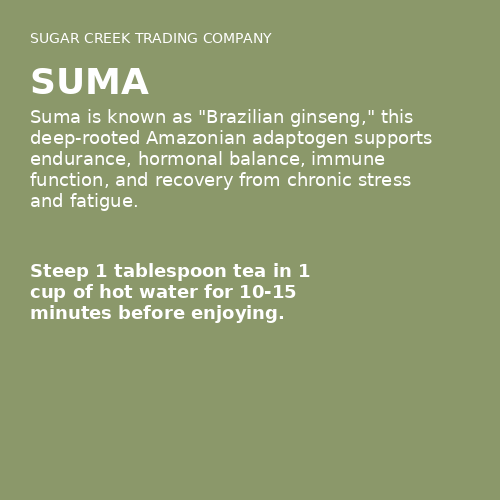
Known as "Brazilian ginseng," this deep-rooted Amazonian adaptogen supports endurance, hormonal balance, immune function, and recovery from chronic stress and fatigue.
BOTANICAL IDENTIFICATION
Scientific Name: Pfaffia paniculata (Mart.) Kuntze
Common Names: Suma, Brazilian ginseng, para toda (Portuguese: "for all things"), corango-acu, pfaffia
Family: Amaranthaceae (Amaranth family)
Pfaffia paniculata is a large, sprawling, perennial ground vine native to the tropical and subtropical rainforests of Central and South America, with its primary range in the Brazilian Amazon basin, Paraguay, and parts of Ecuador, Peru, and Venezuela. The plant features an extensive root system with a thick, branching taproot that can grow to remarkable size over years of development. Above ground, it produces long, rambling stems with opposite, elliptical leaves and small, inconspicuous whitish flower clusters.
Despite its common name "Brazilian ginseng," suma is not botanically related to true ginseng (Panax species). The nickname reflects its similar adaptogenic reputation and its status as a revered tonic root in South American traditional medicine. The plant thrives in rich, moist tropical soils and is found in both lowland forest understory and disturbed edge habitats, where its vigorous growth habit allows it to spread readily.
CULTURAL AND HISTORICAL USE
Suma root has been used for centuries by indigenous peoples of the Amazon basin, who called it para toda, meaning "for all things," a name that speaks to the breadth of conditions for which it was traditionally employed. Indigenous communities in Brazil, including the Tupi-Guarani peoples, used suma as a general tonic to boost energy, improve sexual function, enhance immunity, and support recovery from illness and physical exertion.
In Brazilian folk medicine, suma root has been employed as a remedy for chronic fatigue, anemia, diabetes, hormonal imbalances, skin problems, and tumors. It has long been regarded as one of the premier tonic herbs in the South American pharmacopoeia, valued for its ability to restore vitality in debilitated individuals. Market vendors in Brazilian cities continue to sell suma root as a powder, tea, and capsule for general health enhancement.
The herb gained international recognition in the 1970s and 1980s through the work of Dr. Milton Brazzach, a Brazilian physician who studied suma's effects on cancer patients and reported improvements in energy, pain reduction, and quality of life. Japanese researcher Dr. Takemoto subsequently isolated pfaffic acid and pfaffosides from the root, contributing to the scientific understanding of its bioactive compounds. Suma has since become established in the global adaptogen market alongside ashwagandha, rhodiola, and eleuthero.
KEY BIOACTIVE COMPOUNDS & BENEFITS
| Compound/Class | Location in Plant | Human Benefit | Role in Plant |
|---|---|---|---|
| Pfaffic acid | Root | Demonstrated anti-tumor activity in cell studies; supports cellular integrity | Chemical defense compound |
| Pfaffosides (nortriterpene saponins) | Root | Adaptogenic activity; modulates stress response and hormonal balance | Antimicrobial and antifungal defense |
| Beta-ecdysterone (ecdysteroids) | Root | Supports protein synthesis, lean muscle recovery, and anabolic processes without androgenic effects | Insect molting hormone analog; deters insect feeding |
| Germanium (organic) | Root | Enhances oxygen transport and cellular oxygenation; supports immune surveillance | Mineral uptake from soil |
| Polysaccharides | Root | Immunomodulating activity; supports macrophage and natural killer cell function | Structural and energy storage |
| Allantoin | Root | Promotes tissue repair and wound healing; soothes mucosal inflammation | Nitrogen storage and transport |
The therapeutic identity of suma is anchored by two particularly noteworthy compounds. Beta-ecdysterone, a plant-derived ecdysteroid, has attracted significant research attention for its ability to support protein synthesis and lean muscle maintenance through non-hormonal, non-androgenic pathways. Pfaffic acid and the associated pfaffosides have shown anti-proliferative effects in laboratory cell studies. The combination of these compounds with immune-modulating polysaccharides and tissue-repairing allantoin creates a multidimensional tonic profile.
HOW IT WORKS IN THE BODY
Suma operates through the classical adaptogenic model, supporting the body's ability to resist and recover from stress while simultaneously nourishing depleted tissues and enhancing baseline vitality.
Adaptogenic Stress Modulation:
The pfaffosides in suma root modulate the hypothalamic-pituitary-adrenal (HPA) axis, helping to normalize cortisol output in individuals experiencing chronic stress. Unlike stimulant tonics that push the stress response further, suma helps recalibrate the stress thermostat, reducing excessive cortisol production while supporting adequate adrenal output in depleted individuals. This bidirectional activity is the hallmark of true adaptogenic function.
Anabolic and Muscle Support:
Beta-ecdysterone has been studied for its ability to enhance protein synthesis at the cellular level, working through a mechanism that involves activation of the estrogen receptor beta (ERbeta) pathway rather than androgenic receptors. This means it supports lean tissue maintenance and recovery from exercise without the side effects associated with anabolic steroids or prohormones. A 2019 study published in Archives of Toxicology confirmed that ecdysterone significantly increased muscle fiber size in human subjects.
Immune Enhancement:
The polysaccharide fraction of suma root stimulates innate immune function by activating macrophages, enhancing natural killer cell activity, and promoting cytokine production. This immunomodulatory action helps the body maintain robust defenses during periods of stress, overtraining, or seasonal vulnerability without overstimulating the immune system into autoimmune territory.
Oxygenation and Cellular Vitality:
Suma's organic germanium content supports oxygen transport at the cellular level, potentially improving aerobic capacity and reducing the sensation of fatigue during physical and mental exertion. This oxygenation support may contribute to the subjective experience of increased vitality and endurance that traditional users consistently report.
DOSE GUIDELINES
| Preparation Type | Typical Dose | Purpose |
|---|---|---|
| Dried root powder | 2 to 4 grams daily | General adaptogenic support and daily tonic use |
| Tincture (1:5, 45% alcohol) | 30 to 60 drops, 2 to 3 times daily | Stress adaptation and immune support |
| Capsules (powdered root) | 500 mg to 1 gram, 2 to 3 times daily | Convenient daily adaptogenic supplementation |
| Decoction | 3 to 5 grams simmered in 500 ml water for 15 minutes, divided into 2 to 3 doses | Traditional Brazilian tonic preparation |
As with all adaptogens, suma is most effective when taken consistently over extended periods of 8 to 12 weeks or longer. Many practitioners recommend cycling adaptogen use with periodic breaks, such as 5 days on and 2 days off, or 6 weeks on and 1 week off, to maintain the body's responsiveness. Suma can be taken at any time of day, though those using it for physical performance often take it in the morning or before exercise.
PREPARATION AND USES
Suma root powder has a mild, slightly sweet, earthy flavor that blends well into smoothies, protein shakes, warm beverages, and breakfast bowls. In Brazil, it is traditionally consumed as a simple decoction made by simmering the dried root in water, sometimes sweetened with honey. The powder can be mixed directly into juice or water for a quick daily tonic.
For more concentrated therapeutic use, tinctures and fluid extracts offer higher potency per dose. Suma also combines well with other adaptogens in synergistic formulas. Popular combinations include suma with maca for hormonal balance and libido, with ashwagandha for deep stress recovery, with rhodiola for mental clarity and endurance, and with eleuthero for sustained physical performance. Athletes and physically active individuals often add suma powder to post-workout shakes to support recovery and lean muscle maintenance.
OPTIMAL CONTEXT FOR USE
This herb is especially well-suited for individuals experiencing:
Chronic fatigue and adrenal depletion from prolonged stress, overwork, or demanding life circumstances
Physical performance and recovery needs, whether from athletic training, physically demanding work, or rehabilitation from illness
Hormonal imbalances including low libido, menopausal symptoms, or general endocrine sluggishness
Immune vulnerability with recurrent infections, slow recovery from illness, or seasonal susceptibility
Convalescence and debility following surgery, prolonged illness, or chemotherapy, where deep nutritive rebuilding is needed
Suma is particularly valued as a gentle, nourishing adaptogen appropriate for individuals who find stimulating tonics like ginseng or rhodiola too activating. Its mild, building nature makes it suitable for sensitive constitutions and long-term daily use.
SUSTAINABILITY AND ETHICAL HARVESTING
Pfaffia paniculata is not currently listed as endangered, and its vigorous growth habit in tropical environments makes it amenable to both wild harvesting and cultivation. However, the increasing global demand for suma root has led to concerns about overharvesting in some regions of the Brazilian Amazon, where wild populations provide income for rural harvesters.
Cultivation programs in Brazil and other South American countries have expanded in response to market demand, and cultivated suma is now available from several responsible suppliers. Supporting fair trade and sustainably sourced suma helps ensure that the economic benefits of the global adaptogen market reach the Brazilian farming communities that grow and harvest this root. When possible, choose suppliers who can verify sustainable wildcrafting practices or cultivated origin.
SAFETY AND CAUTIONS
Generally well tolerated: Suma root has an excellent safety profile with centuries of traditional use as a food-level tonic in Brazil. No significant toxicity has been reported at recommended doses.
Estrogen-sensitive conditions: Due to the presence of beta-ecdysterone and its interaction with estrogen receptor beta, individuals with estrogen-receptor-positive cancers or other estrogen-sensitive conditions should consult a healthcare provider before use as a precautionary measure.
Pregnancy and nursing: While suma has been used traditionally by pregnant women in South America, there is insufficient clinical data to confirm safety during pregnancy and lactation. Consult a qualified practitioner.
Asthma consideration: Some sources suggest suma may exacerbate asthma symptoms in susceptible individuals. Those with active asthma should start with a low dose and monitor their response.
Drug interactions: Suma's effects on immune function and hormonal pathways could theoretically interact with immunosuppressant medications and hormone therapies. Professional guidance is recommended for those on such medications.
REFERENCES
Nishimoto, N., et al. "Pfaffic acid, a novel nortriterpene from Pfaffia paniculata Kuntze." Tetrahedron Letters, 25(30), 1984, pp. 3399-3402.
Isenmann, E., et al. "Ecdysteroids as non-conventional anabolic agent: performance enhancement by ecdysterone supplementation in humans." Archives of Toxicology, 93(7), 2019, pp. 1807-1816.
De Oliveira, F. "Pfaffia paniculata (Martius) Kuntze -- Brazilian ginseng." Revista Brasileira de Farmacognosia, 1(1), 1986, pp. 86-92.
Panossian, A., and Wikman, G. "Effects of adaptogens on the central nervous system and the molecular mechanisms associated with their stress-protective activity." Pharmaceuticals, 3(1), 2010, pp. 188-224.
FINAL NOTE
Suma root embodies the wisdom of an entire rainforest pharmacopoeia distilled into a single root. Its Portuguese name, para toda, reflects not vague marketing but centuries of observed benefit across a remarkable range of conditions. As modern science continues to validate the adaptogenic model of herbal medicine, suma stands out for its unique combination of stress-modulating saponins, anabolic ecdysteroids, immune-activating polysaccharides, and tissue-healing allantoin. It is a true whole-body tonic, gentle enough for daily use yet powerful enough to support recovery from the deepest depletion.
Share