Sugar Creek Trading Company
Szechuan Pepper
Szechuan Pepper
Impossible de charger la disponibilité du service de retrait
Zanthoxylum bungeanum — Szechuan Pepper
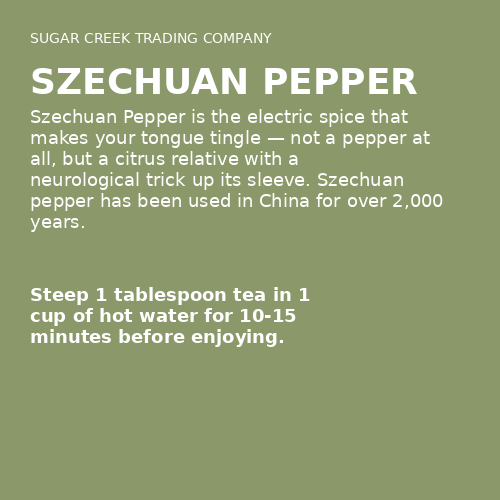
The electric spice that makes your tongue tingle — not a pepper at all, but a citrus relative with a neurological trick up its sleeve.
Botanical Identification
Common Names: Szechuan pepper, Sichuan pepper, Chinese prickly ash, flower pepper (hua jiao)
Latin Binomial: Zanthoxylum bungeanum Maxim.
Family: Rutaceae (citrus family)
Parts Used: Dried pericarp (outer husk of the fruit); seeds are typically removed as they are gritty and lack flavor
Origin: Native to the Sichuan province of China; cultivated widely across East Asia including Korea, Japan, Nepal, and Bhutan
Despite its name, Szechuan pepper is not related to black pepper (Piper nigrum) or chili peppers (Capsicum spp.). It belongs to the citrus family and is more closely related to lemons and oranges. The "pepper" designation is a Western misnomer based on its use as a seasoning. The dried husks are the prized culinary and medicinal portion, producing the signature numbing, tingling sensation known in Chinese as ma (numbing) — the "ma" in mala (numbing-spicy) cuisine.
Cultural and Historical Use
Szechuan pepper has been used in China for over 2,000 years. It appears in the earliest Chinese materia medica texts, including the Shennong Ben Cao Jing (circa 200 CE), where it is classified as a warming herb that expels cold and dampness. In Traditional Chinese Medicine (TCM), hua jiao is used to warm the middle jiao (digestive center), relieve abdominal pain, kill parasites, and treat toothache.
Culturally, Szechuan pepper was so valued that it was used as a form of tribute payment to the imperial court. It was mixed into wall plaster in the imperial harem chambers — hence the term "pepper room" (jiao fang) — both for its fragrance and as a symbol of fertility, since the plant produces abundant seeds.
In Sichuan cuisine, it is the foundational spice that defines the regional palate. The mala flavor profile — combining the numbing ma of Szechuan pepper with the burning la of chili peppers — is the cornerstone of dishes like mapo tofu, dan dan noodles, and Chongqing hot pot. Japanese cuisine uses the related species Zanthoxylum piperitum (sansho) as a garnish for grilled eel and in seven-spice blends.
Key Bioactive Compounds
| Compound | Class | Activity |
|---|---|---|
| Hydroxy-alpha-sanshool | Alkylamide | Primary numbing/tingling agent; activates mechanosensory neurons (touch receptors, not pain receptors) |
| Hydroxy-beta-sanshool | Alkylamide | Contributes to tingling sensation; modulates TRPV1 and KCNK channels |
| Limonene | Monoterpene | Citrusy aroma; anti-inflammatory, potential gastroprotective effects |
| Linalool | Monoterpene alcohol | Floral aroma component; anxiolytic, sedative properties |
| Geraniol | Monoterpene alcohol | Aromatic compound; antimicrobial activity |
| Xanthoxylin | Phenolic compound | Anti-inflammatory; found across Zanthoxylum species |
| Quercetin and rutin | Flavonoids | Antioxidant, anti-inflammatory, capillary-strengthening |
How It Works in the Body
The tingling, buzzing, slightly numbing sensation produced by Szechuan pepper is one of the most unusual sensory experiences in the culinary world. Research published in Proceedings of the Royal Society B (2013) found that hydroxy-alpha-sanshool activates tactile (touch) nerve fibers — specifically, RA1 mechanoreceptors — at a frequency of approximately 50 Hz. This means the "tingle" is literally a vibration sensation, not a taste or a pain signal. It is neurologically distinct from both the heat of capsaicin and the cooling of menthol.
Sanshool compounds interact with two-pore potassium channels (KCNK3 and KCNK9, also called TASK-1 and TASK-3), inhibiting their function. These channels normally help set the resting membrane potential of sensory neurons. When blocked, the neurons become more excitable, firing spontaneously and producing the characteristic buzzing, electric numbness.
In the digestive system, Szechuan pepper stimulates salivation and gastric secretion, which may improve appetite and digestion. Its volatile oils have demonstrated antispasmodic effects on smooth muscle in animal studies, supporting its traditional use for abdominal cramping. The essential oil also shows broad-spectrum antimicrobial activity against foodborne pathogens, which may partly explain its historical importance as a food preservative in warm climates.
Dose Guidelines
| Use | Amount | Notes |
|---|---|---|
| Culinary seasoning | 1/4 to 1 teaspoon per dish | Toast whole husks in dry pan until fragrant, then grind. Add to stir-fries, soups, marinades. |
| Infused oil | 1-2 tablespoons whole peppercorns per cup of oil | Heat gently in neutral oil for 5-10 minutes. Strain. Use as finishing oil. |
| TCM decoction | 3-6 grams dried pericarp | Simmered in water for digestive complaints. Traditionally combined with ginger and jujube. |
| Topical (toothache) | Chew 1-2 husks on affected area | Traditional folk remedy; numbing effect provides temporary analgesic relief. |
Preparation and Uses
- Toast and grind: Dry-toast whole Szechuan peppercorns in a skillet over medium heat for 1-2 minutes until fragrant and slightly smoking. Grind in a mortar and pestle or spice grinder. This is the foundation for authentic mala seasoning.
- Mala spice blend: Combine ground Szechuan pepper with dried chili flakes, star anise, fennel seed, and cinnamon for a classic five-spice-adjacent mala powder.
- Szechuan pepper salt: Mix freshly ground Szechuan pepper with coarse sea salt at a 1:3 ratio. Use as a dipping condiment for fried foods.
- Infused honey: Steep lightly crushed peppercorns in warm honey for 1-2 weeks. Use on cheese, drizzle over roasted fruit, or add to cocktails.
- Hot pot base: Add whole peppercorns to simmering broth along with dried chilies, garlic, ginger, and star anise for authentic Sichuan hot pot.
Optimal Context for Use
Szechuan pepper excels in cuisines that layer complex flavors — Sichuan, Tibetan, Nepali, and Bhutanese cooking all rely on it as a primary spice. It pairs particularly well with fatty, rich dishes because the numbing sensation cuts through richness and stimulates the palate. Combine it with chili heat, garlic, ginger, soy sauce, and black vinegar for the most authentic Sichuan flavor profiles.
For those exploring the spice for the first time, start with small amounts. The numbing sensation can be surprising and even disorienting in large doses. Toast lightly before grinding for the best aromatic release, and store in an airtight container away from light to preserve the volatile oils that carry its distinctive fragrance.
Sustainability and Ethical Harvesting
Zanthoxylum bungeanum is widely cultivated across China, particularly in Sichuan, Shaanxi, and Gansu provinces, and is not considered threatened. It is a hardy, drought-tolerant tree that can grow in poor soils, making it a valuable crop for marginal agricultural land. Sustainable production is supported by the Chinese government as part of rural economic development programs.
When purchasing, look for whole peppercorns with vibrant reddish-brown color and a strong citrusy aroma. Avoid pre-ground products that may have lost volatile oils. High-quality Szechuan pepper should produce a strong tingling sensation on the tongue within seconds of tasting.
Safety and Cautions
- Generally recognized as safe when used in culinary quantities.
- Excessive consumption may cause temporary intense numbness of the mouth and tongue, which resolves on its own within 15-30 minutes.
- Rare allergic reactions are possible, particularly in individuals with sensitivities to other Rutaceae family plants (citrus).
- Pregnant and nursing individuals should use in normal culinary amounts only; concentrated medicinal doses lack sufficient safety data.
- May interact with anesthetic medications due to its effects on ion channels — inform your healthcare provider of regular use before surgical procedures.
- This product is not intended to diagnose, treat, cure, or prevent any disease.
References
- Hagiwara, K., et al. (2013). "Hydroxy-alpha-sanshool activates mechanosensitive RA1 fibers." Proceedings of the Royal Society B, 280(1770), 20131680.
- Bautista, D.M., et al. (2008). "Pungent agents from Szechuan peppers excite sensory neurons by inhibiting two-pore potassium channels." Nature Neuroscience, 11(7), 772-779.
- Yang, X. (2008). "Aroma constituents and alkylamides of red and green huajiao (Zanthoxylum bungeanum and Zanthoxylum schinifolium)." Journal of Agricultural and Food Chemistry, 56(5), 1689-1696.
- Bensky, D., Clavey, S., & Stoger, E. (2004). Chinese Herbal Medicine: Materia Medica. 3rd ed. Eastland Press.
- Zhang, M., et al. (2017). "Chemical composition and antimicrobial activity of essential oils from Zanthoxylum bungeanum." Molecules, 22(12), 2077.
Final Note
Szechuan pepper is one of those rare spices that fundamentally changes your understanding of flavor. It is not hot. It is not cold. It is electric — a 50-hertz vibration on your tongue that opens the door to one of the world's great culinary traditions. Once you experience authentic mala, you will understand why Sichuan cuisine has captivated palates for millennia. Keep it whole, toast it fresh, grind it just before use, and let it do what no other spice on earth can do.
Share