Sugar Creek Trading Company
Tribulus Terrestris
Tribulus Terrestris
Impossible de charger la disponibilité du service de retrait
Tribulus terrestris — Tribulus Terrestris
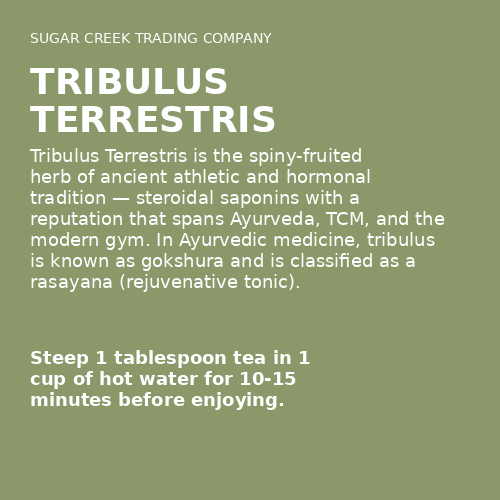
The spiny-fruited herb of ancient athletic and hormonal tradition — steroidal saponins with a reputation that spans Ayurveda, TCM, and the modern gym.
Botanical Identification
Common Names: Tribulus, puncture vine, goat's head, caltrop, devil's thorn, gokshura (Sanskrit), bai ji li (Chinese), bindii
Latin Binomial: Tribulus terrestris L.
Family: Zygophyllaceae (caltrop family)
Parts Used: Fruit (most common), aerial parts, root
Origin: Native to warm temperate and tropical regions of southern Europe, southern Asia, Africa, and northern Australia. Now naturalized worldwide, including the Americas.
Tribulus terrestris is a low-growing, spreading annual herb with pinnately compound leaves and small yellow flowers. It is best recognized by its fruit — a hard, spiny bur with sharp thorns capable of puncturing bicycle tires and bare feet, earning it the common name "puncture vine." Despite being considered an aggressive weed in many regions, the plant has been used medicinally for thousands of years across multiple healing traditions.
Cultural and Historical Use
In Ayurvedic medicine, tribulus is known as gokshura and is classified as a rasayana (rejuvenative tonic). It is one of the principal herbs for urinary and reproductive health in the Ayurvedic pharmacopoeia. Classical texts including the Charaka Samhita and Sushruta Samhita describe gokshura as a diuretic, aphrodisiac, and kidney tonic, and it is a key ingredient in the classical formula Gokshuradi Guggulu, used for urinary tract conditions.
In Traditional Chinese Medicine, bai ji li (the fruit of Tribulus terrestris) is used to soothe the Liver, dispel wind, brighten the eyes, and stop itching. It is classified as acrid and warm, entering the Liver and Lung channels.
In traditional Bulgarian and Eastern European folk medicine, tribulus was used as a tonic for vitality, sexual function, and physical endurance. It gained international attention in the 1990s when Bulgarian Olympic weightlifters reportedly used tribulus supplements as part of their training regimen, leading to a global surge in popularity among athletes and bodybuilders.
Across Africa, various Tribulus species have traditional uses as treatments for urinary infections, kidney stones, infertility, and inflammation.
Key Bioactive Compounds
| Compound | Class | Activity |
|---|---|---|
| Protodioscin | Furostanol steroidal saponin | Most studied compound; proposed mechanism for androgen-supportive effects. May increase dehydroepiandrosterone (DHEA) and nitric oxide. Precursor conversion to diosgenin. |
| Protogracillin | Furostanol steroidal saponin | Structurally related to protodioscin; contributes to total saponin activity |
| Dioscin and diosgenin | Steroidal saponin / sapogenin | Anti-inflammatory, hepatoprotective; diosgenin has been studied as a precursor for pharmaceutical steroid synthesis |
| Tribulosin | Spirostanol saponin | Cardioprotective; shown to protect cardiac cells from ischemic damage in animal studies |
| Kaempferol and quercetin | Flavonoids | Antioxidant, anti-inflammatory |
| Harmine and related alkaloids | Beta-carboline alkaloids | Trace amounts; MAO-inhibitory and neuroprotective activity at higher concentrations |
| Phytosterols (beta-sitosterol, stigmasterol) | Plant sterols | Cholesterol modulation; prostate health support |
How It Works in the Body
Hormonal effects — what the evidence actually shows: Tribulus is most famous for its reputation as a "natural testosterone booster." The reality is more nuanced. Multiple human clinical trials have found that tribulus supplementation does not directly increase serum testosterone levels in healthy young men with normal testosterone. A 2014 systematic review in the Journal of Dietary Supplements concluded that tribulus did not reliably raise testosterone in controlled trials.
However, the story does not end there. Studies in men with low or borderline testosterone (including aging men and those with partial androgen deficiency) have shown modest improvements in sexual function, libido, and in some cases, free testosterone levels. The mechanism may involve increasing luteinizing hormone (LH) release from the pituitary, which stimulates testicular testosterone production — an effect that would be most noticeable in individuals with suboptimal baseline function rather than healthy young men.
Nitric oxide and cardiovascular support: Protodioscin has been shown to increase nitric oxide (NO) production in endothelial cells. Nitric oxide is a vasodilator — it relaxes blood vessel walls, improving blood flow. This mechanism supports tribulus's traditional use for sexual function (erectile support) and may also explain observed benefits for blood pressure and exercise performance.
Urinary and kidney support: Animal and in vitro studies demonstrate that tribulus extracts have diuretic effects and can reduce the formation of calcium oxalate crystals in the kidneys, supporting its long Ayurvedic history as a kidney and urinary tonic. A study in Phytomedicine (2010) found that tribulus extract reduced kidney stone formation in rats by decreasing stone-forming constituents in urine.
Adaptogenic and anti-fatigue effects: Tribulus may exert general tonic effects through its antioxidant flavonoids and saponins, reducing exercise-induced oxidative stress and supporting recovery. Some evidence suggests improved endurance capacity in animal models, though human exercise performance data is mixed.
Dose Guidelines
| Form | Amount | Standardization | Notes |
|---|---|---|---|
| Powdered fruit | 2-5 grams per day | Whole herb, unstandardized | Mix into smoothies, capsules, or stir into warm water. Divide into 2-3 doses. |
| Standardized extract | 250-750 mg per day | Standardized to 40-60% saponins (as protodioscin) | Most clinical trials used this range. Take with meals. |
| Tincture (1:5) | 2-4 mL, 2-3 times daily | N/A | Take in water or juice. Bitter flavor. |
| Tea / decoction | 3-6 grams dried fruit simmered in 2 cups water for 15-20 min | N/A | Traditional preparation. Strain well to remove spiny material. |
Cycling: Many practitioners recommend cycling tribulus — for example, 8 weeks on, 2-4 weeks off — rather than continuous indefinite use, particularly when using it for hormonal support.
Preparation and Uses
- Powder in smoothies: Blend 2-3 grams of tribulus powder into a post-workout smoothie with banana, protein powder, and nut butter. The earthy, slightly bitter flavor is well-masked by strong flavors.
- Capsule preparation: For those who dislike the taste, fill "00" capsules with tribulus powder for convenient dosing. Each capsule holds approximately 500-700 mg.
- Decoction (Ayurvedic style): Simmer 3-5 grams of crushed tribulus fruit in 2 cups of water for 15-20 minutes. Strain through a fine mesh. Add honey and a pinch of cardamom. Drink warm, twice daily.
- Athletic support stack: Combine tribulus with ashwagandha, maca, and cordyceps for a comprehensive adaptogenic and performance-support formula.
- Gokshuradi guggulu (traditional): In Ayurvedic practice, tribulus is combined with guggulu resin, triphala, and other herbs for urinary and reproductive conditions. This formula is best prepared or obtained through a qualified Ayurvedic practitioner.
Optimal Context for Use
Tribulus is best suited for adults seeking support for sexual health, libido, urinary function, or general physical vitality — particularly those who may be experiencing age-related or stress-related decline in these areas. It is not a steroid, not a hormone, and not a magic bullet for muscle growth. Its effects are modest and work best as part of a foundation that includes adequate sleep, proper nutrition, regular exercise, and stress management.
For athletic use, combine with strength training and adequate protein intake. For urinary and kidney support, combine with proper hydration and dietary management. Effects typically become noticeable after 2-4 weeks of consistent use.
Sustainability and Ethical Harvesting
Tribulus terrestris is one of the most abundant and aggressive weeds on the planet. It thrives in disturbed soils, roadsides, agricultural margins, and waste ground across warm temperate and tropical regions. It is classified as an invasive species in parts of the United States, Australia, and South Africa. Sustainability is generally not a concern — in many regions, harvesting tribulus is more akin to weed management than resource extraction.
Most commercial tribulus is cultivated in India and Bulgaria, where standardized agricultural practices ensure consistent saponin content. Bulgarian-grown tribulus has historically been considered premium quality due to higher protodioscin content, though this may vary by cultivar and growing conditions rather than geography alone.
Safety and Cautions
- Generally well-tolerated at recommended doses. Mild gastrointestinal discomfort (nausea, cramping) is the most commonly reported side effect.
- Do not use during pregnancy or while nursing. Tribulus has traditional use as an emmenagogue (menstruation promoter) and its steroidal saponins present theoretical risks during pregnancy.
- Individuals with hormone-sensitive conditions (breast cancer, prostate cancer, endometriosis, uterine fibroids) should avoid tribulus due to its potential hormonal activity.
- May lower blood sugar. Diabetics on hypoglycemic medications should monitor glucose levels and consult their healthcare provider.
- Rare case reports of hepatotoxicity and nephrotoxicity exist at very high doses or with prolonged use. Cycling on and off is recommended.
- May interact with blood pressure medications, diuretics, lithium, and diabetes medications.
- Do not combine with prescription testosterone, anabolic agents, or hormone replacement therapy without medical supervision.
- This product is not intended to diagnose, treat, cure, or prevent any disease.
References
- Neychev, V., & Mitev, V. (2005). "The aphrodisiac herb Tribulus terrestris does not influence the androgen production in young men." Journal of Ethnopharmacology, 101(1-3), 319-323.
- Qureshi, A., et al. (2014). "A systematic review on the herbal extract Tribulus terrestris and the roots of its putative aphrodisiac and performance enhancing effect." Journal of Dietary Supplements, 11(1), 64-79.
- Gauthaman, K., & Ganesan, A.P. (2008). "The hormonal effects of Tribulus terrestris and its role in the management of male erectile dysfunction." Journal of Ethnopharmacology, 118(2), 371-376.
- Sangeeta, D., et al. (2010). "Antiurolithiatic activity of Tribulus terrestris fruit extract on ethylene glycol-induced renal calculi." Phytomedicine, 17(13), 1052-1057.
- Akram, M., et al. (2011). "Tribulus terrestris Linn.: A review article." Journal of Medicinal Plants Research, 5(16), 3601-3605.
- Williamson, E., Driver, S., & Baxter, K. (2009). Stockley's Herbal Medicines Interactions. Pharmaceutical Press.
Final Note
Tribulus terrestris is an herb that has been both overhyped and underappreciated. The supplement industry sold it as a testosterone miracle; the research showed that was an oversimplification. But dismissing tribulus entirely misses the broader picture painted by millennia of traditional use across Ayurvedic, Chinese, and European folk medicine. It supports urinary health, may improve sexual function through nitric oxide pathways, and offers adaptogenic support for physical vitality — especially in those whose systems are depleted or declining. Use it honestly, use it consistently, and let the herb do what it actually does rather than what marketing promised it would do.
Share