Sugar Creek Trading Company
Tulsi Leaf
Tulsi Leaf
Impossible de charger la disponibilité du service de retrait
OCIMUM TENUIFLORUM (LEAF & FLOWERING TOPS)
(Holy Basil, Tulsi)
Family: Lamiaceae
Part Used: Leaf and flowering tops
Energetics: Warming, drying, uplifting
Taste: Pungent, aromatic, slightly bitter
BOTANICAL IDENTIFICATION
Scientific Name: Ocimum tenuiflorum L.
Synonym: Ocimum sanctum L.
Common Names: Holy Basil, Tulsi
Family: Lamiaceae
Morphology:
Ocimum tenuiflorum is a short-lived perennial to annual aromatic herb reaching 30–90 cm (1–3 ft) in height. Stems are square and branched. Leaves are opposite, ovate, slightly toothed, and softly hairy, often purple-tinged depending on cultivar (Rama, Krishna, Vana types).
Flowers are small, tubular, white to lavender, arranged in terminal spikes with purplish bracts. The entire plant is strongly aromatic, releasing volatile oils when bruised.
Root system:
A fibrous root system suited to warm-season growth and rapid nutrient uptake.
HABITAT, RANGE, AND ADAPTATIONS
Tulsi is native to the Indian subcontinent and is cultivated widely across South and Southeast Asia, and increasingly worldwide.
It thrives in warm, sunny environments with well-drained soils, tolerating drought once established. Adaptations include high production of volatile oils and phenolic compounds that deter insects, fungi, and grazing.
CULTIVATION AND ECOLOGY
Tulsi is easy to cultivate, grows rapidly from seed, and responds well to regular harvesting, which increases bushiness and yields.
Ecologically, it is highly supportive of pollinators and beneficial insects. Its aromatic chemistry makes it a valuable companion plant for pest management in regenerative gardens.
TRADITIONAL AND ETHNOBOTANICAL USE
Tulsi is one of the most revered herbs in Ayurveda and broader South Asian culture, considered a sacred plant embodying protection and purification. It is used daily in households as a spiritual ally and medicinal tea.
Traditionally, Tulsi is used for respiratory illness (cough, cold, asthma), fever, stress, grief, digestive weakness, metabolic imbalance, and immune resilience. It is also used in rituals for clarity, devotion, and protection, reflecting its role as both medicine and sacred plant.
In Ayurveda, Tulsi is often described as sattvic—promoting clarity and balanced vitality—supporting the nervous system while strengthening the immune response.
Modern herbalism frames Tulsi as an adaptogen-like nervine with broad systemic benefits, particularly for stress physiology and immune modulation.
KEY BIOACTIVE COMPOUNDS AND BENEFITS
| Compound Class | Representative Compounds | Role in Plant | Human Benefits |
|---|---|---|---|
| Volatile oils | Eugenol, methyl eugenol, linalool | Defense against herbivores and pathogens | Antimicrobial, calming, anti-inflammatory |
| Phenylpropanoids | Rosmarinic acid | Oxidative and microbial defense | Anti-inflammatory, antiviral support |
| Triterpenes | Ursolic acid, oleanolic acid | Structural and microbial defense | Anti-inflammatory, metabolic support |
| Flavonoids | Apigenin, luteolin | UV protection and oxidative buffering | Nervine support, antioxidant |
| Polysaccharides | Water-soluble polysaccharides | Structural matrix | Immune modulation |
Eugenol contributes strongly to Tulsi’s antimicrobial and anti-inflammatory effects, while rosmarinic acid supports allergy and inflammation modulation.
HOW IT WORKS IN THE BODY
Stress Physiology and Nervous System:
Tulsi supports stress adaptation by modulating cortisol dynamics and improving resilience to sympathetic overactivation. It calms without dulling, often improving clarity and mood stability.
Immune and Respiratory Support:
Volatile oils and phenolic acids provide antimicrobial and anti-inflammatory action in respiratory tissues, supporting recovery from colds and reducing allergic reactivity.
Metabolic and Inflammatory Balance:
Triterpenes and antioxidant compounds support healthy blood sugar signaling and reduce chronic low-grade inflammation.
ACTIONS AND INDICATIONS
Ocimum tenuiflorum acts as an adaptogen-like tonic, nervine, immune modulator, antimicrobial, anti-inflammatory, carminative, and mild expectorant.
It is indicated for stress, anxiety with fatigue, grief, mild depression patterns, immune weakness, colds and flu, asthma/allergy patterns, digestive stagnation, and metabolic stress states.
PREPARATIONS AND DOSAGE
| Form | Preparation | Suggested Dose | Notes |
|---|---|---|---|
| Infusion | 1–2 tsp dried leaf per cup hot water; steep 10–15 min | 1–3 cups daily | Daily tonic use |
| Tincture (1:5, 40–60%) | Fresh or dried herb | 2–4 mL, 2–3× daily | Stress and immune support |
| Fresh leaf | Chewed or added to food | As desired | Strong aromatic |
| Syrup | Infusion + honey | 1–2 tsp as needed | Cough support |
Tulsi pairs well with Ginger, Turmeric, Lemon Balm, Ashwagandha, and Elderberry depending on the desired emphasis.
SAFETY, CONTRAINDICATIONS, AND TOXICITY
Tulsi is generally very safe at customary doses.
Use caution with high-dose extracts in individuals taking anticoagulant medications or with bleeding disorders, as Tulsi may mildly affect platelet activity. Use caution in pregnancy at medicinal doses due to limited modern safety data (culinary use is generally considered safe).
General Toxicological Reference (LD₅₀)
-
Whole Ocimum tenuiflorum aerial-part preparations:
Acute oral toxicity studies in animals indicate very low toxicity, with reported LD₅₀ values generally >5,000 mg/kg -
Eugenol (isolated):
Oral LD₅₀ in rats reported approximately 1,900–2,700 mg/kg
Clinical relevance:
Whole-plant use has a wide safety margin; isolated constituents at high doses are less representative of traditional use.
HARVEST AND PROCESSING
Leaves and flowering tops are harvested throughout the growing season, ideally in the morning after dew dries. Dry quickly in shade with airflow to preserve volatile oils. Store airtight and protected from light.
Potency is retained for 1–2 years.
SUSTAINABILITY AND CONSERVATION
Tulsi is widely cultivated and not threatened. Ethical sourcing emphasizes organic cultivation, seed saving, and fair labor practices. It is an excellent plant for regenerative gardens due to its pollinator support and pest-deterrent chemistry.
SUMMARY
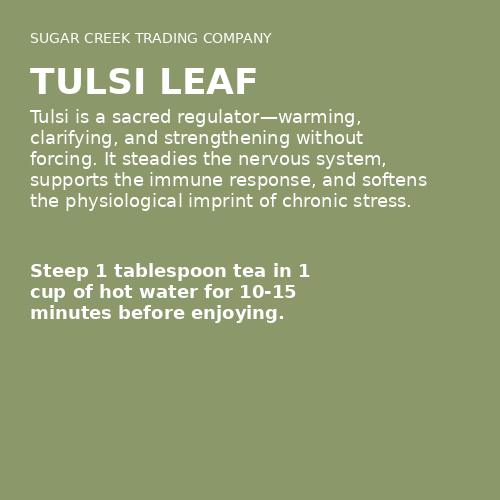
Tulsi is a sacred regulator—warming, clarifying, and strengthening without forcing. It steadies the nervous system, supports the immune response, and softens the physiological imprint of chronic stress.
Ocimum tenuiflorum reminds us that the boundary between spiritual practice and medicine is often artificial: daily devotion to balance is itself a form of healing, and Tulsi is one of the clearest botanical expressions of that truth.
Share