Sugar Creek Trading Company
Vasaka Malabar Leaf
Vasaka Malabar Leaf
Impossible de charger la disponibilité du service de retrait
JUSTICIA ADHATODA (LEAF & ROOT)
(Vasaka, Malabar Nut, Adhatoda)
Family: Acanthaceae
Part Used: Leaf (primary); root and flowers secondary
Energetics: Cooling, drying, dispersing
Taste: Bitter, astringent
BOTANICAL IDENTIFICATION
Scientific Name: Justicia adhatoda L.
Synonyms: Adhatoda vasica Nees
Common Names: Vasaka, Malabar Nut, Adhatoda
Family: Acanthaceae
Morphology:
Justicia adhatoda is an evergreen shrub reaching 1–3 meters (3–10 ft) in height. Leaves are opposite, lanceolate to ovate-lanceolate, leathery, and deep green with prominent veins. Flowers are white with purple or maroon markings, borne in dense axillary spikes with large bracts.
The plant emits a distinct bitter–green aroma when crushed, reflecting its alkaloid content.
Root system:
A woody, branching root system supporting perennial growth; roots contain alkaloids but are used less frequently than leaves.
HABITAT, RANGE, AND ADAPTATIONS
Vasaka is native to South and Southeast Asia, especially India, Sri Lanka, Nepal, and Bangladesh. It thrives in tropical and subtropical climates, commonly found along forest edges, roadsides, and cultivated hedges.
Key adaptations include:
-
High production of quinazoline alkaloids for herbivore and microbial defense
-
Evergreen habit allowing year-round photosynthesis
-
Tolerance of pruning and periodic drought
CULTIVATION AND ECOLOGY
Justicia adhatoda is easily cultivated and often planted near homes and temples in India due to its medicinal value. It responds well to regular harvesting, which stimulates fresh leaf growth.
Ecologically, it supports pollinators and functions as a resilient medicinal hedge plant in agroecological systems.
TRADITIONAL AND ETHNOBOTANICAL USE
Vasaka is one of the most important respiratory herbs in Ayurveda, with continuous use documented for over 2,000 years.
Traditionally, it is used for cough, bronchitis, asthma, tuberculosis, pneumonia, hemoptysis (coughing blood), and fever with respiratory involvement. Classical Ayurvedic texts describe Vasaka as shwasahara (reliever of breath disorders) and kasahara (reliever of cough).
It has also been used for bleeding disorders, uterine conditions, and as a febrifuge, reflecting its astringent and cooling nature.
In folk medicine, fresh leaf juice is often administered with honey for acute cough and wheezing.
KEY BIOACTIVE COMPOUNDS AND BENEFITS
| Compound Class | Representative Compounds | Role in Plant | Human Benefits |
|---|---|---|---|
| Quinazoline alkaloids | Vasicine, vasicinone | Chemical defense against herbivores | Bronchodilator, expectorant |
| Alkaloid derivatives | Deoxyvasicine | Antimicrobial defense | Respiratory support |
| Flavonoids | Apigenin, luteolin | UV and oxidative protection | Anti-inflammatory |
| Tannins | Condensed tannins | Tissue protection | Astringent, hemostatic |
| Essential oil (trace) | Monoterpenes | Ecological signaling | Mild antimicrobial |
Vasicine is the signature compound, responsible for Vasaka’s strong bronchodilatory and expectorant effects.
HOW IT WORKS IN THE BODY
Respiratory System:
Vasicine relaxes bronchial smooth muscle, improves airflow, and promotes productive expectoration, making Vasaka especially effective for wet, congested coughs.
Anti-inflammatory & Antimicrobial Effects:
Flavonoids and alkaloids reduce airway inflammation and inhibit respiratory pathogens, supporting recovery from infection.
Hemostatic Action:
Tannins and cooling energetics help reduce excessive bleeding, explaining traditional use in hemoptysis.
ACTIONS AND INDICATIONS
Justicia adhatoda acts as an expectorant, bronchodilator, antitussive, antimicrobial, anti-inflammatory, and hemostatic.
It is indicated for:
-
Acute and chronic bronchitis
-
Asthma and wheezing
-
Productive cough with thick mucus
-
Pneumonia and tuberculosis (adjunctive)
-
Cough with blood or excessive heat
PREPARATIONS AND DOSAGE
| Form | Preparation | Suggested Dose | Notes |
|---|---|---|---|
| Fresh leaf juice | Expressed juice | 5–10 mL, 1–2× daily | Traditionally with honey |
| Decoction | 1–2 tsp dried leaf per cup; simmer 15–20 min | 1 cup, 2× daily | Bitter |
| Tincture (1:5, 40–60%) | Dried leaf | 2–4 mL, 2–3× daily | Modern use |
| Syrup | Decoction + honey | 1–2 tsp as needed | Pediatric-friendly |
Commonly combined with Licorice, Ginger, Tulsi, Pippali, or Long Pepper.
SAFETY, CONTRAINDICATIONS, AND TOXICITY
Vasaka is generally safe at therapeutic doses but should not be used during pregnancy, as vasicine has uterine-stimulating activity.
Use caution in individuals with chronic hypotension, as bronchodilation may mildly lower blood pressure.
Mild GI upset may occur due to bitterness.
General Toxicological Reference (LD₅₀)
-
Whole Justicia adhatoda leaf extracts:
Acute oral LD₅₀ values in animal models are reported >2,000–5,000 mg/kg, indicating low toxicity -
Vasicine (isolated):
Oral LD₅₀ in rodents reported approximately 700–1,000 mg/kg
Clinical relevance:
Whole-leaf preparations are significantly safer than isolated alkaloids and reflect traditional use.
HARVEST AND PROCESSING
Leaves may be harvested year-round, ideally before flowering for peak alkaloid content. Dry in shade with airflow to preserve activity.
Properly dried leaves retain potency for 1–2 years.
SUSTAINABILITY AND CONSERVATION
Justicia adhatoda is abundant and widely cultivated; it is not considered threatened. Sustainable use emphasizes cultivation over wild collection and regular pruning rather than uprooting.
SUMMARY
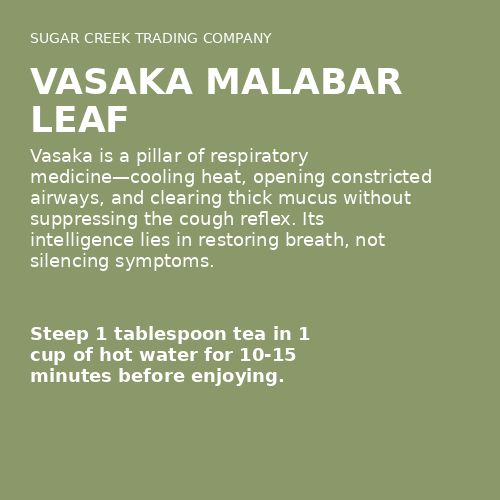
Vasaka is a pillar of respiratory medicine—cooling heat, opening constricted airways, and clearing thick mucus without suppressing the cough reflex. Its intelligence lies in restoring breath, not silencing symptoms.
In both classical Ayurveda and modern herbal practice, Justicia adhatoda remains one of the most reliable allies for deep lung congestion and inflammatory respiratory disease, demanding respect for its strength and its contraindications.
Share