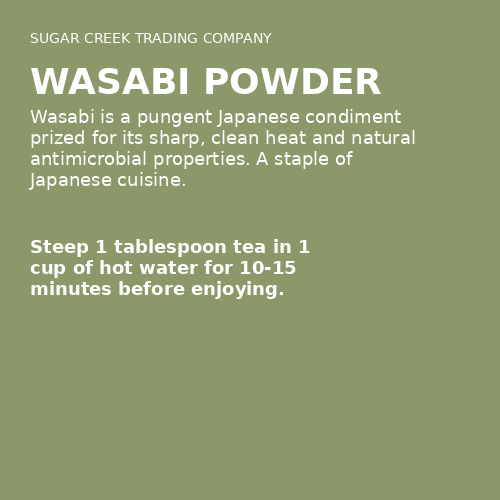
Sugar Creek Trading Company
Wasabi Powder
Wasabi Powder
Impossible de charger la disponibilité du service de retrait
WASABI POWDER
(Wasabi Root Powder; Hon-wasabi when authentic)
Botanical Source: Wasabia japonica (syn. Eutrema japonicum)
Family: Brassicaceae
Part Used: Rhizome (primary); powder is a dehydrated, milled preparation
Energetics: Hot, drying, rapidly dispersing
Taste: Intensely pungent, sharp, volatile
BOTANICAL IDENTIFICATION (SOURCE PLANT)
Scientific Name: Wasabia japonica (Miq.) Matsum.
Common Names: Wasabi, Japanese Wasabi
Family: Brassicaceae
Morphology:
A slow-growing perennial with glossy, heart-shaped leaves arising from a thick, green rhizome. Flowers are small, white, and cruciform. The rhizome contains specialized cells storing glucosinolates and the enzyme myrosinase, which interact upon tissue damage.
Root system:
A shallow, fibrous system adapted to cool, flowing water environments; the rhizome is the medicinal and culinary focus.
TERROIR, RANGE, AND ADAPTATIONS
Native to Japan, wasabi grows along cold mountain streams with constant flow, high oxygen, and mineral-balanced water. These conditions select for potent chemical defenses due to constant microbial pressure.
Adaptations:
Separation of glucosinolates and myrosinase prevents self-toxicity; when the rhizome is grated (or rehydrated from powder), enzymatic activation produces isothiocyanates—the signature pungency.
PROCESSING & AUTHENTICITY (POWDER CONTEXT)
True wasabi powder is made from dehydrated W. japonica rhizome and retains the glucosinolate–myrosinase system. However, many commercial “wasabi powders” are substitutes composed primarily of horseradish (Armoracia rusticana), mustard flour, and colorants.
Key distinction:
-
Authentic wasabi powder: softer, fleeting heat; sweet–green finish
-
Horseradish-based powder: harsher, longer-lasting nasal burn
Medicinally, both rely on isothiocyanates, but authentic wasabi contains a distinct profile (e.g., 6-methylthiohexyl isothiocyanate).
TRADITIONAL AND ETHNOBOTANICAL CONTEXT
In Japan, wasabi has long been paired with raw fish not only for flavor but for antimicrobial protection, reducing foodborne risk. Traditional uses include support for sinus congestion, digestion, circulation, and preservation.
Beyond cuisine, wasabi was valued as a dispersing agent—cutting through heaviness, stagnation, and cold accumulation. Powdered forms expanded availability outside stream-growing regions.
KEY BIOACTIVE COMPOUNDS AND BENEFITS
| Compound Class | Representative Compounds | Role in Plant | Human Benefits |
|---|---|---|---|
| Glucosinolates | Sinigrin, related precursors | Stored chemical defense | Precursor to isothiocyanates |
| Isothiocyanates | 6-methylthiohexyl ITC | Rapid deterrent upon damage | Antimicrobial, decongestant |
| Enzymes | Myrosinase | Defense activation | Enables bioactive formation |
| Phenolics (minor) | Flavonoid traces | Oxidative buffering | Antioxidant support |
| Minerals (trace) | Potassium, calcium | Cellular regulation | Minor nutritive role |
Isothiocyanates are volatile and short-lived, explaining the quick rise-and-fade heat when properly prepared.
HOW IT WORKS IN THE BODY
Respiratory & Sinus Effects:
Volatile isothiocyanates stimulate trigeminal receptors, producing rapid nasal and sinus clearing without prolonged mucosal irritation when used modestly.
Digestive Stimulation:
Sharp pungency increases salivation and gastric secretions, aiding digestion of fats and proteins.
Antimicrobial Action:
Isothiocyanates inhibit a range of bacteria and fungi, supporting food safety and oral health contexts.
Circulatory Dispersion:
Heat promotes peripheral circulation and disperses cold stagnation patterns.
ACTIONS AND INDICATIONS
Wasabi powder functions as a:
-
Rapid dispersant
-
Decongestant
-
Digestive stimulant
-
Antimicrobial adjunct
Indicated for:
-
Sinus congestion and head colds
-
Digestive sluggishness after heavy meals
-
Cold, damp patterns with stagnation
-
Food safety support (traditional pairing)
PREPARATIONS AND DOSAGE
| Form | Preparation | Suggested Use | Notes |
|---|---|---|---|
| Paste (traditional) | Rehydrate powder with cool water; rest 1–3 min | Small amounts | Activates enzymes |
| Condiment | Mixed with foods | Culinary-medicinal | Short-lived heat |
| Inhalation (indirect) | Aroma from freshly mixed paste | Brief exposure | Avoid direct inhalation |
| External poultice | Very dilute paste | Rare | Skin sensitivity caution |
Use small quantities; effects are immediate.
SAFETY, CONTRAINDICATIONS, AND TOXICITY
Generally safe in culinary amounts.
Cautions:
-
Excess may irritate GI mucosa
-
Avoid in active ulcers or severe gastritis
-
Powder dust can irritate eyes and lungs; avoid inhalation
General Toxicological Reference (LD₅₀)
-
Wasabi rhizome / powder (whole):
No specific LD₅₀ established; culinary use considered low toxicity -
Isothiocyanates (isolated):
Oral LD₅₀ values in rodents commonly reported >1,000–2,000 mg/kg (compound-dependent)
Clinical relevance:
Risk is driven by concentration and irritation, not systemic toxicity.
STORAGE AND QUALITY
Store powder airtight, cool, and dry. Potency declines as volatile precursors degrade. Once rehydrated, activity peaks within minutes and fades quickly.
Quality indicators:
-
Fresh, green aroma
-
Quick-onset, clean heat
-
No artificial dyes (for authentic products)
SUSTAINABILITY AND ETHICS
True wasabi cultivation is labor-intensive and environmentally sensitive, relying on clean mountain water. Ethical sourcing supports small growers and discourages mislabeling.
Substitute powders reduce pressure on wild habitats but should be clearly labeled.
SUMMARY
Wasabi powder is medicine by immediacy—a flash of heat that clears, protects, and moves stagnation without lingering heaviness. Its intelligence lies in volatility: act fast, then get out of the way.
Whether authentic hon-wasabi or a horseradish-based analog, its proper role is modest, precise, and situational—an ally for clarity, digestion, and protection when used with restraint.
Share