Sugar Creek Trading Company
Wheatgrass
Wheatgrass
Impossible de charger la disponibilité du service de retrait
TRITICUM AESTIVUM (AERIAL PARTS)
(Common Wheat, Wheatgrass)
Family: Poaceae
Part Used: Young aerial parts (wheatgrass); seed (grain) secondary, nutritional
Energetics: Cooling, moistening, gently tonifying
Taste: Sweet, grassy, mildly bitter
BOTANICAL IDENTIFICATION
Scientific Name: Triticum aestivum L.
Common Names: Common Wheat, Wheatgrass
Family: Poaceae
Morphology:
Triticum aestivum is an annual grass reaching 60–120 cm (2–4 ft) at maturity. Leaves are narrow, linear, flat to slightly folded, with parallel venation and a smooth to slightly rough texture. The flowering structure is a terminal spike (ear) composed of multiple spikelets; each spikelet bears florets that develop into grains (caryopses).
When harvested young (7–14 days post-germination), the plant presents as wheatgrass: tender, bright green blades rich in chlorophyll and enzymes. At this stage, lignification is minimal and phytochemical density is highest.
Root system:
A fibrous root system forming a dense mat in the upper soil layers, efficient at nutrient uptake during rapid early growth.
HABITAT, RANGE, AND ADAPTATIONS
Originally domesticated in the Fertile Crescent, Triticum aestivum is now cultivated globally across temperate regions.
It thrives in well-drained loams with moderate fertility and adequate moisture. As a domesticated annual, wheat relies on rapid early growth and high photosynthetic efficiency rather than long-term structural defenses.
Young shoots accumulate chlorophyll, minerals, and enzymes rapidly, supporting vigorous early development before reproductive allocation.
CULTIVATION AND ECOLOGY
Wheatgrass is easily cultivated indoors or outdoors from seed, requiring minimal inputs. Harvest occurs before jointing (stem elongation), when nutrient density peaks.
Ecologically, wheat has transformed landscapes through agriculture; while monoculture grain systems can degrade soils, young wheatgrass cultivation—especially in rotations or as cover—can support soil structure, microbial life, and nutrient cycling.
TRADITIONAL AND ETHNOBOTANICAL USE
While the grain of Triticum aestivum is among humanity’s most important staple foods, the use of young wheatgrass as a medicinal food is a relatively modern development.
In the early 20th century, wheatgrass gained prominence through nutritional and naturopathic movements, where it was promoted as a blood builder, detoxifier, and vitality tonic. Traditional systems did not isolate wheatgrass per se, but grasses and green juices were widely regarded as spring tonics across cultures.
In contemporary herbalism and functional nutrition, wheatgrass is used as a nutritive, alkalizing, and restorative agent, particularly during convalescence or periods of deficiency.
KEY BIOACTIVE COMPOUNDS AND BENEFITS
| Compound Class | Representative Compounds | Role in Plant | Human Benefits |
|---|---|---|---|
| Chlorophylls | Chlorophyll a & b | Photosynthesis and energy capture | Hematinic support, detoxification |
| Flavonoids | Apigenin, luteolin derivatives | UV protection and oxidative buffering | Antioxidant, anti-inflammatory |
| Enzymes | Superoxide dismutase, catalase | Oxidative stress management | Cellular antioxidant support |
| Minerals | Magnesium, iron, potassium | Structural and metabolic support | Electrolyte balance, hematopoiesis |
| Amino acids | Glutamic acid, glycine | Protein synthesis | Tissue repair, metabolic support |
| Polysaccharides | Cellulose, beta-glucans (trace) | Structural integrity | Prebiotic support (minor) |
Chlorophyll content is especially high in wheatgrass and underlies many of its systemic effects.
HOW IT WORKS IN THE BODY
Nutritional and Cellular Support:
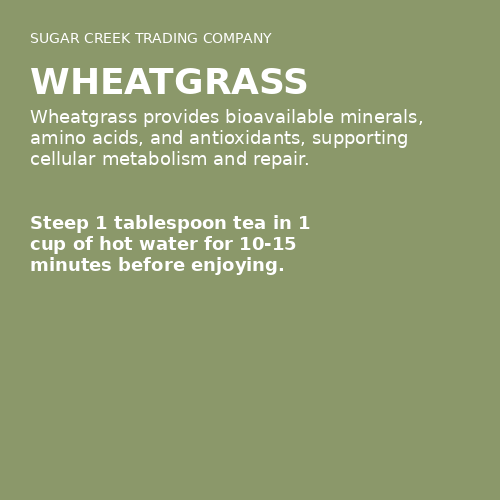
Wheatgrass provides bioavailable minerals, amino acids, and antioxidants, supporting cellular metabolism and repair.
Blood and Detoxification Support:
Chlorophyll’s structural similarity to hemoglobin has led to its traditional association with blood building; while not a direct substitute, it supports detoxification pathways and oxygen utilization.
Digestive and Metabolic Effects:
Fresh wheatgrass juice stimulates digestion gently and may support liver function through antioxidant and enzyme activity.
ACTIONS AND INDICATIONS
Triticum aestivum (aerial parts) acts as a nutritive tonic, antioxidant, mild detoxifier, alkalizing agent, and restorative food-medicine.
It is indicated for nutritional deficiency, fatigue, convalescence, anemia patterns (supportive), inflammatory stress, digestive weakness, and general vitality support.
PREPARATIONS AND DOSAGE
| Form | Preparation | Suggested Dose | Notes |
|---|---|---|---|
| Fresh juice | Pressed from young shoots | 15–30 mL daily | Most potent form |
| Powder | Freeze-dried wheatgrass | 1–3 g daily | Convenient alternative |
| Tablets | Compressed powder | As directed | Variable quality |
| Poultice | Fresh pulp | Apply externally | Burns, skin irritation (traditional) |
Wheatgrass pairs well with Nettle Leaf, Alfalfa, Spirulina, and Barley Grass in nutritive formulas.
SAFETY, CONTRAINDICATIONS, AND TOXICITY
Wheatgrass is generally very safe and well tolerated.
Initial use may cause mild nausea or detox-like symptoms, particularly with fresh juice. Start low and increase gradually.
Individuals with celiac disease or gluten sensitivity should note that wheatgrass harvested before grain formation is naturally gluten-free, though cross-contamination is possible.
No significant drug interactions are documented.
General Toxicological Reference (LD₅₀)
-
Whole Triticum aestivum aerial-part preparations (wheatgrass):
Acute toxicity studies indicate extremely low toxicity, with oral LD₅₀ values in animal models reported as >5,000 mg/kg -
Chlorophyll derivatives:
Oral LD₅₀ values reported >3,000 mg/kg
Clinical relevance:
These values support wheatgrass’s role as a safe daily nutritive, appropriate for long-term use.
HARVEST AND PROCESSING
Harvest young shoots 7–14 days after sprouting, before jointing. Cut above the root crown to allow regrowth (one or two cuts maximum).
For powder, material is freeze-dried or low-temperature dried to preserve enzymes and chlorophyll. Store airtight, protected from light.
SUSTAINABILITY AND CONSERVATION
Triticum aestivum is globally abundant. While industrial grain farming raises sustainability concerns, small-scale wheatgrass cultivation is low-impact and regenerative, especially when integrated into soil-building systems.
SUMMARY
Triticum aestivum in its young, green form is food as medicine—simple, restorative, and foundational. It does not force change, but supplies the raw materials from which resilience is rebuilt.
As a nutritive tonic, wheatgrass reminds us that healing often begins not with intervention, but with replenishment, restoring the body’s capacity to regulate and renew itself.
Share