Sugar Creek Trading Company
White Pine Bark
White Pine Bark
Impossible de charger la disponibilité du service de retrait
PINUS STROBUS (BARK)
(White Pine Bark, Eastern White Pine)
Family: Pinaceae
Part Used: Inner bark (cambium), resin secondary
Energetics: Warming, drying, gently stimulating
Taste: Bitter, resinous, slightly astringent
BOTANICAL IDENTIFICATION
Scientific Name: Pinus strobus L.
Common Names: Eastern White Pine, White Pine
Family: Pinaceae
Morphology:
Pinus strobus is a large evergreen conifer reaching 20–50 meters (65–165 ft) in height, with a straight trunk and a broad, layered crown. Needles are soft, flexible, and bluish-green, borne in bundles of five, a key identifying trait. Cones are slender, cylindrical, and pendulous, maturing to light brown.
The bark is gray to dark brown, becoming deeply furrowed with age. The inner bark (cambium) is pale, resinous, and aromatic; this layer is the primary medicinal portion.
Root system:
A shallow but wide-spreading root system that anchors the tree in forest soils and facilitates nutrient uptake across large areas.
HABITAT, RANGE, AND ADAPTATIONS
White Pine is native to eastern North America, ranging from southeastern Canada through the northeastern and upper Midwestern United States.
It thrives in mixed deciduous–conifer forests, preferring well-drained sandy or loamy soils but tolerating a wide range of conditions. The species is moderately shade-tolerant in youth and long-lived.
Adaptations include resin-rich tissues that deter insects and pathogens, flexible wood that resists wind damage, and rapid vertical growth that allows access to canopy light.
CULTIVATION AND ECOLOGY
Pinus strobus is easily cultivated and widely used in reforestation, timber production, and windbreak plantings. It is relatively fast-growing compared to other conifers.
Ecologically, White Pine is a keystone forest species, providing habitat, food, and shelter for birds, mammals, insects, and mycorrhizal fungi. Its needles acidify soil slightly, influencing understory plant communities.
TRADITIONAL AND ETHNOBOTANICAL USE
White Pine Bark was an essential medicine among many Indigenous nations, including the Haudenosaunee (Iroquois), Ojibwe, Abenaki, and Algonquin peoples.
The inner bark and resin were used for coughs, colds, sore throats, chest congestion, wounds, infections, and joint pain. Decoctions of the bark were taken internally for respiratory infections and fever, while poultices and salves were applied externally to sores, burns, and abscesses.
During early European settlement, White Pine bark became famous as a treatment for scurvy, due to its vitamin C content, saving many lives during winter shortages. It was later adopted into early American and Eclectic herbal practice as a respiratory and wound-healing agent.
Modern herbalists continue to value White Pine Bark as a gentle expectorant, antimicrobial, and tissue tonic, especially for chronic respiratory weakness.
KEY BIOACTIVE COMPOUNDS AND BENEFITS
| Compound Class | Representative Compounds | Role in Plant | Human Benefits |
|---|---|---|---|
| Proanthocyanidins | OPCs, catechin polymers | Structural defense and UV protection | Antioxidant, capillary-strengthening |
| Resin acids | Abietic acid, pimaric acid | Defense against insects and pathogens | Antimicrobial, expectorant |
| Volatile oils | α-pinene, β-pinene, limonene | Herbivore deterrence and signaling | Decongestant, bronchodilatory |
| Tannins | Condensed tannins | Bark tissue protection | Astringent, wound-healing |
| Vitamin C | Ascorbic acid | Stress protection | Immune support, scurvy prevention |
The synergy between resins and tannins accounts for White Pine’s dual action as both an antimicrobial and a tissue-repair agent.
HOW IT WORKS IN THE BODY
Respiratory System:
White Pine Bark acts as a mild expectorant and decongestant, loosening mucus while toning respiratory tissues. Volatile oils open bronchial passages, while tannins reduce excessive secretions.
Immune and Antimicrobial Effects:
Resin acids and polyphenols inhibit bacterial and fungal growth, supporting immune defense during respiratory and skin infections.
Circulatory and Tissue Support:
Proanthocyanidins strengthen capillaries and connective tissue, aiding wound healing and reducing inflammation.
ACTIONS AND INDICATIONS
Pinus strobus bark functions as an expectorant, antimicrobial, astringent, anti-inflammatory, antioxidant, and tissue tonic.
It is indicated for coughs, bronchitis, sore throat, chest congestion, chronic respiratory weakness, minor infections, wounds, ulcers, and inflammatory skin conditions.
PREPARATIONS AND DOSAGE
| Form | Preparation | Suggested Dose | Notes |
|---|---|---|---|
| Decoction | 1 tsp inner bark per cup water; simmer 20–30 min | 1 cup, 2–3× daily | Traditional respiratory remedy |
| Tincture (1:5, 40–60%) | Fresh or dried bark | 2–4 mL, 2–3× daily | Broad internal use |
| Syrup | Decoction reduced with honey | 1–2 tsp as needed | Especially for cough |
| Salve | Resin infused in oil | Apply externally | Wounds, sores |
| Steam inhalation | Bark or needles | As needed | Decongestant |
White Pine Bark pairs well with Yerba Santa, Mullein, Wild Cherry Bark, and Elecampane in respiratory formulas.
SAFETY, CONTRAINDICATIONS, AND TOXICITY
White Pine Bark is generally safe at customary doses.
Excessive internal use may cause mild gastrointestinal irritation due to tannins. Use caution in individuals with severe kidney disease when using concentrated resin preparations.
Avoid confusion with toxic pine species or non-medicinal conifers; correct identification is essential.
No significant drug interactions are documented.
General Toxicological Reference (LD₅₀)
-
Whole Pinus strobus bark extracts:
Acute oral toxicity studies indicate very low toxicity, with LD₅₀ values generally >2,000 mg/kg in animal models -
Isolated pine resin acids:
Oral LD₅₀ values reported >1,000 mg/kg, indicating low acute toxicity when properly processed
Clinical relevance:
These values support White Pine Bark’s long history as a safe respiratory and wound-healing remedy when used appropriately.
HARVEST AND PROCESSING
Inner bark is harvested sparingly from fallen trees, storm-damaged limbs, or through careful strip-harvesting that does not girdle living trees. Only the cambium layer is taken.
Material is dried quickly and stored airtight. Resin is collected from natural exudates or shallow incisions.
SUSTAINABILITY AND CONSERVATION
Pinus strobus is abundant and widely cultivated, though historical overlogging greatly reduced old-growth stands. Ethical harvesting emphasizes non-lethal bark collection and use of naturally fallen material.
White Pine remains a cornerstone species for reforestation, carbon sequestration, and forest regeneration.
SUMMARY
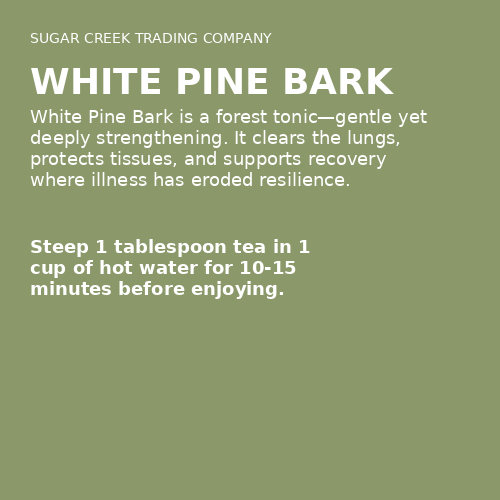
White Pine Bark is a forest tonic—gentle yet deeply strengthening. It clears the lungs, protects tissues, and supports recovery where illness has eroded resilience.
Rooted in Indigenous wisdom and validated by chemistry and history, Pinus strobus embodies the medicine of endurance: not forceful, but faithful, restoring breath, integrity, and continuity in the living system.
Share