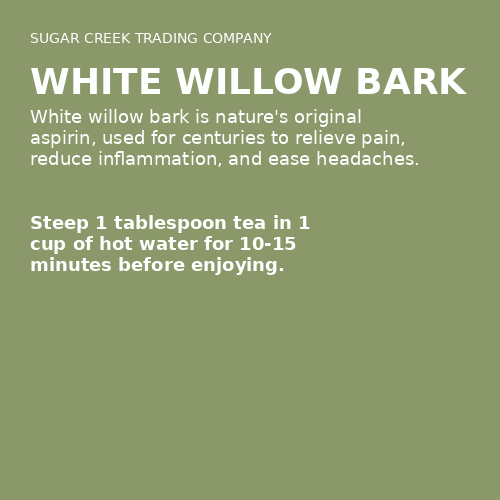
Sugar Creek Trading Company
White Willow Bark
White Willow Bark
Impossible de charger la disponibilité du service de retrait
SALIX ALBA
(White Willow, Willow Bark, European Willow)
Family: Salicaceae
Part Used: Inner bark (secondary phloem)
Energetics: Cooling, drying, dispersing
Taste: Bitter, astringent
BOTANICAL IDENTIFICATION
Scientific Name: Salix alba L.
Common Names: White Willow, Willow Bark, European Willow
Family: Salicaceae
Morphology:
Salix alba is a large, fast-growing deciduous tree reaching 10–30 meters (33–100 ft) in height. It develops a broad, rounded crown with gracefully drooping branches. The bark is gray-brown and becomes deeply fissured with age, while young twigs are slender, flexible, and yellow to olive-toned.
Leaves are narrow, lanceolate, finely serrated, and distinctly silvery-white on the underside, a defining feature that gives the tree its common name. Leaves emerge early in spring. Flowers appear as catkins, often before full leaf expansion, and the species is dioecious, with male and female catkins borne on separate trees. Seeds are minute and wind-dispersed, attached to fine cottony hairs.
Roots:
The root system is extensive, shallow, and water-seeking, enabling the tree to stabilize riverbanks and floodplains effectively.
HABITAT, RANGE, AND ADAPTATIONS
White Willow is native to Europe, western and central Asia, and North Africa, and has become widely naturalized throughout North America and other temperate regions.
It thrives in riparian zones, wetlands, floodplains, and moist lowlands, preferring nutrient-rich soils but tolerating clay and periodic flooding. Its rapid growth, flexible branches, and aggressive rooting strategy allow it to colonize unstable soils efficiently.
High salicylate content serves as a chemical defense against herbivory and microbial pressure, while its growth habit makes it a keystone species for erosion control and ecological restoration.
CULTIVATION AND ECOLOGY
White Willow is easily cultivated in moist environments and propagates readily from cuttings. Coppicing encourages vigorous regrowth and allows for sustainable bark harvest without killing the tree.
Ecologically, it plays a major role in erosion control, carbon sequestration, and riparian ecosystem stabilization. It provides early-season pollen for insects and serves as a host plant for numerous Lepidoptera species. Historically, willow has also been used in basketry, fencing, and land reclamation projects.
TRADITIONAL AND ETHNOBOTANICAL USE
White Willow is one of humanity’s oldest recorded medicinal trees, revered across cultures for its pain-relieving and fever-reducing properties.
Ancient Sumerian and Egyptian medical traditions used willow preparations for pain and inflammation. Hippocrates (5th century BCE) prescribed willow bark infusions for fever and childbirth pain, establishing its role in classical medicine.
Throughout traditional European herbalism, willow bark was a foundational remedy for rheumatism, gout, headaches, musculoskeletal pain, and febrile illnesses. Independently, many Native American tribes—including Cherokee, Iroquois, and Salish peoples—used various Salix species for pain, fever, sore throats, wounds, and inflammatory conditions, demonstrating convergent ethnobotanical knowledge.
In the 19th century, the isolation of salicin from Salix alba directly led to the synthesis of acetylsalicylic acid (aspirin), positioning White Willow as the botanical ancestor of one of modern medicine’s most widely used drugs.
Today, herbalists continue to employ White Willow Bark as a gentler, slower-acting alternative to aspirin, particularly suited for chronic inflammatory pain.
KEY BIOACTIVE COMPOUNDS AND BENEFITS
| Compound Class | Representative Compounds | Role in Plant | Human Benefits |
|---|---|---|---|
| Salicylates | Salicin, salicortin, tremulacin | Chemical defense against herbivory and microbial attack | Analgesic, antipyretic, anti-inflammatory |
| Flavonoids | Isosalipurposide, naringenin | UV protection and oxidative stress mitigation | Anti-inflammatory, antioxidant |
| Tannins | Catechins, proanthocyanidins | Tissue protection and pest deterrence | Astringent, tissue-toning |
| Phenolic acids | Caffeic acid, ferulic acid | Structural defense and oxidative buffering | Antioxidant, vascular protection |
| Polysaccharides | — | Energy storage and cellular signaling | Mild immunomodulatory support |
Unlike isolated aspirin, White Willow Bark contains multiple synergistic compounds, producing a slower onset of action with improved tolerability for many individuals.
HOW IT WORKS IN THE BODY
Pain and Inflammation:
Salicylates inhibit cyclooxygenase pathways, reducing prostaglandin synthesis and lowering pain, fever, and inflammation. The gradual metabolic conversion of salicin contributes to sustained relief rather than abrupt suppression.
Musculoskeletal and Rheumatic Effects:
Flavonoids and phenolic acids modulate inflammatory signaling in joints and connective tissues, making White Willow especially appropriate for chronic arthritis, tendonitis, bursitis, and low back pain.
Fever and Systemic Heat:
The herb’s cooling energetics and antipyretic action reduce fever while allowing the immune response to proceed naturally.
ACTIONS AND INDICATIONS
White Willow Bark acts as an analgesic, antipyretic, anti-inflammatory, anti-rheumatic, and mild antimicrobial agent.
It is indicated for headaches, migraines, neuralgia, osteoarthritis, rheumatic disorders, low back pain, musculoskeletal injuries, fever, and select inflammatory conditions where a cooling, dispersive action is appropriate.
PREPARATIONS AND DOSAGE
| Form | Preparation | Suggested Dose | Notes |
|---|---|---|---|
| Decoction | 1–2 tsp dried bark per cup water, simmer 15–20 min | 1 cup, 2–3× daily | Traditional method; bitter |
| Tincture (1:5, 40–50%) | Dried bark | 2–4 mL up to 3× daily | Useful for chronic pain |
| Capsules / Extract | Standardized to 15–25% salicin | 240–480 mg daily | Comparable to low-dose aspirin |
| Topical use | Compress or liniment | Apply locally | For inflamed joints or muscles |
White Willow pairs well with Meadowsweet, Turmeric, Devil’s Claw, Ginger, and Elderflower, depending on the clinical context.
SAFETY, CONTRAINDICATIONS, AND TOXICITY
White Willow should be avoided in individuals with aspirin or salicylate allergy and is contraindicated in children with viral illness due to the risk of Reye’s syndrome. Use caution when combined with anticoagulants, NSAIDs, or bleeding disorders, and avoid during late pregnancy due to antiplatelet effects.
Gastrointestinal irritation is possible in sensitive individuals, though it occurs less frequently than with aspirin.
Toxicity:
Low when used appropriately. Excessive dosing may result in nausea, tinnitus, or dizziness.
HARVEST AND PROCESSING
Bark is harvested in early spring from young branches (2–5 years old). Only small sections should be removed to prevent harm. Bark is dried quickly in thin strips at low heat (<120°F / 49°C) and stored airtight. Properly stored bark retains potency for 2–3 years.
SUSTAINABILITY AND CONSERVATION
White Willow is abundant, fast-growing, and highly sustainable when harvested responsibly. Coppicing allows repeated harvest without tree loss.
Its cultivation supports riparian restoration, erosion control, carbon sequestration, and regenerative land management practices.
SUMMARY
Salix alba is the archetypal pain-relieving tree, offering one of humanity’s earliest and most enduring medicines. Cooling, bitter, and grounding, it quiets inflammation while respecting the body’s natural rhythms rather than overriding them.
As a whole-plant remedy, White Willow Bark reflects a balanced botanical intelligence—less aggressive than synthetic aspirin, yet profoundly effective. It stands as a living bridge between ancient ethnobotanical wisdom and modern pharmacology.
Share