Sugar Creek Trading Company
Wild Yam Root
Wild Yam Root
Impossible de charger la disponibilité du service de retrait
DIOSCOREA VILLOSA
(Wild Yam, Colic Root, Rheumatism Root)
Family: Dioscoreaceae
Part Used: Root (rhizome)
Energetics: Warming, moistening, relaxing
Taste: Bitter, slightly sweet, earthy
BOTANICAL IDENTIFICATION
Scientific Name: Dioscorea villosa L.
Common Names: Wild Yam, Colic Root, Rheumatism Root
Family: Dioscoreaceae
Morphology:
Dioscorea villosa is a perennial twining vine native to eastern North America. It produces slender, climbing stems that twine clockwise around supports and can reach 3–6 meters (10–20 ft) in length. Leaves are alternate, heart-shaped to ovate, with prominent parallel venation typical of monocots.
The plant is dioecious, bearing small greenish-yellow flowers in axillary clusters on separate male and female plants. Fruits are papery, three-winged capsules containing flat seeds.
Root system:
The medicinal portion is a thick, knobby rhizome with branching fibrous roots. The rhizome is rich in steroidal saponins and penetrates deeply into forest soils, allowing long-term survival and mineral access.
HABITAT, RANGE, AND ADAPTATIONS
Wild Yam is native to eastern and southeastern North America, ranging from southern Ontario and New England south to Florida and west to Texas.
It thrives in rich, moist woodlands, forest edges, and thickets, preferring partial shade and well-drained loamy soils. As a climbing vine, it uses surrounding vegetation for support rather than investing heavily in woody structure.
Steroidal saponins in the root function as chemical defenses against herbivores and soil pathogens, while the vine habit allows efficient access to sunlight in dense forest understories.
CULTIVATION AND ECOLOGY
Dioscorea villosa is slow-growing and requires several years to produce harvestable roots. It propagates primarily by seed or careful rhizome division.
Ecologically, Wild Yam contributes to woodland biodiversity and soil stability. However, due to overharvesting and habitat loss, wild populations have declined in parts of its range.
Cultivation and forest-farming practices are strongly encouraged to reduce pressure on wild stands.
TRADITIONAL AND ETHNOBOTANICAL USE
Wild Yam has a deep history of use among Native American tribes, including Cherokee, Catawba, and Seminole peoples.
Traditionally, the root was used for colic, intestinal cramping, menstrual pain, labor pains, and musculoskeletal spasms. It was regarded as a premier antispasmodic, especially where pain involved smooth muscle contraction.
In 19th-century Eclectic medicine, Dioscorea villosa became a cornerstone remedy for gallbladder pain, dysmenorrhea, irritable bowel conditions, and neuralgia. It earned the name “colic root” due to its reliability in severe abdominal pain.
A common misconception arose in the 20th century that Wild Yam converts to progesterone in the human body. While this is biochemically false, its steroidal saponins nonetheless exert significant antispasmodic and anti-inflammatory effects.
Modern herbalists continue to use Wild Yam for cramping, pain syndromes, and autonomic imbalance, not as a hormone replacement but as a neuromuscular relaxant.
KEY BIOACTIVE COMPOUNDS AND BENEFITS
| Compound Class | Representative Compounds | Role in Plant | Human Benefits |
|---|---|---|---|
| Steroidal saponins | Diosgenin, dioscin | Chemical defense against herbivores and pathogens | Antispasmodic, anti-inflammatory |
| Sapogenins | Diosgenin derivatives | Structural and metabolic defense | Smooth muscle relaxation |
| Alkaloids (trace) | — | Defensive signaling | Mild analgesic contribution |
| Tannins | Condensed tannins | Root tissue protection | Astringent, tissue-stabilizing |
| Starch & polysaccharides | Inulin-like polysaccharides | Energy storage | Demulcent, gut-soothing |
Diosgenin is the precursor used industrially to synthesize steroid hormones, though no such conversion occurs endogenously in humans.
HOW IT WORKS IN THE BODY
Antispasmodic Action:
Wild Yam relaxes smooth muscle tissue, reducing spasms in the gastrointestinal tract, biliary system, uterus, and urinary tract. This accounts for its effectiveness in colic, menstrual cramps, and gallbladder pain.
Pain Modulation:
By reducing spasm-driven ischemia and nerve irritation, Wild Yam indirectly reduces pain without suppressing normal nerve function.
Autonomic Nervous System Balance:
The root appears to modulate parasympathetic tone, making it especially useful in pain syndromes worsened by stress or autonomic dysregulation.
ACTIONS AND INDICATIONS
Dioscorea villosa functions as an antispasmodic, anti-inflammatory, analgesic, nervine relaxant, and digestive aid.
It is indicated for intestinal colic, irritable bowel patterns, gallbladder attacks, dysmenorrhea, labor pain (historical use), muscle cramping, neuralgia, and inflammatory pain involving smooth muscle contraction.
PREPARATIONS AND DOSAGE
| Form | Preparation | Suggested Dose | Notes |
|---|---|---|---|
| Decoction | 1 tsp dried root per cup water; simmer 20–30 min | 1 cup, up to 3× daily | Traditional form |
| Tincture (1:5, 60–70%) | Dried root | 2–5 mL, 2–3× daily | Preferred for acute pain |
| Capsules / Powder | Dried root powder | 500–1500 mg daily | Slower onset |
| External compress | Strong decoction | Apply warm | For abdominal or muscle pain |
Wild Yam pairs well with Cramp Bark, Black Cohosh, Valerian, and Wood Betony in spasm- and pain-focused formulas.
SAFETY, CONTRAINDICATIONS, AND TOXICITY
Wild Yam is generally safe at customary doses.
Large doses may cause nausea or gastrointestinal upset due to saponins. Use caution in individuals with severe liver disease due to bile-modulating effects.
Use during pregnancy should be guided by a skilled practitioner; while historically used in labor, unsupervised use is not advised.
No significant drug interactions are well documented.
General Toxicological Reference (LD₅₀)
-
Whole Dioscorea villosa extracts:
Acute oral toxicity studies in animals indicate low toxicity, with reported LD₅₀ values generally >2,000 mg/kg -
Isolated diosgenin:
Oral LD₅₀ values in rodents reported >1,000 mg/kg, indicating relatively low acute toxicity
Clinical relevance:
These values support Wild Yam’s reputation as a safe antispasmodic, suitable for repeated short-term use and cautious longer-term use under guidance.
HARVEST AND PROCESSING
Roots are harvested in late fall after aerial parts die back or in early spring before growth resumes. Rhizomes are sliced and dried at low heat (<110°F / 43°C).
Because the plant grows slowly, only a portion of the root should be taken when wild-harvesting.
SUSTAINABILITY AND CONSERVATION
Dioscorea villosa is listed by United Plant Savers as an At-Risk plant due to overharvesting and habitat loss.
Ethical use requires cultivated or forest-farmed sources, seed saving, and regenerative harvesting practices.
SUMMARY
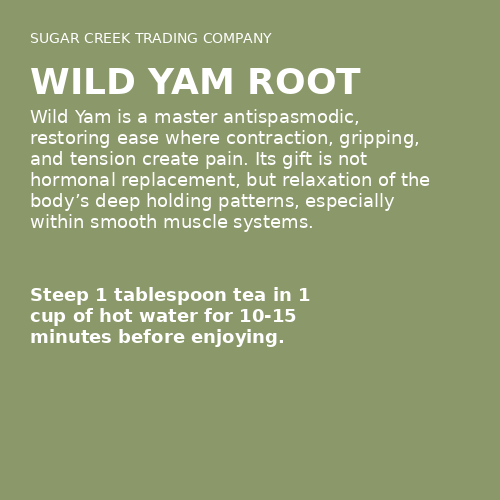
Wild Yam is a master antispasmodic, restoring ease where contraction, gripping, and tension create pain. Its gift is not hormonal replacement, but relaxation of the body’s deep holding patterns, especially within smooth muscle systems.
Grounded in Indigenous knowledge and refined through Eclectic medicine, Dioscorea villosa remains one of the most reliable allies for colic, cramps, and autonomic imbalance, offering relief without suppression.
Share