Sugar Creek Trading Company
Wood Betony
Wood Betony
Impossible de charger la disponibilité du service de retrait
STACHYS OFFICINALIS
(Wood Betony, Betony, Bishop’s Wort)
Family: Lamiaceae
Part Used: Aerial parts (leaves and flowering tops); root used historically
Energetics: Warming, drying, gently dispersing
Taste: Bitter, slightly astringent, aromatic
BOTANICAL IDENTIFICATION
Scientific Name: Stachys officinalis (L.) Trevis.
Synonym: Betonica officinalis L.
Common Names: Wood Betony, Betony, Bishop’s Wort
Family: Lamiaceae
Morphology:
Stachys officinalis is a perennial herbaceous plant reaching 30–60 cm (1–2 ft) in height. Stems are square, erect, and softly pubescent, characteristic of the mint family. Leaves are opposite, ovate to lanceolate, softly hairy, and borne on long petioles at the base, becoming smaller and sessile up the stem.
Flowers are deep pink to purplish, tubular, and arranged in dense terminal spikes. Blooming occurs from late spring through summer. The plant emits a subtle, earthy-aromatic scent rather than a strong minty fragrance.
Root system:
A fibrous perennial rootstock that allows regrowth year after year and moderate tolerance to disturbance.
HABITAT, RANGE, AND ADAPTATIONS
Wood Betony is native to Europe, western Asia, and North Africa, and has been introduced to parts of North America.
It thrives in woodland edges, hedgerows, meadows, and lightly shaded grasslands, preferring moderately moist, well-drained soils. It tolerates partial shade better than many Lamiaceae members.
Adaptations include bitter and aromatic compounds that deter herbivory and microbial attack, as well as pubescent leaves that reduce water loss and insect damage.
CULTIVATION AND ECOLOGY
Stachys officinalis is easy to cultivate and well-suited to herb gardens, woodland gardens, and meadow plantings. It prefers full sun to partial shade and moderate moisture.
Ecologically, Wood Betony supports pollinators, especially bees, and contributes to meadow biodiversity. It is non-invasive and compatible with regenerative and companion planting systems.
TRADITIONAL AND ETHNOBOTANICAL USE
Wood Betony was one of the most revered herbs of medieval Europe, often described as a panacea. A famous proverb stated that Betony could cure “forty-seven diseases.”
In classical and medieval European herbalism, Betony was used for headaches, nervous disorders, digestive complaints, anxiety, nightmares, and melancholy. It was considered a primary herb for disorders of the head, nerves, and spirit, bridging physical and psychological realms.
Monastic medicine valued Betony for protection against hysteria, possession, and fear, while folk traditions used it as a charm against evil and misfortune.
In later Western herbalism, Betony became known as a nervine tonic and bitter, useful for tension-related headaches, digestive weakness, and psychosomatic conditions where stress manifests physically.
Modern herbalists continue to use Wood Betony as a grounding nervine, particularly where anxiety, muscular tension, and digestive stagnation overlap.
KEY BIOACTIVE COMPOUNDS AND BENEFITS
| Compound Class | Representative Compounds | Role in Plant | Human Benefits |
|---|---|---|---|
| Iridoid glycosides | Harpagide, aucubin | Defense against herbivores and pathogens | Anti-inflammatory, nervine support |
| Phenylethanoid glycosides | Acteoside (verbascoside) | Antioxidant and microbial defense | Neuroprotective, anti-inflammatory |
| Flavonoids | Apigenin, luteolin | UV protection and oxidative buffering | Anxiolytic, antioxidant |
| Tannins | Condensed tannins | Tissue protection and pest deterrence | Astringent, toning |
| Volatile oils | Trace monoterpenes | Herbivore deterrence | Mild antispasmodic |
The presence of verbascoside links Betony pharmacologically to other nervine and anti-inflammatory herbs such as Lemon Balm and Skullcap.
HOW IT WORKS IN THE BODY
Nervous System:
Wood Betony acts as a mild nervine tonic, calming excess nervous tension without sedation. It is especially useful where stress produces muscular tightness, headaches, or digestive discomfort.
Digestive and Somatic Integration:
Bitter principles stimulate digestion, while flavonoids and iridoids modulate inflammatory signaling, making Betony effective in stress-induced digestive and musculoskeletal conditions.
Head and Circulatory Effects:
Traditionally regarded as a “head herb,” Betony improves circulation to the head and neck, easing tension headaches and mental fatigue.
ACTIONS AND INDICATIONS
Stachys officinalis functions as a nervine tonic, mild bitter, antispasmodic, anti-inflammatory, and grounding adaptogen-like herb.
It is indicated for tension headaches, anxiety with somatic symptoms, digestive upset linked to stress, nervous exhaustion, muscle tightness, mild depression, insomnia related to overthinking, and psychosomatic pain patterns.
PREPARATIONS AND DOSAGE
| Form | Preparation | Suggested Dose | Notes |
|---|---|---|---|
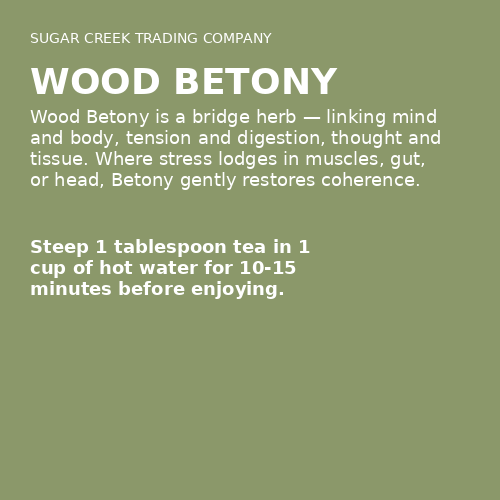
| Infusion | 1–2 tsp dried herb per cup hot water; steep 10–15 min | 1 cup, up to 3× daily | Gentle daily nervine |
| Tincture (1:5, 40–60%) | Fresh or dried aerial parts | 2–4 mL, 2–3× daily | Most common modern form |
| Powder | Encapsulated herb | 500–1000 mg daily | Mild, cumulative |
| External compress | Strong infusion | Apply externally | For tension and inflammation |
Wood Betony pairs well with Skullcap, Lemon Balm, Passionflower, and Milky Oat in nervous system formulas, and with Yarrow for tension-related headaches.
SAFETY, CONTRAINDICATIONS, AND TOXICITY
Wood Betony is considered very safe at customary doses.
Large amounts may cause mild gastrointestinal upset due to bitter content. Historically, excessive use of the root was considered overly stimulating, though this is rarely used today.
Use caution during pregnancy due to limited modern safety data, though historical use suggests low risk.
No significant drug interactions are documented.
General Toxicological Reference (LD₅₀)
-
Whole Stachys officinalis extracts:
Acute toxicity studies indicate very low toxicity, with oral LD₅₀ values in animal models generally reported as >2,000 mg/kg
Clinical relevance:
This wide safety margin supports Betony’s reputation as a gentle, long-term tonic rather than an acute intervention herb.
HARVEST AND PROCESSING
Aerial parts are harvested during early to full flowering, when flavonoid and iridoid content is highest. Material is dried in shade with good airflow and stored airtight.
Properly dried herb retains potency for 1–2 years.
SUSTAINABILITY AND CONSERVATION
Stachys officinalis is not threatened and is easily cultivated. Ethical harvesting involves cutting only upper portions and allowing plants to regenerate.
Its compatibility with pollinators and meadow systems makes it an excellent choice for regenerative and biodiversity-focused plantings.
SUMMARY
Wood Betony is a bridge herb — linking mind and body, tension and digestion, thought and tissue. Where stress lodges in muscles, gut, or head, Betony gently restores coherence.
Once hailed as a cure-all, its true gift lies not in force but in integration. Stachys officinalis remains one of Western herbalism’s finest allies for grounding the nervous system and reuniting scattered energies into functional wholeness.
Share