Sugar Creek Trading Company
African Bird Hot Pepper 150 000 Hu
African Bird Hot Pepper 150 000 Hu
Impossibile caricare la disponibilità di ritiro
CAPSICUM ANNUUM / CAPSICUM FRUTESCENS
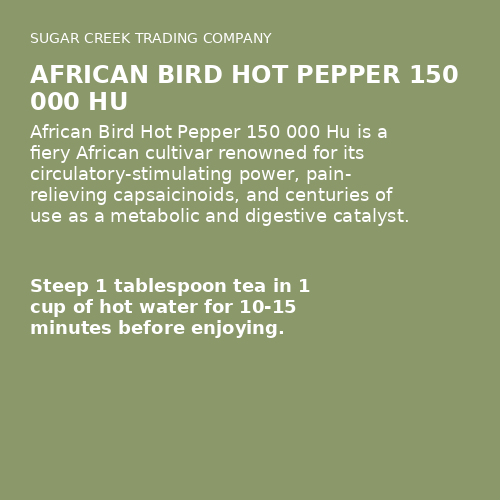
Fiery African cultivar renowned for its circulatory-stimulating power, pain-relieving capsaicinoids, and centuries of use as a metabolic and digestive catalyst.
BOTANICAL IDENTIFICATION
Scientific Name: Capsicum annuum L. / Capsicum frutescens L.
Common Names: African bird pepper, African bird's eye chili, peri-peri, pili-pili, bird chili, bird's eye pepper, small African cayenne
Family: Solanaceae (Nightshade family)
Capsicum annuum and Capsicum frutescens are closely related species often grouped together under the common name African bird pepper. The plants are small, erect, woody-stemmed perennials (grown as annuals in temperate climates) that reach 0.5 to 1.5 meters in height. They bear small, tapered fruits typically 2 to 4 centimeters long that ripen from green through yellow and orange to a vivid red, pointing upward on the branch. The small fruit size and upright orientation evolved specifically to attract birds, which are immune to capsaicin and serve as the primary seed dispersers.
African bird pepper thrives in tropical and subtropical climates across sub-Saharan Africa, where it has been cultivated for centuries. It is especially prominent in West African, East African, and Southern African cuisines and pharmacopeias. The plant favors well-drained soils, full sun, and warm temperatures, and produces prolifically throughout the growing season. Heat levels in these cultivars typically range from 90,000 to 350,000 Scoville Heat Units (SHU), placing them among the hotter varieties of culinary peppers.
CULTURAL AND HISTORICAL USE
Capsicum peppers originated in the Americas and were introduced to Africa by Portuguese traders in the 15th and 16th centuries, where they rapidly integrated into local agricultural systems and cultural practices. African bird pepper became so thoroughly adopted across the continent that many communities consider it a native plant. In West African traditional medicine, bird pepper is used extensively as a circulatory stimulant, digestive aid, and fever-reducing agent. Yoruba healers in Nigeria employ it in preparations for colds, rheumatic pain, and toothache, often combining it with shea butter for topical application. In Ghana and Senegal, hot pepper infusions are administered for intestinal parasites and sluggish digestion.
In Western herbalism, cayenne and bird pepper have held a central place since the physiomedicalist and Thomsonian traditions of the 19th century. Samuel Thomson regarded cayenne as one of the most important medicines in his entire system, calling it the purest stimulant known. The Eclectic physicians adopted it for cardiovascular support, internal hemorrhage, and as a synergistic catalyst added to other herbal formulas to improve their absorption and effectiveness. Dr. John Christopher, the influential 20th-century American herbalist, considered cayenne the most useful herb in the entire materia medica and recommended it for heart emergencies, shock, and circulatory insufficiency.
In Ayurvedic medicine, hot peppers are classified as having a pungent taste (katu rasa) and a heating energy (ushna virya). They are used to kindle digestive fire (agni), reduce kapha and ama (metabolic waste), and stimulate sluggish circulation. African bird pepper fits squarely within these therapeutic categories and is used similarly across multiple global herbal traditions.
KEY BIOACTIVE COMPOUNDS & BENEFITS
| Compound/Class | Location in Plant | Human Benefit | Role in Plant |
|---|---|---|---|
| Capsaicin (8-methyl-N-vanillyl-6-nonenamide) | Placental tissue and septa of fruit | Pain relief via TRPV1 receptor desensitization; circulatory stimulation; thermogenic metabolism | Mammalian deterrent to protect seeds while allowing bird dispersal |
| Dihydrocapsaicin | Placental tissue of fruit | Analgesic and anti-inflammatory effects similar to capsaicin | Secondary mammalian deterrent compound |
| Carotenoids (capsanthin, capsorubin, beta-carotene) | Fruit flesh and skin | Antioxidant protection; supports eye health and immune function | Fruit pigmentation for avian attraction; photoprotection |
| Ascorbic acid (vitamin C) | Fruit flesh | Immune support; collagen synthesis; antioxidant synergy | Antioxidant defense and enzymatic cofactor |
| Flavonoids (quercetin, luteolin) | Fruit skin and leaves | Anti-inflammatory and antioxidant support; cardiovascular protection | UV protection and pathogen defense |
The therapeutic potency of African bird pepper is determined primarily by its capsaicinoid concentration, measured in Scoville Heat Units (SHU). Higher SHU varieties deliver more intense circulatory stimulation and analgesic effects per unit weight, while also requiring more careful dosing. The interplay between capsaicin's receptor-mediated pain modulation and the fruit's antioxidant carotenoids and vitamin C creates a botanical profile that is simultaneously stimulating and protective.
HOW IT WORKS IN THE BODY
African bird pepper exerts its effects through direct receptor activation, neurochemical signaling, and broad metabolic stimulation.
Pain and Inflammation (TRPV1 Pathway):
Capsaicin binds to the transient receptor potential vanilloid 1 (TRPV1) receptor on sensory neurons, initially triggering a sensation of burning heat. With repeated or sustained exposure, the receptor becomes desensitized and substance P (a key pain neurotransmitter) is depleted from nerve endings, resulting in significant analgesic effects. This mechanism underlies the widespread use of capsaicin in topical pain creams for arthritis, neuropathy, and musculoskeletal pain.
Circulatory Stimulation:
Capsaicin promotes vasodilation through the release of nitric oxide and calcitonin gene-related peptide (CGRP), increasing blood flow to peripheral tissues. This is why consuming bird pepper produces a warming sensation throughout the body and why herbalists use it to enhance the delivery of other herbs to target tissues. It also supports healthy blood pressure by relaxing vascular smooth muscle.
Metabolic and Thermogenic Effects:
Capsaicin activates brown adipose tissue and increases energy expenditure through diet-induced thermogenesis. Studies show that capsaicin consumption temporarily raises metabolic rate by 8 to 20 percent for several hours after ingestion. It also promotes the oxidation of fat stores and can reduce appetite through effects on satiety hormones including GLP-1.
Digestive Support:
Contrary to popular belief, capsaicin in moderate doses protects the gastric mucosa rather than damaging it. It stimulates mucus and bicarbonate secretion in the stomach lining, increases gastric blood flow, and enhances the production of digestive enzymes. It also inhibits the growth of Helicobacter pylori, the bacterium associated with peptic ulcers.
DOSE GUIDELINES
| Preparation Type | Typical Dose | Purpose |
|---|---|---|
| Dried powder (in food or capsules) | 250 to 1,000 mg, 1 to 3 times daily | Circulatory stimulation, digestive support, metabolic boost |
| Warm infusion | 1/4 to 1/2 teaspoon powder in 8 oz hot water | Acute cold and flu support, warming tonic |
| Tincture (1:5 in 90% alcohol) | 5 to 20 drops in water, 1 to 3 times daily | Circulatory catalyst, formula enhancer, acute cardiovascular support |
| Topical poultice or oil infusion | Applied externally as needed | Localized pain relief, joint and muscle support |
Start with small doses and increase gradually. Higher-SHU varieties such as the 150,000 HU grade require proportionally smaller amounts to achieve the same effects as milder cultivars. Taking capsules with food or coating them in enteric capsules can reduce initial gastric discomfort for sensitive individuals. Cayenne and bird pepper can be used both acutely for immediate circulatory stimulation and as a long-term daily tonic for cardiovascular maintenance.
PREPARATION AND USES
African bird pepper powder is extraordinarily versatile. The most straightforward preparation is simply adding the dried powder to food -- soups, stews, sauces, curries, and marinades all benefit from its heat and its health-promoting properties. For therapeutic purposes, a popular method is the cayenne lemonade tonic: combine 1/4 teaspoon bird pepper powder with fresh lemon juice, a small amount of honey or maple syrup, and warm water. This preparation is widely used in herbalism for cold and flu onset, circulatory sluggishness, and morning vitality.
For topical applications, infuse bird pepper powder into a carrier oil (olive, coconut, or sesame) at a ratio of approximately 1 tablespoon per cup of oil, warming gently for 1 to 2 hours. Strain thoroughly and apply to sore joints, stiff muscles, or areas of poor circulation. Always wash hands thoroughly after handling and avoid contact with eyes and mucous membranes. Tinctures made with high-proof alcohol extract the capsaicinoids efficiently and can be added drop by drop to other herbal formulas as a circulatory catalyst, a technique that herbalists call using cayenne as a "driver" herb.
OPTIMAL CONTEXT FOR USE
This herb is especially well-suited for individuals experiencing:
Poor peripheral circulation, cold hands and feet, or Raynaud's-type symptoms
Chronic pain conditions including arthritis, neuropathy, fibromyalgia, and musculoskeletal tension
Sluggish digestion, low appetite, or slow metabolic function
Frequent colds and respiratory congestion, particularly with chills, pallor, and cold constitution
Cardiovascular support needs including blood pressure regulation and healthy cholesterol maintenance
African bird pepper combines synergistically with ginger for warming digestive support, with turmeric for enhanced anti-inflammatory effects (capsaicin increases curcumin bioavailability by up to 2,000 percent), and with hawthorn berry for comprehensive cardiovascular toning.
SUSTAINABILITY AND ETHICAL HARVESTING
Capsicum annuum and Capsicum frutescens are widely cultivated annual crops with no conservation concerns. African bird pepper is grown extensively by smallholder farmers across sub-Saharan Africa, where it provides important income for rural communities. The plants are prolific producers, with a single plant capable of yielding hundreds of small fruits over a growing season, making them an efficient and sustainable crop.
Supporting suppliers who source directly from African farming cooperatives helps ensure equitable pricing for the growers who cultivate these peppers. Bird pepper cultivation requires minimal inputs compared to many commercial crops, growing well without synthetic fertilizers or pesticides in its native tropical environments, making it well-suited to organic and sustainable farming practices.
SAFETY AND CAUTIONS
African bird pepper is generally recognized as safe when used in culinary and moderate supplemental amounts. However, its high capsaicinoid content demands respect and mindful dosing.
Gastric sensitivity: Individuals with active gastric ulcers, severe GERD, or inflammatory bowel conditions should begin with very small doses or avoid internal use during acute flare-ups. While capsaicin is gastroprotective in moderate doses, excessive amounts can irritate inflamed tissues.
Skin and mucous membrane contact: Avoid touching eyes, open wounds, or sensitive skin after handling bird pepper. Wash hands thoroughly with soap or use gloves when preparing topical applications.
Drug interactions: Capsaicin may increase the absorption of certain medications including theophylline and ACE inhibitors. It may also potentiate the effects of anticoagulant and antiplatelet medications. Consult a healthcare provider if taking blood-thinning drugs.
Pregnancy and nursing: Moderate culinary use is generally considered safe during pregnancy. However, high-dose supplemental use is not recommended due to potential gastrointestinal stimulation. Capsaicin can pass into breast milk and may cause discomfort for nursing infants.
REFERENCES
Sharma, S. K., Vij, A. S., and Sharma, M. "Mechanisms and clinical uses of capsaicin." European Journal of Pharmacology, 720(1-3), 2013, pp. 55-62.
Whiting, S., Derbyshire, E., and Tiwari, B. K. "Capsaicinoids and capsinoids: A potential role for weight management? A systematic review of the evidence." Appetite, 59(2), 2012, pp. 341-348.
Felter, H. W. and Lloyd, J. U. King's American Dispensatory, 18th ed., 1898. [Capsicum monograph]
Tewksbury, J. J., and Nabhan, G. P. "Directed deterrence by capsaicin in chillies." Nature, 412(6845), 2001, pp. 403-404.
FINAL NOTE
African bird pepper is one of the most immediate and visceral medicines in the herbal kingdom. Its heat is not mere sensation but a direct physiological event -- blood vessels dilating, nerve receptors activating, metabolism accelerating. Whether used as a daily circulatory tonic, an acute cold-season ally, or a topical pain reliever, this small but formidable fruit has earned its central place in herbalism across every continent it has reached. Respect its intensity, start low, and let it teach you the power of fire as medicine.
Condividere