Sugar Creek Trading Company
Arame Seaweed Sun
Arame Seaweed Sun
Impossibile caricare la disponibilità di ritiro
EISENIA BICYCLIS
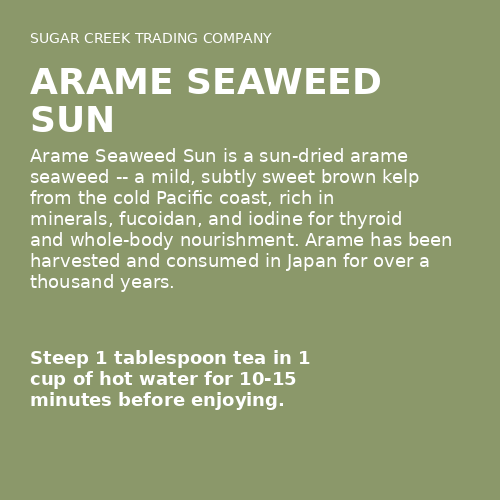
Sun-dried arame seaweed -- a mild, subtly sweet brown kelp from the cold Pacific coast, rich in minerals, fucoidan, and iodine for thyroid and whole-body nourishment.
BOTANICAL IDENTIFICATION
Scientific Name: Eisenia bicyclis (Kjellman) Setchell
Common Names: Arame, sea oak, Eisenia kelp
Family: Lessoniaceae (order Laminariales, brown algae / Phaeophyceae)
Arame is a species of large brown kelp that grows in dense underwater forests attached to rocky substrates in the cold, nutrient-rich waters of the northwestern Pacific Ocean. The thallus (body) consists of a holdfast anchoring it to rock, a short stipe (stem), and broad, deeply divided fronds that branch dichotomously, resembling the shape of a spreading oak tree -- hence the common name "sea oak." Mature plants can reach 1 to 2 meters in length. The fronds are leathery and dark olive-brown when living, turning nearly black when dried.
Arame thrives in the intertidal and shallow subtidal zones along the coasts of Japan and Korea, particularly around the Ise-Shima peninsula of central Japan, which has been the center of arame harvesting for centuries. It prefers cold, well-oxygenated water with strong wave action and rocky coastline, conditions that concentrate the mineral density and bioactive compound production within the plant tissue.
CULTURAL AND HISTORICAL USE
Arame has been harvested and consumed in Japan for over a thousand years. Archaeological evidence from coastal Jomon-period settlements suggests that seaweeds including brown kelps were a significant food source in prehistoric Japan. Written records from the Nara period (8th century CE) document seaweed as both a food and a tribute item offered to the imperial court. Arame specifically has been a dietary staple in the Ise-Shima region, where specialized harvesting families (known as ama divers and coastal fishing communities) developed traditional methods for gathering, processing, and sun-drying the kelp.
In Japanese cuisine, arame is traditionally prepared by soaking the dried fronds in water for five to ten minutes to rehydrate, then sauteing or simmering with soy sauce, mirin, sesame oil, and other seasonings. It appears in classic dishes alongside tofu, root vegetables, and rice. Its mild, slightly sweet flavor makes it one of the most approachable sea vegetables for people unfamiliar with seaweed, lacking the strong ocean taste of some other kelps like kombu or hijiki.
In the macrobiotic dietary movement that gained international popularity in the mid-20th century through the work of George Ohsawa and Michio Kushi, arame was promoted as a key food for mineral balance, thyroid health, and alkalizing the body. Macrobiotic practitioners recommended regular consumption of sea vegetables including arame as an essential component of a balanced whole-foods diet, and this tradition brought arame to the attention of health-conscious consumers in North America and Europe. Today, arame is widely available in natural food stores and is used by raw food enthusiasts, macrobiotic practitioners, and anyone seeking to increase their dietary mineral intake from whole-food sources.
KEY BIOACTIVE COMPOUNDS & BENEFITS
| Compound/Class | Location in Plant | Human Benefit | Role in Plant |
|---|---|---|---|
| Fucoidan (sulfated polysaccharide) | Cell wall matrix | Immune modulation, anti-inflammatory activity, supports healthy cell signaling | Structural protection against desiccation and microbial attack |
| Alginic acid (alginate) | Cell wall and intercellular matrix | Binds heavy metals and toxins in the GI tract, supports detoxification | Provides flexible structural support in wave-battered environments |
| Iodine | Concentrated throughout thallus | Essential for thyroid hormone synthesis (T3 and T4), metabolic regulation | Accumulated from seawater; role in algal halogen metabolism |
| Fucoxanthin (carotenoid pigment) | Chloroplasts | Antioxidant, supports healthy metabolism and body composition | Accessory photosynthetic pigment capturing blue-green light at depth |
| Minerals (Ca, Mg, Fe, K, Zn, Mn) | Concentrated throughout thallus | Broad mineral supplementation supporting bones, muscles, blood, and enzymes | Absorbed from mineral-rich seawater for enzymatic and structural functions |
Arame's exceptional mineral density reflects its ability to bioconcentrate dissolved minerals from seawater by factors of hundreds to thousands. A single serving of rehydrated arame provides meaningful amounts of calcium (comparable to dairy), iron (more per calorie than red meat), magnesium, potassium, and trace minerals including zinc, manganese, and selenium. The fucoidan and fucoxanthin content place arame among the most bioactive of the edible seaweeds, with a growing body of research supporting their roles in immune health and metabolic function.
HOW IT WORKS IN THE BODY
Arame's bioactive compounds engage multiple physiological systems through distinct mechanisms:
Thyroid and Metabolic Regulation:
Iodine from arame is absorbed in the gastrointestinal tract and actively transported to the thyroid gland via the sodium-iodide symporter. The thyroid uses iodine to synthesize thyroxine (T4) and triiodothyronine (T3), the hormones that regulate basal metabolic rate, body temperature, protein synthesis, and the rate of energy utilization in every cell. Mild iodine insufficiency is common even in developed countries, particularly among individuals who do not consume iodized salt or seafood regularly. Sea vegetables like arame offer a whole-food source of bioavailable iodine.
Immune Modulation and Anti-Inflammatory Activity:
Fucoidan, the sulfated polysaccharide unique to brown algae, has demonstrated immunomodulatory effects in numerous in vitro and animal studies. It enhances the activity of natural killer (NK) cells and macrophages while modulating the production of inflammatory cytokines. Research published in Marine Drugs and other journals has shown that fucoidan can inhibit NF-kB activation and reduce the expression of COX-2 and iNOS, two key enzymes in the inflammatory response.
Heavy Metal Binding and Detoxification:
Alginic acid (alginate) in arame has a well-documented ability to bind heavy metals -- particularly lead, mercury, cadmium, and radioactive strontium -- in the gastrointestinal tract, forming insoluble alginates that are excreted in the feces rather than absorbed. This was studied extensively after nuclear testing and the Chernobyl incident, when sodium alginate was administered to reduce absorption of radioactive isotopes. For individuals concerned about environmental heavy metal exposure, regular consumption of alginate-rich seaweeds offers a passive, food-based chelation support.
Antioxidant and Metabolic Support:
Fucoxanthin, the golden-brown carotenoid pigment responsible for arame's color, has shown in research studies an ability to promote thermogenesis in white adipose tissue by upregulating uncoupling protein 1 (UCP1), supporting healthy body composition. It also acts as a potent antioxidant with particular affinity for quenching singlet oxygen and scavenging peroxyl radicals in cell membranes.
DOSE GUIDELINES
| Preparation Type | Typical Dose | Purpose |
|---|---|---|
| Rehydrated arame (culinary) | 1/4 to 1/2 cup dry (approximately 7-15 grams) per serving, rehydrated | Daily mineral and iodine supplementation through food |
| Added to soups and stews | 1-2 tablespoons dry, added directly to cooking liquid | Mineral enrichment of prepared dishes |
| Sprinkled dry on foods | 1-2 teaspoons crumbled over salads, rice, or grain bowls | Light mineral supplementation and umami flavor |
Arame is mild enough for daily consumption as a food. For individuals not accustomed to sea vegetables, starting with small amounts (a tablespoon of dry arame a few times per week) allows the body to adjust to the increased iodine and mineral intake. Those with thyroid conditions should consult their healthcare provider regarding appropriate iodine intake levels, as both deficiency and excess can affect thyroid function.
PREPARATION AND USES
To prepare arame, place the desired amount of dried seaweed in a bowl and cover with room-temperature or warm water. Allow to soak for 5 to 10 minutes until the fronds soften and expand (they will roughly double in volume). Drain the soaking water (which can be used as mineral-rich plant water for houseplants or gardens) and the arame is ready for use.
The most traditional preparation is to saute the rehydrated arame in a small amount of sesame oil with soy sauce or tamari, often combined with thinly sliced carrots, onions, or lotus root. It can also be added to miso soup, grain bowls, stir-fries, noodle dishes, and salads. Arame pairs particularly well with tofu, rice, root vegetables, ginger, and sesame. For raw preparations, simply add the soaked arame to green salads, slaws, or spring rolls. Its mild, slightly sweet flavor blends seamlessly into a wide range of cuisines beyond Japanese cooking -- it works well in Mediterranean-style grain salads, Latin American bean bowls, and even Western-style pasta dishes where it adds umami depth and mineral richness without an overpowering seaweed taste.
OPTIMAL CONTEXT FOR USE
Arame seaweed is especially well-suited for individuals who:
Seek a whole-food source of bioavailable iodine to support healthy thyroid function, particularly those who do not regularly consume iodized salt or seafood
Want to increase their dietary intake of calcium, iron, magnesium, and trace minerals without dairy or meat
Are interested in the immune-modulating and anti-inflammatory properties of fucoidan and other brown algae polysaccharides
Follow macrobiotic, plant-based, vegan, or traditional Japanese dietary frameworks that emphasize sea vegetables
Are concerned about environmental toxin exposure and want to support the body's natural detoxification processes through alginate-rich foods
Arame integrates most effectively into a balanced, whole-food diet rich in vegetables, whole grains, legumes, and fermented foods, reflecting the traditional dietary context in which it has been consumed for centuries.
SUSTAINABILITY AND ETHICAL HARVESTING
Arame is wild-harvested from natural kelp forests along the rocky Pacific coastline, primarily in Japan. Traditional harvesting practices involve cutting the kelp above its holdfast and lower stipe, allowing the plant to regenerate. This method has been practiced sustainably for centuries by coastal communities who depend on the continued health of kelp forest ecosystems. Kelp forests are among the most productive and ecologically important marine ecosystems on Earth, supporting hundreds of species of fish, invertebrates, and marine mammals.
Sun-drying is the traditional preservation method for arame, requiring no fossil fuel inputs beyond transportation. The seaweed is spread on mats or racks in open air and dried by sunlight and ocean breezes, preserving its nutrient content while dramatically reducing weight and volume for storage and shipping. This product represents one of the lowest environmental-impact foods available: it requires no fresh water, no arable land, no fertilizer, and no pesticides to produce. Seaweeds also absorb dissolved carbon dioxide and release oxygen during photosynthesis, making kelp forests significant contributors to ocean carbon sequestration.
SAFETY AND CAUTIONS
Arame is generally recognized as a safe, edible seaweed with a long history of dietary use. However, the following cautions should be noted:
Iodine content: Arame contains significant iodine, though considerably less than kombu or kelp granules. Individuals with hyperthyroidism, Hashimoto's thyroiditis, or other thyroid conditions should consult their healthcare provider before adding sea vegetables to their diet, as excess iodine can exacerbate certain thyroid disorders.
Heavy metal considerations: All seaweeds bioaccumulate minerals from seawater, which can include trace amounts of arsenic, cadmium, and lead depending on water quality. Arame generally has lower heavy metal levels than hijiki (which is specifically flagged for inorganic arsenic). Purchasing from reputable suppliers who test for contaminants is recommended.
Blood-thinning medications: Fucoidan has demonstrated mild anticoagulant properties in some studies. Individuals on warfarin or other blood-thinning medications should be aware of this and consult their provider if consuming sea vegetables regularly in large amounts.
Pregnancy and nursing: Moderate dietary consumption of arame is generally considered safe during pregnancy, but excessive iodine intake should be avoided. Consult a healthcare provider for personalized guidance.
REFERENCES
Fitton, J. H., Stringer, D. N., & Karpiniec, S. S. (2015). "Therapies from Fucoidan: An Update." Marine Drugs, 13(9), 5920-5946.
Maeda, H., et al. (2005). "Fucoxanthin from edible seaweed, Undaria pinnatifida, shows antiobesity effect through UCP1 expression in white adipose tissue." Biochemical and Biophysical Research Communications, 332(2), 392-397.
Teas, J., et al. (2004). "Dietary seaweed (Laminaria) and mammary carcinogenesis in rats." Cancer Letters, 40(2), 121-131.
MacArtain, P., et al. (2007). "Nutritional value of edible seaweeds." Nutrition Reviews, 65(12), 535-543.
Nishizawa, K. (2002). "Seaweeds kaiso: Bountiful harvest from the seas." In Sustenance and Health from the Sea. Japan Seaweed Association.
FINAL NOTE
Arame is the ideal gateway sea vegetable -- mild enough to win over even dedicated seaweed skeptics, yet potent enough to deliver meaningful mineral nutrition, thyroid-supportive iodine, and the unique bioactive polysaccharides found only in brown marine algae. Its thousand-year history in Japanese coastal cuisine speaks to both its safety and its value, and its minimal environmental footprint makes it one of the most sustainable foods on Earth. For anyone looking to bring the mineral richness of the ocean into their daily diet, sun-dried arame is a remarkably simple and delicious place to start.
Condividere