Sugar Creek Trading Company
Arrowroot
Arrowroot
Impossibile caricare la disponibilità di ritiro
MARANTA ARUNDINACEA
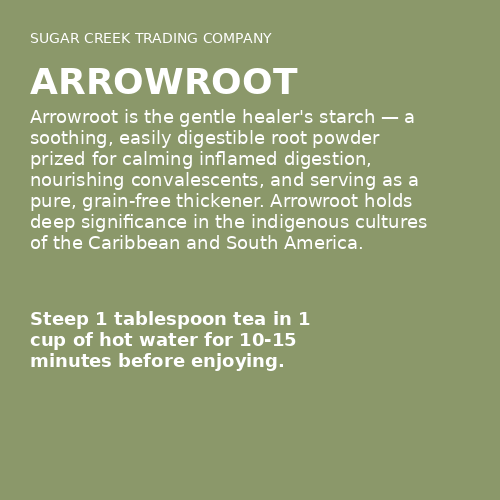
The gentle healer's starch — a soothing, easily digestible root powder prized for calming inflamed digestion, nourishing convalescents, and serving as a pure, grain-free thickener.
BOTANICAL IDENTIFICATION
Scientific Name: Maranta arundinacea L.
Common Names: Arrowroot, West Indian Arrowroot, Maranta, Obedience Plant, Bermuda Arrowroot, Araruta
Family: Marantaceae
Maranta arundinacea is a tropical perennial herb growing 60 to 120 centimeters tall from fleshy, cylindrical rhizomes covered in papery scales. The plant produces broad, ovate-lanceolate leaves on long petioles and small, white, asymmetrical flowers typical of the Marantaceae family. The starchy rhizomes are the commercially valuable part, harvested after 10 to 12 months of growth when starch content is at its peak.
Native to the tropical regions of Central and South America, particularly the rainforest zones of Brazil, Guyana, and the Caribbean islands, arrowroot is now cultivated throughout the tropics including Southeast Asia, Australia, East Africa, and the Pacific Islands. It thrives in warm, humid conditions with well-drained, fertile soil and partial shade, and is well-suited to understory cultivation in agroforestry systems.
CULTURAL AND HISTORICAL USE
Arrowroot holds deep significance in the indigenous cultures of the Caribbean and South America. The Arawak peoples, from whom the plant derives its common name (from the Arawak word "aru-aru" meaning "meal of meals"), cultivated arrowroot as a primary food source and prized it as a treatment for wounds inflicted by poisoned arrows — the rhizome poultice was applied to draw out toxins and promote healing. This traditional wound use gave rise to the English name "arrowroot," though the Arawak etymological origin is equally compelling.
European colonists quickly recognized arrowroot's value after encountering it in the Caribbean in the 17th century. By the 18th and 19th centuries, arrowroot starch had become a staple of the Victorian sickroom, prescribed by physicians as the ideal food for invalids, infants, and those recovering from illness. Its extreme ease of digestion — superior to any grain starch — made it the standard recommendation for patients with gastric inflammation, dysentery, and febrile illness. British colonial cultivation centers in St. Vincent, Bermuda, and India produced arrowroot starch for export to Europe, where it commanded premium prices.
In traditional Caribbean and South American herbal medicine, arrowroot has been used internally for diarrhea, stomach pain, intestinal inflammation, and urinary infections, and externally as a poultice for wounds, sores, insect bites, and snakebite. In Ayurvedic-influenced tropical medicine, arrowroot is considered cooling, light, and easily digestible — suitable for pacifying pitta conditions involving heat and inflammation in the digestive tract.
KEY BIOACTIVE COMPOUNDS & BENEFITS
| Compound/Class | Location in Plant | Human Benefit | Role in Plant |
|---|---|---|---|
| Starch (high-amylose, 20-25% of fresh rhizome) | Rhizome | Highly digestible; demulcent action soothes inflamed mucous membranes; gentle energy source | Energy storage for vegetative reproduction |
| Dietary Fiber (including resistant starch) | Rhizome | Prebiotic; supports beneficial gut bacteria; regulates bowel function | Structural component of rhizome tissue |
| Folate (Vitamin B9) | Rhizome | Supports cell division; critical for DNA synthesis; important in pregnancy | Coenzyme in plant metabolism |
| Potassium | Rhizome | Electrolyte balance; supports heart rhythm; aids rehydration during illness | Osmotic regulation and enzyme activation |
| Iron and B Vitamins | Rhizome | Support energy metabolism; contribute to recovery during convalescence | Enzymatic cofactors in plant growth |
Arrowroot's therapeutic profile is built on the exceptional quality of its starch rather than on potent phytochemicals. The starch granules of Maranta arundinacea are unusually small (5-40 micrometers), smooth, and easily gelatinized at low temperatures, which accounts for their superior digestibility compared to grain starches. The high amylose content creates a gentle, mucilaginous consistency when cooked that physically coats and soothes inflamed gastrointestinal tissue — a classic demulcent action. The presence of resistant starch fractions provides prebiotic benefit, feeding beneficial Bifidobacterium and Lactobacillus species in the colon.
HOW IT WORKS IN THE BODY
Arrowroot acts primarily in the gastrointestinal tract, where its demulcent starch provides both mechanical and nutritional support to compromised digestive tissue.
Demulcent and Mucosal Protection:
When arrowroot starch is mixed with warm water or milk, it forms a smooth, mucilaginous gel that coats the mucous membranes of the esophagus, stomach, and intestines. This physical barrier reduces contact between irritated tissue and gastric acid, digestive enzymes, and inflammatory bowel contents. This demulcent action provides symptomatic relief for gastritis, peptic irritation, colitis, and inflammatory bowel conditions. The effect is gentle and mechanical rather than pharmacological, making it safe for virtually all populations.
Digestive Ease and Convalescent Nutrition:
Arrowroot starch is among the most easily digested carbohydrate sources known. The small, uniform starch granules gelatinize completely at relatively low temperatures (around 70 degrees Celsius), breaking down rapidly under the action of salivary and pancreatic amylase. This makes arrowroot an ideal caloric source for individuals with impaired digestion — including those recovering from illness, surgery, food poisoning, or chemotherapy-induced nausea. It provides usable energy without taxing a weakened digestive system.
Prebiotic and Bowel-Regulating Effects:
The resistant starch fraction of arrowroot passes through the small intestine undigested and is fermented by colonic bacteria, producing short-chain fatty acids (SCFAs) — particularly butyrate — that nourish colonocytes and support a healthy intestinal environment. This prebiotic effect helps regulate bowel function in both diarrhea and constipation. Research published in the journal Digestion (2000) demonstrated that arrowroot powder significantly reduced diarrhea and abdominal pain in patients with irritable bowel syndrome (IBS).
Electrolyte Support During Illness:
Arrowroot's natural potassium content and easy digestibility make it a useful component of oral rehydration strategies during gastroenteritis and other fluid-depleting conditions, providing both calories and electrolytes in a form that is unlikely to provoke further nausea or vomiting.
DOSE GUIDELINES
| Preparation Type | Typical Dose | Purpose |
|---|---|---|
| Arrowroot gruel (demulcent drink) | 1-2 tablespoons powder stirred into 1 cup warm water or milk | Soothe digestive inflammation; convalescent nutrition |
| Digestive support | 1-3 tablespoons daily, mixed into food or beverages | IBS symptom management; prebiotic support |
| Infant/child food | 1-2 teaspoons cooked into porridge or added to formula (ages 6+ months, under pediatric guidance) | Easily digestible first food; diarrhea management |
| Topical poultice | Mix powder with water to form paste, apply to affected area | Soothe irritated skin, insect bites, minor rashes |
Arrowroot can be used daily as both a food and a gentle therapeutic agent. It is safe for long-term use and is appropriate for all ages, from infants (under appropriate guidance) to the elderly. For digestive complaints, consistency of use over several weeks yields the best results.
PREPARATION AND USES
The classic arrowroot preparation is a simple gruel or porridge: mix 1 to 2 tablespoons of arrowroot powder with a small amount of cold water to form a smooth slurry (this prevents lumping), then stir the slurry into a cup of hot water, milk, or broth. The mixture will thicken almost immediately into a smooth, translucent gel. Season with honey, cinnamon, vanilla, or a pinch of salt according to taste. This preparation was the standard sickroom food in Western medicine for over two centuries and remains an excellent choice for nausea, stomach upset, or recovery from illness.
In the kitchen, arrowroot powder is valued as a superior thickener for sauces, gravies, puddings, pie fillings, and glazes. It produces a clearer, more neutral-tasting thickening than cornstarch and does not break down in acidic liquids. It is grain-free, gluten-free, and paleo-friendly, making it essential for those with celiac disease or grain sensitivities. For topical use, arrowroot powder can be applied directly to skin as a natural body powder — it absorbs moisture without the concerns associated with talc — or mixed with water to form a soothing poultice for insect bites, rashes, and minor skin irritations.
OPTIMAL CONTEXT FOR USE
This herb is especially well-suited for individuals experiencing:
Gastritis, peptic irritation, acid reflux, or inflammatory bowel conditions seeking gentle mucosal protection
Diarrhea, IBS symptoms, or digestive distress requiring a soothing, binding food
Convalescence from illness, surgery, or medical treatments that impair appetite and digestion
Nausea during pregnancy, chemotherapy, or viral illness where bland nutrition is needed
Celiac disease, gluten intolerance, or grain allergies requiring a pure, grain-free starch alternative
Infant feeding transitions or childhood digestive upset (under pediatric guidance)
Arrowroot works best as part of a comprehensive approach to digestive healing that includes identifying and addressing root causes of inflammation, maintaining hydration, and gradually reintroducing a diverse diet as tolerated.
SUSTAINABILITY AND ETHICAL HARVESTING
Maranta arundinacea is widely cultivated throughout the tropics and is not threatened or endangered. It is a relatively low-input crop that grows well in shade, requires minimal fertilization, and can be intercropped with other tropical plants in agroforestry systems. Small-scale arrowroot cultivation supports rural livelihoods in the Caribbean — particularly St. Vincent, which remains the world's premier source of high-quality arrowroot starch — as well as in parts of Southeast Asia, India, and Australia.
The environmental footprint of arrowroot production is generally low compared to industrial corn or wheat starch production. Traditional processing involves simple washing, grating, and sun-drying of the rhizomes, though commercial operations may use more mechanized extraction. Supporting small-farm and cooperative-produced arrowroot helps maintain traditional agricultural knowledge and provides economic alternatives to monoculture commodity crops in tropical regions.
SAFETY AND CAUTIONS
Arrowroot is one of the safest botanical products available, with virtually no reported adverse effects in its long history of use as both food and medicine.
Allergies: Allergic reactions to arrowroot are extremely rare. It is naturally free of gluten, dairy, soy, corn, and all major allergens, making it suitable for highly restricted diets.
Drug interactions: No known drug interactions. Arrowroot's demulcent coating of the GI tract could theoretically slow absorption of simultaneously ingested medications — a general consideration for any demulcent substance. Take medications at least 30 minutes before consuming arrowroot as a precaution.
Pregnancy and nursing: Arrowroot is considered safe during pregnancy and lactation and has been traditionally used to ease pregnancy-related nausea and provide gentle nutrition during breastfeeding.
Blood sugar: As a pure starch, arrowroot can raise blood sugar. Individuals with diabetes should account for its carbohydrate content in their meal planning, though its glycemic impact is generally lower than refined grain starches due to its resistant starch content.
REFERENCES
Leach, H.W. (1965). "Gelatinization of starch." In Starch: Chemistry and Technology, Vol. 1, Academic Press, 289-307.
Cooke, R.D., & Maduagwu, E.N. (1978). "The effects of simple processing on the cyanide content of cassava chips." Journal of Food Technology, 13(4), 299-306.
Patel, B., et al. (2000). "Potato starch and arrowroot in irritable bowel syndrome." Digestion, 61(1), 32-36 (referenced study on arrowroot in IBS).
Morton, J.F. (1981). Atlas of Medicinal Plants of Middle America. Charles C. Thomas Publisher.
FINAL NOTE
Arrowroot embodies the principle that the gentlest remedies are sometimes the most valuable. In a world of potent phytochemicals and aggressive interventions, this humble tropical starch offers something irreplaceable — a truly soothing, universally tolerated food-medicine that has been nourishing the sick, calming inflamed digestion, and supporting recovery for centuries. Whether used as a healing gruel during illness or as a clean, grain-free kitchen staple, arrowroot deserves a permanent place in every household.
Condividere