Sugar Creek Trading Company
Bay Leaf
Bay Leaf
Impossibile caricare la disponibilità di ritiro
LAURUS NOBILIS
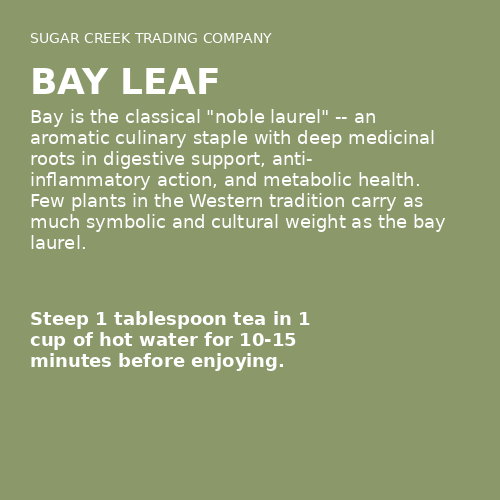
The classical "noble laurel" -- an aromatic culinary staple with deep medicinal roots in digestive support, anti-inflammatory action, and metabolic health.
BOTANICAL IDENTIFICATION
Scientific Name: Laurus nobilis L.
Common Names: Bay Leaf, Bay Laurel, Sweet Bay, True Laurel, Grecian Laurel, Noble Laurel
Family: Lauraceae (Laurel family)
Bay laurel is an aromatic evergreen tree or large shrub that can reach 10 to 18 meters in height in favorable conditions, though it is often maintained as a smaller specimen through pruning. The leaves are the primary harvest: leathery, glossy, dark green on the upper surface and paler beneath, elliptical to lanceolate in shape, 6 to 12 cm long, with smooth, slightly wavy margins. When crushed, they release a complex, warm, herbaceous aroma. The tree produces small, pale yellow-green flowers in spring, followed by dark purple to black drupes approximately 1 cm in diameter.
Native to the Mediterranean basin, bay laurel thrives in warm temperate and subtropical climates with mild, wet winters and dry summers. It grows naturally in coastal hillsides, maquis shrublands, and canyon bottoms from Portugal and Morocco east to Turkey and the Caucasus. It is widely cultivated worldwide as both a culinary herb and an ornamental, and can be grown in containers in cooler climates.
CULTURAL AND HISTORICAL USE
Few plants in the Western tradition carry as much symbolic and cultural weight as the bay laurel. In ancient Greece, the laurel was sacred to Apollo, god of healing, music, poetry, and prophecy. The Pythia, the oracle at Delphi, reportedly chewed bay leaves or inhaled their smoke before entering her prophetic trance. Victorious athletes at the Pythian Games were crowned with laurel wreaths, and the practice extended to Roman generals, emperors, and eventually poets -- giving us the enduring terms "laureate" and "baccalaureate" (from bacca lauri, "laurel berry"). The laurel wreath became the universal Western symbol of achievement and honor.
Beyond symbolism, bay leaf has been a cornerstone of Mediterranean medicine for over two millennia. Hippocrates prescribed bay leaf preparations for digestive complaints, and Dioscorides documented the leaf and berry oil in De Materia Medica (c. 70 CE) as warming, diuretic, and useful for chest complaints, ear infections, and joint pain. Galen classified bay leaf as warm and dry in the second degree, appropriate for conditions of cold and dampness. Throughout the medieval and Renaissance periods, bay leaf remained a pharmacy staple across Europe, North Africa, and the Near East, used in poultices, infused oils, and internal preparations for digestion, respiratory congestion, and rheumatic pain.
In Unani (Greco-Islamic) medicine, bay leaf (hab al-ghar or waraq al-ghar) continues to be prescribed for flatulence, hepatic congestion, and joint stiffness. In Indian folk medicine, bay leaves are used as a carminative and digestive aid, and are burned as a household fumigant believed to purify the air. Culinarily, bay leaf is arguably the most universal seasoning herb in the world, essential to French bouquet garni, Indian biryani, Filipino adobo, Turkish dolma, and countless stews, soups, sauces, and braises across virtually every global cuisine. Its flavor transforms through long cooking, releasing layers of warm, slightly floral, eucalyptus-like complexity that forms the backbone of innumerable dishes.
KEY BIOACTIVE COMPOUNDS & BENEFITS
| Compound/Class | Location in Plant | Human Benefit | Role in Plant |
|---|---|---|---|
| 1,8-Cineole (eucalyptol) | Leaves (major essential oil component, 30-50%) | Bronchodilatory, anti-inflammatory, mucolytic, analgesic | Herbivore deterrent; antimicrobial volatile defense |
| Eugenol | Leaves | Analgesic, anti-inflammatory, antimicrobial, antioxidant | Antimicrobial and insect-repellent volatile |
| Linalool | Leaves | Anxiolytic, sedative, anti-inflammatory | Pollinator attractant and antimicrobial agent |
| Parthenolide and costunolide (sesquiterpene lactones) | Leaves | Anti-inflammatory (NF-kB inhibition), potential anti-tumor activity | Chemical defense against herbivory |
| Polyphenols (flavonoids, phenolic acids) | Leaves | Antioxidant, cardioprotective, blood sugar-modulating | UV protection and oxidative stress defense |
Bay leaf's therapeutic complexity arises from the interplay between its volatile essential oil fraction -- dominated by 1,8-cineole, eugenol, and linalool -- and its non-volatile polyphenolic and sesquiterpene lactone content. The essential oils provide the immediate aromatic and respiratory benefits, while the lactones and polyphenols deliver deeper anti-inflammatory, metabolic, and antioxidant effects. This dual nature makes bay leaf both a flavor-building culinary herb and a genuinely medicinal plant.
HOW IT WORKS IN THE BODY
Bay leaf delivers its compounds through both the digestive tract (when consumed as food or tea) and the respiratory mucosa (when its aromatic vapors are inhaled during cooking or steam inhalation).
Digestive Support and Carminative Action:
The essential oil compounds in bay leaf stimulate the secretion of digestive enzymes and bile, improving the breakdown of food -- particularly fats and proteins. Eugenol and 1,8-cineole have antispasmodic effects on intestinal smooth muscle, helping to relieve cramping, bloating, and flatulence. Bay leaf's mild astringent tannins can help tone the intestinal lining, and its antimicrobial volatile oils help maintain a healthy gut microbial environment.
Anti-inflammatory Pathways:
The sesquiterpene lactones parthenolide and costunolide are potent inhibitors of the NF-kB signaling pathway, one of the master switches of the inflammatory cascade. By blocking NF-kB activation, these compounds reduce the production of pro-inflammatory cytokines, prostaglandins, and nitric oxide. This mechanism underlies bay leaf's traditional use for joint pain, rheumatic conditions, and inflammatory digestive complaints. The essential oil component 1,8-cineole adds additional anti-inflammatory activity through inhibition of cyclooxygenase-2 (COX-2) and lipoxygenase enzymes.
Blood Sugar and Metabolic Regulation:
Several clinical studies have demonstrated that daily consumption of bay leaves (1 to 3 grams per day) can reduce fasting blood glucose, total cholesterol, LDL cholesterol, and triglycerides in individuals with type 2 diabetes, while increasing HDL cholesterol. The mechanism appears to involve improved insulin receptor sensitivity and enhanced glucose uptake by cells, possibly mediated by the polyphenol content of the leaves.
Respiratory and Aromatherapeutic Effects:
When bay leaf vapors are inhaled -- whether from cooking, tea steam, or direct aromatherapy -- 1,8-cineole acts as a bronchodilator and mucolytic, helping to open airways and thin mucus. Linalool contributes calming, mildly anxiolytic effects. This combination makes bay leaf steam a traditional home remedy for colds, coughs, and sinus congestion.
DOSE GUIDELINES
| Preparation Type | Typical Dose | Purpose |
|---|---|---|
| Culinary use (whole leaves in cooking) | 1-3 leaves per dish, removed before serving | Digestive support, daily flavor and mild therapeutic benefit |
| Infusion (bay leaf tea) | 2-3 dried leaves steeped in 1 cup boiling water, covered, for 10-15 minutes; 1-3 cups daily | Digestive aid, blood sugar support, respiratory relief |
| Powdered leaf (capsules or added to food) | 1-3 grams daily, divided with meals | Metabolic support (blood sugar and lipids), consistent therapeutic dosing |
| Steam inhalation | 5-6 crushed leaves in a bowl of just-boiled water; inhale 5-10 minutes | Respiratory congestion, sinus relief, headache |
Bay leaf is well-suited to long-term daily use, particularly in culinary amounts. For therapeutic purposes such as blood sugar and lipid management, consistent daily intake of 1 to 3 grams of powdered leaf with meals over a period of 30 days or more has been shown to be effective in clinical studies. The leaves should always be removed from cooked dishes before eating, as the stiff, sharp-edged leaves do not soften sufficiently to be safely swallowed whole.
PREPARATION AND USES
The most familiar preparation of bay leaf is culinary: adding one to three whole dried leaves to soups, stews, braises, sauces, rice dishes, and bean pots during cooking. The long, slow heat extracts the essential oils and non-volatile compounds into the cooking liquid, imparting both flavor and therapeutic benefit. Bay leaf is a foundational component of bouquet garni (tied with thyme and parsley), garam masala and Indian spice tempering (tadka), and Mediterranean marinades.
For a therapeutic bay leaf tea, lightly crush two to three dried leaves to release the oils, place them in a cup, pour boiling water over them, and cover tightly. Steep for 10 to 15 minutes. The tea has a warm, mildly aromatic, slightly peppery flavor. It can be enhanced with a small amount of honey or combined with cinnamon, ginger, or lemon. For blood sugar support, some practitioners recommend steeping the leaves overnight in cold water for a gentle cold infusion. Bay leaves can also be ground to a powder in a spice grinder and encapsulated, added directly to food as a seasoning, or blended into spice mixes. Topically, bay leaf-infused oil (dried leaves macerated in olive oil for 2 to 4 weeks) has traditional use as a warming massage oil for joint and muscle pain.
OPTIMAL CONTEXT FOR USE
Bay leaf is especially well-suited for individuals experiencing:
Digestive discomfort including bloating, gas, cramping, or sluggish digestion after meals -- where bay leaf's carminative and bile-stimulating properties provide gentle, food-based relief
Elevated blood sugar or lipid levels, particularly in the context of type 2 diabetes or metabolic syndrome, as an adjunctive dietary strategy alongside medical care
Chronic low-grade inflammation or joint stiffness, where the NF-kB-inhibiting sesquiterpene lactones may provide cumulative benefit over time
Upper respiratory congestion, colds, or sinus pressure, where inhaling bay leaf steam offers a simple, drug-free approach to opening airways
A desire to integrate medicinal benefit into everyday cooking, making the kitchen itself a vehicle for health maintenance
Bay leaf combines naturally with other culinary-medicinal herbs and spices including turmeric, cinnamon, black pepper, ginger, thyme, rosemary, and oregano for comprehensive daily support.
SUSTAINABILITY AND ETHICAL HARVESTING
Bay laurel is widely cultivated throughout the Mediterranean region, California, and other warm-temperate zones, and is not considered threatened or at risk from commercial harvest. Turkey is the world's largest producer and exporter of bay leaves, with significant production also in Greece, Italy, Morocco, and the United States. The trees are long-lived, can be coppiced and pruned repeatedly, and produce abundant leaf harvests year after year. Many bay laurel trees are multi-generational family assets, tended for decades or even centuries.
Because bay laurel is a cultivated crop rather than a wild-harvested species, sustainability concerns are minimal. Organic and pesticide-free bay leaves are widely available. Consumers should look for whole, intact leaves with a strong aroma and a deep green color, as these indicate freshness and proper handling. Stale or faded leaves have lost much of their essential oil content and therapeutic value.
SAFETY AND CAUTIONS
Bay leaf is extremely safe when used in culinary and standard tea preparations. It has been consumed daily by millions of people for thousands of years without significant adverse effects.
Whole bay leaves should always be removed from dishes before eating. The leaves remain stiff even after prolonged cooking and can present a choking hazard or, rarely, cause injury to the esophagus or intestinal lining if swallowed whole.
Bay leaf may lower blood sugar. Individuals taking insulin or oral hypoglycemic medications should monitor blood glucose carefully if adding therapeutic doses (1-3 grams daily) of bay leaf to their regimen, and should inform their healthcare provider.
While rare, allergic contact dermatitis has been reported in individuals handling large quantities of fresh bay leaves, particularly in occupational settings. This is primarily associated with the essential oil component and is uncommon with dried leaf preparations.
Bay leaf in normal food amounts is considered safe during pregnancy and nursing. However, concentrated therapeutic doses (powdered leaf supplements or strong extracts) have not been well-studied in pregnancy, and standard precautionary guidance applies: consult a healthcare provider before using therapeutic doses during pregnancy or breastfeeding.
REFERENCES
Khan, A., et al. "Bay leaves improve glucose and lipid profile of people with type 2 diabetes." Journal of Clinical Biochemistry and Nutrition, 44(1): 52-56, 2009.
Patrakar, R., et al. "Phytochemical and pharmacological review on Laurus nobilis." International Journal of Pharmaceutical and Chemical Sciences, 1(4): 595-602, 2012.
Saab, A.M., et al. "Phytochemical analysis and cytotoxicity towards multidrug-resistant leukemia cells of essential oils derived from Lebanese medicinal plants." Planta Medica, 78(18): 1927-1931, 2012.
Fang, F., et al. "Anti-inflammatory sesquiterpene lactones from Laurus nobilis L." Phytochemistry Letters, 11: 59-63, 2015.
Dioscorides, P. De Materia Medica. c. 70 CE. (Classical Greek pharmacological text referencing Laurus nobilis.)
FINAL NOTE
Bay leaf is that rare botanical that stands equally at home in the kitchen and the apothecary, offering a seamless bridge between food and medicine that the ancient Mediterranean healers always understood. Its unassuming presence in the simmering pot belies a sophisticated phytochemical profile that modulates inflammation, supports metabolic health, and aids digestion with every meal. For those who believe that the best medicine is woven into the fabric of daily life, bay leaf is an indispensable ally -- noble in name, gentle in action, and profound in its cumulative effects.
Condividere