Sugar Creek Trading Company
Bayberry Root Bark
Bayberry Root Bark
Impossibile caricare la disponibilità di ritiro
MYRICA CERIFERA
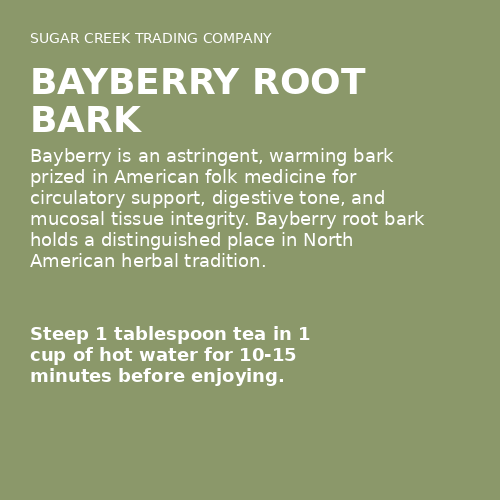
An astringent, warming bark prized in American folk medicine for circulatory support, digestive tone, and mucosal tissue integrity.
BOTANICAL IDENTIFICATION
Scientific Name: Myrica cerifera L.
Common Names: Bayberry, Southern Bayberry, Wax Myrtle, Candleberry, Tallow Shrub
Family: Myricaceae
Bayberry is a large evergreen or semi-evergreen shrub to small tree, typically reaching 3 to 12 meters in height. It bears narrow, oblanceolate leaves with a leathery texture and aromatic resin dots on their undersurface. Small, inconspicuous flowers appear in spring as catkins, followed by clusters of small, round, grayish-white drupes coated in a distinctive waxy layer that gives the plant its common name "wax myrtle."
Native to the eastern and southeastern United States, bayberry thrives in sandy soils, coastal plains, swamp margins, and pine barrens from New Jersey south to Florida and west to Texas. It is a nitrogen-fixing species, forming root nodule symbioses with Frankia bacteria, which allows it to colonize poor soils readily.
CULTURAL AND HISTORICAL USE
Bayberry root bark holds a distinguished place in North American herbal tradition. Indigenous peoples of the southeastern United States, including the Choctaw and Cherokee, used preparations of the root bark as a remedy for fevers, sore throats, and digestive complaints. The waxy berries were boiled to extract tallow for candle-making, a practice adopted widely by European colonists and considered essential to household economy in colonial America.
In the Thomsonian system of medicine developed by Samuel Thomson in the early 19th century, bayberry root bark was one of the most important remedies. Thomson regarded it as the premier astringent herb and included it in his famous "Composition Powder," a warming formula used to restore vitality and treat chills, colds, and sluggish digestion. The Eclectic physicians who followed continued to value bayberry for its tonic effects on mucous membranes throughout the body, prescribing it for chronic catarrh, leucorrhea, and bleeding gums.
Bayberry also found a place in early American folk magic and prosperity rituals. Burning bayberry candles at the New Year was believed to bring wealth and good fortune to the household, a tradition that persists in parts of New England and the Appalachian region to this day.
KEY BIOACTIVE COMPOUNDS & BENEFITS
| Compound/Class | Location in Plant | Human Benefit | Role in Plant |
|---|---|---|---|
| Myricitrin (flavonoid glycoside) | Root bark, leaves | Anti-inflammatory, antioxidant; supports vascular integrity and reduces capillary fragility | UV protection and defense against herbivory |
| Tannins (condensed and hydrolyzable) | Root bark | Powerful astringent action; tightens and tones mucous membranes, reduces secretions and bleeding | Deters herbivores and inhibits microbial infection of wounded tissue |
| Triterpenes (taraxerol, myricadiol) | Root bark, wax | Myricadiol has demonstrated mineralocorticoid-like activity, promoting sodium and chloride excretion while retaining potassium | Structural component of waxy cuticle; defense signaling |
| Volatile oils (including cineole) | Leaves, bark | Mild antimicrobial and warming stimulant properties; supports respiratory comfort | Aromatic defense against insects and pathogens |
| Gallic acid | Root bark | Antioxidant, antimicrobial; supports tissue repair and modulates inflammatory pathways | Phenolic defense compound against fungal and bacterial pathogens |
Taken together, bayberry root bark's chemistry produces a profile that is strongly astringent, mildly stimulating, and broadly antimicrobial. The high tannin content is responsible for its tissue-tightening effect on mucous membranes, while the triterpene myricadiol and the flavonoid myricitrin contribute anti-inflammatory and circulatory-supporting actions that extend its usefulness well beyond simple astringency.
HOW IT WORKS IN THE BODY
Bayberry root bark acts primarily through astringent toning of mucosal tissues and gentle stimulation of peripheral circulation.
Mucosal Tissue Integrity:
The condensed tannins in bayberry bark bind to proteins on the surface of mucous membranes, forming a protective layer that reduces inflammation, limits excessive secretion, and promotes tissue repair. This mechanism underlies the traditional use of bayberry for sore throats, bleeding gums, nasal congestion, and intestinal looseness.
Circulatory Stimulation:
Bayberry is classified as a "warming" herb in traditional Western herbalism. Its volatile oils and triterpene compounds gently stimulate peripheral blood flow, helping to resolve stagnation and support the delivery of immune cells and nutrients to affected tissues. This makes it particularly valuable during the onset of colds and chills.
Electrolyte and Fluid Balance:
The triterpene myricadiol has been studied for its effects on renal electrolyte handling. Research has shown it promotes sodium and chloride excretion while sparing potassium, a profile distinct from conventional diuretics. This action may contribute to the herb's traditional reputation for resolving edema and supporting healthy fluid balance.
Antimicrobial Activity:
Gallic acid, myricitrin, and the volatile oil fraction all contribute mild but broad-spectrum antimicrobial effects against both gram-positive and gram-negative bacteria, as well as certain fungi. This supports the topical and internal use of bayberry preparations for infections of the mouth, throat, and gastrointestinal tract.
DOSE GUIDELINES
| Preparation Type | Typical Dose | Purpose |
|---|---|---|
| Decoction (simmered tea) | 1-2 teaspoons dried root bark in 8 oz water, simmered 15-20 minutes; up to 3 cups daily | Digestive toning, circulatory support, cold onset |
| Powdered bark (capsules) | 500-1,000 mg, 2-3 times daily | General astringent and tonic support |
| Tincture (1:5, 60% alcohol) | 2-4 mL, 3 times daily | Convenient dosing for circulatory and digestive support |
| Gargle or mouthwash | Strong decoction (2 tsp per cup), cooled; gargle several times daily | Sore throat, bleeding gums, oral infections |
Bayberry root bark is best used in short-to-medium-term applications of 2 to 6 weeks. Because of its strong astringent nature, prolonged continuous use is not recommended. It is often most effective when combined with warming herbs such as ginger or cayenne in traditional formulas.
PREPARATION AND USES
As a hard, woody bark, bayberry root bark requires decoction rather than simple infusion. Simmer 1 to 2 teaspoons of the dried bark in one cup of water for 15 to 20 minutes, then strain. The resulting tea is strongly astringent with a somewhat bitter, warming character. Adding a small amount of honey or combining with peppermint can improve palatability.
For topical use, a strong decoction can be applied as a poultice or compress to slow-healing wounds, varicose veins, or hemorrhoids. As a gargle, bayberry decoction is one of the most effective herbal remedies for sore, inflamed, or bleeding gums. The powdered bark can also be incorporated into tooth powders. In capsule form, bayberry root bark is convenient for internal use targeting digestive or circulatory support.
OPTIMAL CONTEXT FOR USE
Bayberry root bark is especially well-suited for individuals experiencing:
Chronic loose stools, sluggish digestion, or intestinal laxity where astringent toning is needed
Recurrent sore throats, post-nasal drip, or excessive nasal and sinus congestion
Poor peripheral circulation, cold extremities, or a general feeling of chilliness
Bleeding or spongy gums, mouth ulcers, or other oral mucosal complaints
The onset of colds and flu, particularly when accompanied by chills and fatigue
Bayberry pairs well with other warming circulatory herbs such as ginger, cayenne, and cinnamon, and with complementary astringents like white oak bark and cranesbill root for more targeted mucosal support.
SUSTAINABILITY AND ETHICAL HARVESTING
Bayberry is abundant throughout its native range in the eastern and southeastern United States and is not currently listed as threatened or endangered. The species is ecologically resilient, colonizing disturbed soils and contributing to nitrogen fixation in poor-quality sites. Root bark harvesting does impact the plant more significantly than leaf or berry collection, so ethical practice involves harvesting from well-established stands, taking bark from lateral roots rather than the main taproot, and allowing populations adequate time to regenerate between harvests.
Cultivated bayberry is increasingly available from native plant nurseries, and wildcrafted material should ideally be sourced from harvesters who follow United Plant Savers guidelines for sustainable collection of native medicinal plants.
SAFETY AND CAUTIONS
Bayberry root bark is generally well tolerated when used in recommended doses for limited periods.
Gastrointestinal sensitivity: High tannin content may cause nausea or stomach upset in sensitive individuals, especially on an empty stomach. Start with a lower dose and take with food if needed.
Pregnancy and nursing: Bayberry root bark is not recommended during pregnancy due to its potential emmenagogue and mineralocorticoid-like effects. Nursing mothers should also avoid use without professional guidance.
Drug interactions: The tannins in bayberry can reduce absorption of certain medications, particularly iron supplements and alkaloid-based drugs. Separate dosing by at least two hours. Individuals on blood pressure medications or diuretics should consult a healthcare provider, as myricadiol's effects on sodium and potassium handling may interact with these drugs.
Long-term use: Extended continuous use (beyond 6 weeks) is not advisable due to the potential for high tannin intake to irritate the gastrointestinal lining over time. Cycle on and off as needed.
REFERENCES
Felter, H.W. & Lloyd, J.U. King's American Dispensatory, 18th ed. (1898). Ohio Valley Company. Monograph on Myrica cerifera.
Paul, B.D., et al. "Isolation of myricadiol, myricitrin, taraxerol, and taraxerone from Myrica cerifera L. root bark." Journal of Pharmaceutical Sciences, 63(6): 958-959 (1974).
Teucher, T. & Obertreis, B. "Pharmacological investigations of Myrica species: antimicrobial, anti-inflammatory, and astringent properties." Planta Medica, 58(Suppl 1): A680 (1992).
Moerman, D.E. Native American Ethnobotany. Timber Press (1998). Entries on Myrica cerifera.
Mills, S. & Bone, K. The Essential Guide to Herbal Safety. Churchill Livingstone (2005). Safety profile for bayberry.
FINAL NOTE
Bayberry root bark is one of the great unsung pillars of American herbalism, a warming astringent that restores tone and resilience to lax, congested tissues throughout the body. Its combination of tannin-driven astringency, circulatory stimulation, and gentle antimicrobial action makes it uniquely effective at the intersection of digestive, respiratory, and vascular support. Whether sipped as a decoction at the first sign of a cold or gargled to soothe inflamed gums, bayberry root bark delivers the kind of straightforward, dependable results that earned it a permanent place in the herbalist's apothecary.
Condividere