Sugar Creek Trading Company
Black Tea Uva Region Small
Black Tea Uva Region Small
Impossibile caricare la disponibilità di ritiro
CAMELLIA SINENSIS
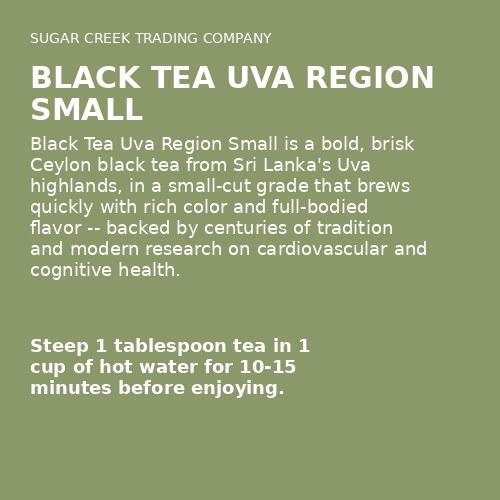
A bold, brisk Ceylon black tea from Sri Lanka's Uva highlands, in a small-cut grade that brews quickly with rich color and full-bodied flavor -- backed by centuries of tradition and modern research on cardiovascular and cognitive health.
BOTANICAL IDENTIFICATION
Scientific Name: Camellia sinensis (L.) Kuntze var. sinensis / var. assamica
Common Names: Black Tea, Ceylon Tea, Uva Tea, Tea Plant
Family: Theaceae (Tea family)
The tea plant is an evergreen shrub or small tree that can grow up to 15 meters tall if left unpruned, but is maintained at waist height in cultivation through regular plucking and pruning. Its leaves are alternate, elliptical, 5 to 12 centimeters long, with serrated margins and a glossy, leathery upper surface. The young growing tips -- the terminal bud and the first two leaves -- are the portions harvested for fine tea production. Small, white, fragrant flowers with yellow stamens appear in autumn but are typically not allowed to develop in commercial plantings, as flowering diverts energy from leaf production.
This tea is grown in the Uva Province of Sri Lanka's central highlands, at elevations typically between 900 and 1,500 meters. The Uva region is one of Sri Lanka's seven principal tea-growing districts, recognized for producing a style of black tea with a distinctive, assertive character driven by the region's unique dual-monsoon climate. The dry cachan wind that sweeps through the Uva hills between June and September creates a natural withering effect that intensifies flavor concentration in the leaf. This small-cut grade is produced through the CTC (Crush-Tear-Curl) or broken leaf process, yielding compact, uniform particles that brew rapidly with strong color, bold flavor, and excellent extraction efficiency.
CULTURAL AND HISTORICAL USE
Tea is arguably the most consumed medicinal plant in human history. The use of Camellia sinensis leaves as a beverage originated in southwestern China at least 3,000 years ago, initially as a medicinal preparation before evolving into the cultural cornerstone it is today. The earliest Chinese texts describing tea, including the Shennong Bencao Jing (attributed to the mythical emperor Shennong), credited it with clearing the mind, sharpening focus, aiding digestion, and dispelling fatigue. In Traditional Chinese Medicine, tea has been categorized as cooling and bitter, used to clear heat, resolve dampness, promote urination, and support the heart and spirit.
Black tea -- the fully oxidized form of Camellia sinensis -- developed in China's Fujian province around the 17th century. It was this oxidized, shelf-stable form that became the tea of global trade, fueling the colonial tea economies of India, Sri Lanka, and East Africa. Sri Lanka's tea industry began in the 1860s after a devastating coffee rust epidemic destroyed the island's coffee plantations. Scottish planter James Taylor established the first commercial tea estate in 1867 in Kandy, and within decades, Ceylon tea had become synonymous with quality black tea worldwide. The Uva region emerged as one of the most prized growing areas, with its teas earning premium prices at Colombo and London auctions for their distinctive briskness and aromatic punch.
The small-cut and broken-grade teas have their own important place in tea history. As demand for tea expanded globally in the 19th and 20th centuries, smaller grades became preferred for their efficiency in brewing -- they release flavor, color, and beneficial compounds quickly, making them ideal for everyday consumption and the teabag revolution. In South Asian tea culture, small-cut black teas are the foundation of masala chai and "milk tea" traditions across India, Pakistan, Sri Lanka, and beyond, where the strong, rapid brew is essential for standing up to milk and spices.
KEY BIOACTIVE COMPOUNDS & BENEFITS
| Compound/Class | Location in Plant | Human Benefit | Role in Plant |
|---|---|---|---|
| Theaflavins and thearubigins | Formed during oxidation of leaf catechins | Antioxidant, cardiovascular protective, cholesterol-modulating, anti-inflammatory | Not present in living plant; formed during processing |
| Caffeine (theine) | Young leaves and buds (highest concentration) | Mental alertness, focus, physical endurance, mild bronchodilation | Insecticidal defense compound; deters herbivory |
| L-Theanine | Leaves (especially high-altitude grown) | Calm focus, anxiety reduction, enhanced alpha brain waves, synergy with caffeine | Nitrogen storage compound; possible pest deterrent |
| Catechins (residual EGCG, EGC, ECG) | Leaves (partially converted during oxidation) | Antioxidant, antimicrobial, metabolic support | UV protection and antimicrobial defense |
| Flavonols (quercetin, kaempferol glycosides) and phenolic acids | Leaves | Antioxidant, anti-inflammatory, vascular protection | UV screening and pathogen defense |
Black tea's distinctive chemistry is shaped by the oxidation process, which converts the green leaf's catechins into theaflavins (golden-orange compounds responsible for briskness and brightness) and thearubigins (larger, darker compounds that provide body, color, and depth). The small-cut grade, due to its increased surface area, tends to release these compounds more rapidly and completely into the brew than whole-leaf grades, resulting in a stronger cup with higher polyphenol density per steeping. The caffeine-L-theanine combination provides the characteristic "alert calm" that distinguishes tea stimulation from the jittery quality of coffee.
HOW IT WORKS IN THE BODY
Black tea delivers a complex of stimulating, protective, and regulatory compounds that act across the nervous, cardiovascular, digestive, and metabolic systems.
Cognitive Function and Mental Performance:
The combination of caffeine and L-theanine in black tea produces a distinctive state of alert, focused calm that has been well-characterized in neuroimaging studies. Caffeine blocks adenosine receptors, increasing dopamine and norepinephrine signaling to enhance wakefulness and reaction time. L-theanine simultaneously promotes alpha brain wave activity associated with relaxed attention, and increases GABA, serotonin, and dopamine in the brain. The net effect is improved concentration, faster information processing, and reduced mental fatigue without the anxiety or crash often associated with caffeine alone.
Cardiovascular and Vascular Health:
Theaflavins and thearubigins in black tea have been shown to improve endothelial function (the ability of blood vessels to dilate properly), reduce LDL cholesterol oxidation, and modestly lower blood pressure with regular consumption. A meta-analysis of randomized controlled trials found that consuming three or more cups of black tea daily was associated with a significant reduction in the risk of coronary heart disease and stroke. These polyphenols also inhibit platelet aggregation and reduce arterial stiffness, contributing to overall vascular resilience.
Metabolic and Digestive Support:
Black tea polyphenols influence carbohydrate metabolism by inhibiting alpha-amylase and alpha-glucosidase enzymes, slowing the absorption of sugars from the gut and helping to moderate post-meal blood glucose spikes. The tannins in black tea are mildly astringent to the digestive tract, which can help firm loose stools and reduce excessive intestinal secretion. Regular black tea consumption has also been associated with favorable shifts in gut microbiome composition, with increased populations of beneficial Lactobacillus and Bifidobacterium species.
Antioxidant Defense:
Despite the oxidation that converts catechins into theaflavins and thearubigins, black tea retains substantial antioxidant capacity. The total antioxidant contribution of a cup of black tea is comparable to that of many fruits and vegetables. These antioxidants help neutralize reactive oxygen species, protect cellular DNA and lipid membranes from oxidative damage, and support the body's endogenous antioxidant enzyme systems.
DOSE GUIDELINES
| Preparation Type | Typical Dose | Purpose |
|---|---|---|
| Hot infusion (standard brewing) | 1-1.5 teaspoons per 8 oz cup, steeped in freshly boiled water (200-212°F) for 2-4 minutes | Daily enjoyment, mental alertness, cardiovascular and digestive support |
| Strong brew (for milk tea or chai) | 2-3 teaspoons per cup, simmered 3-5 minutes in a water-milk mixture with spices | Bold base for spiced or milk tea preparations |
| Cold brew | 2 teaspoons per cup of cold water, steeped in refrigerator for 8-12 hours | Smooth, low-tannin, refreshing preparation; lower caffeine extraction |
For general health benefits, 3 to 5 cups of black tea per day is the range most consistently associated with positive outcomes in epidemiological and clinical studies. This provides approximately 150 to 300 mg of caffeine daily, within the generally recognized safe range for most adults. Because this small-cut grade brews rapidly, shorter steeping times are recommended compared to whole-leaf teas -- taste-test at 2 minutes and adjust upward. Over-steeping small-cut tea beyond 4 to 5 minutes can produce excessive bitterness and astringency. Caffeine-sensitive individuals may prefer fewer cups or cold brewing.
PREPARATION AND USES
For a standard cup, bring fresh, cold water to a full rolling boil (200 to 212 degrees Fahrenheit). Place one to one and a half teaspoons of the small-cut tea in an infuser, strainer, or teapot. Pour the boiling water over and steep for 2 to 4 minutes. The small particle size means this tea infuses quickly, reaching full color and flavor faster than whole-leaf grades -- check at 2 minutes for a brighter, lighter cup, or steep to 4 minutes for maximum body and strength. Strain promptly to avoid over-extraction. Serve plain, with milk, with honey, or with lemon.
This small-cut Uva grade is particularly well-suited as a base for masala chai. Simmer the tea with equal parts water and milk along with crushed cardamom, cinnamon, fresh ginger, cloves, and black pepper for 3 to 5 minutes, then strain and sweeten to taste. The bold, brisk Uva character stands up well to spices and milk without being overwhelmed. For iced tea, brew a concentrated batch at double strength, then pour over ice. Cold brewing in the refrigerator overnight produces a remarkably smooth, naturally sweet iced tea with lower astringency. The small-cut grade can also be used in baking, as a rub component for smoked meats, or brewed into a concentrated liquor for cocktail applications.
OPTIMAL CONTEXT FOR USE
This Uva region small-cut black tea is especially well-suited for individuals seeking:
A strong, efficient daily brew -- the small-cut grade delivers full Uva flavor and polyphenol content in a rapid steep, making it ideal for busy morning routines and workplace tea-making
A bold base for chai, milk tea, or spiced tea preparations -- the concentrated, brisk character of this grade holds its own against milk and spices
Sustained mental clarity and focus without the jitteriness of coffee -- the caffeine-theanine combination provides smooth, long-lasting alertness
Cardiovascular support as part of a healthy daily routine -- regular black tea consumption is one of the most well-supported dietary habits for heart and vascular health
Digestive regularity and post-meal comfort -- the astringent and enzyme-modulating properties of black tea polyphenols support healthy digestion
This tea pairs naturally with breakfast and afternoon meals, and is an excellent companion to rich or spiced foods where its briskness acts as a palate cleanser.
SUSTAINABILITY AND ETHICAL HARVESTING
Sri Lanka is one of the world's leading tea-producing nations, and tea cultivation provides livelihoods for over one million people on the island. The Uva region's tea estates have been in continuous production for over a century, and the industry is governed by the Sri Lanka Tea Board, which sets standards for quality and sustainability. Many estates in the Uva highlands practice shade-growing with native timber trees, which reduces the need for irrigation, protects soil from erosion, and supports local biodiversity.
The global tea industry faces ongoing challenges related to fair labor practices, chemical inputs, and environmental sustainability. Choosing teas from established Sri Lankan growing regions like Uva supports an industry with a strong regulatory framework and a tradition of quality-focused cultivation. Consumers can further support sustainable practices by seeking out teas from estates that practice integrated pest management, minimize chemical fertilizer use, and maintain fair labor standards for their workers.
SAFETY AND CAUTIONS
Black tea is one of the most widely consumed beverages in the world and has an extensive safety record at normal consumption levels of 3 to 5 cups per day.
Caffeine sensitivity varies widely between individuals. Those who are sensitive to caffeine may experience insomnia, restlessness, increased heart rate, or anxiety. The small-cut grade can brew stronger than expected if steeped too long -- start with shorter steep times if you are caffeine-sensitive.
Black tea tannins can reduce the absorption of non-heme iron (plant-based iron) when consumed with meals. Individuals with iron deficiency anemia should consider drinking tea between meals rather than with iron-rich foods or supplements.
High intake of black tea (more than 6 to 8 cups daily) has been associated with increased risk of caffeine-related side effects. Pregnant women are generally advised to limit caffeine intake to 200 mg per day (approximately 2 to 3 cups of black tea).
Black tea can interact with certain medications, including MAO inhibitors, stimulant drugs, blood thinners (due to vitamin K content), and some antibiotics. Consult a healthcare provider if you take prescription medications and consume large amounts of tea.
REFERENCES
Hodgson, J.M. and Croft, K.D. "Tea flavonoids and cardiovascular health." Molecular Aspects of Medicine, 31(2): 159-167, 2010.
Bryan, J. "Psychological effects of dietary components of tea: caffeine and L-theanine." Nutrition Reviews, 66(2): 82-90, 2008.
Sharma, V.K., Bhattacharya, A., Kumar, A., and Sharma, H.K. "Health benefits of tea consumption." Tropical Journal of Pharmaceutical Research, 6(3): 785-792, 2007.
Pan, H., et al. "Black tea consumption and cardiovascular disease risk: a systematic review and meta-analysis." Food and Function, 8(11): 3923-3932, 2017.
Fernando, C.D. and Soysa, P. "Extraction kinetics of phytochemicals and antioxidant activity during black tea (Camellia sinensis L.) brewing." Nutrition Journal, 14: 74, 2015.
FINAL NOTE
This small-cut Uva region black tea is where everyday practicality meets highland terroir. The Uva character -- brisk, aromatic, and unapologetically bold -- comes through with particular directness in this format, delivering a cup that is ready quickly and built to stand up to milk, spices, or simply the pace of a busy day. Behind that direct drinkability lies a well-documented spectrum of health benefits, from cardiovascular protection to sustained mental clarity, that makes the daily tea habit one of the most rewarding traditions a person can maintain. It is a working tea in the best sense: unpretentious, reliable, and quietly doing good with every cup.
Condividere