Sugar Creek Trading Company
Blackberry Leaf
Blackberry Leaf
Impossibile caricare la disponibilità di ritiro
RUBUS SPP.
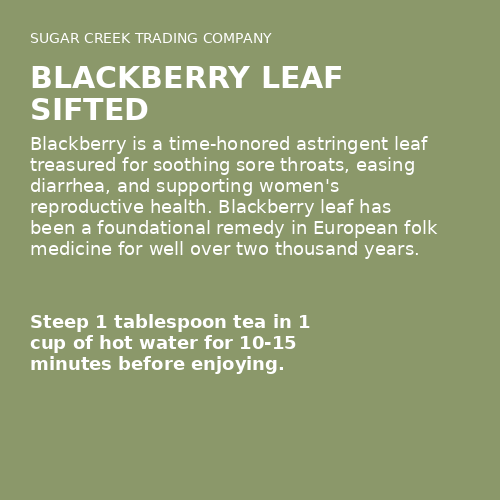
A time-honored astringent leaf treasured for soothing sore throats, easing diarrhea, and supporting women's reproductive health.
BOTANICAL IDENTIFICATION
Scientific Name: Rubus fruticosus L. agg. (aggregate species complex)
Common Names: Blackberry Leaf, Bramble Leaf, Wild Blackberry, Dewberry Leaf
Family: Rosaceae
Blackberry is a vigorous, thorny, semi-evergreen perennial shrub with arching biennial canes (primocanes and floricanes) that can reach 2 to 5 meters in length. The leaves are palmately compound with 3 to 5 oval, toothed leaflets that are dark green on top and lighter with fine hairs beneath. White to pink five-petaled flowers bloom in late spring to early summer, followed by the familiar aggregate drupelets that ripen from green to red to glossy black.
Blackberries are native to Europe, North Africa, and temperate Asia, and have become naturalized throughout North America, Australia, and South America. They thrive in hedgerows, forest edges, disturbed ground, and open meadows, preferring well-drained soil and full to partial sun. The genus Rubus is notoriously variable, with hundreds of microspecies recognized across its range.
CULTURAL AND HISTORICAL USE
Blackberry leaf has been a foundational remedy in European folk medicine for well over two thousand years. The ancient Greeks documented its use, with Dioscorides recommending a decoction of bramble leaves to tighten loose gums, heal mouth sores, and stop diarrhea. Roman physicians employed similar preparations, and the plant maintained an unbroken tradition of use through the medieval monastic herbals and into Renaissance-era pharmacopeias.
In British and Irish folk tradition, blackberry leaf tea was a household staple for sore throats, stomach upsets, and children's diarrhea. The young spring leaves were considered the most potent and were gathered before flowering for drying and year-round use. Blackberry leaf was also traditionally recommended for women's health, particularly for easing menstrual cramps and preparing the uterus for childbirth, a use it shares with its close relative, red raspberry leaf.
Indigenous peoples of North America adopted native Rubus species for similar purposes, using leaf decoctions for dysentery, stomach complaints, and as a general tonic. In Appalachian folk herbalism, blackberry leaf and root remained among the most commonly used remedies well into the 20th century. The leaf was also fermented and dried as a substitute for black tea during wartime shortages, a practice that produced a pleasant, tannic beverage still enjoyed today by herbalists and wild food enthusiasts.
KEY BIOACTIVE COMPOUNDS & BENEFITS
| Compound/Class | Location in Plant | Human Benefit | Role in Plant |
|---|---|---|---|
| Condensed tannins (proanthocyanidins) | Throughout leaf tissue | Powerful astringent action; firms and tones mucous membranes; antidiarrheal | Herbivore deterrent; protein binding reduces leaf palatability |
| Ellagic acid and ellagitannins | Leaves and fruit | Antioxidant; supports cellular health; anti-mutagenic properties | Defense against pathogens and UV damage |
| Flavonoids (quercetin, rutin, kaempferol) | Leaves | Anti-inflammatory; strengthens capillary walls; supports cardiovascular function | UV protection and pigmentation |
| Gallic acid | Leaves | Antimicrobial; anti-inflammatory; supports wound healing | Pathogen defense compound |
| Vitamin C and minerals (iron, calcium, manganese) | Leaves | Nutritive support; immune function; bone health | Essential metabolic cofactors |
Blackberry leaf is fundamentally an astringent herb, with its therapeutic identity built on an exceptionally high tannin content. The proanthocyanidins and ellagitannins work together to tighten, tone, and protect mucous membranes throughout the body, from the mouth and throat down through the entire digestive tract. Layered on top of this astringent foundation are meaningful levels of antioxidant flavonoids and nutritive minerals that add depth to what might otherwise be a simple remedy.
HOW IT WORKS IN THE BODY
Blackberry leaf acts primarily through its dense tannin content, which binds to proteins on contact with mucosal surfaces, creating a tightening, toning, and protective effect.
Gastrointestinal Toning:
When taken as a tea, the tannins bind to proteins in the intestinal lining, reducing hypersecretion, tightening lax tissue, and decreasing the motility associated with diarrhea. This is a direct pharmacological action, not merely symptomatic, as the astringent barrier also reduces the ability of irritants and pathogens to contact the underlying tissue. This makes blackberry leaf one of the most reliable herbal remedies for acute and chronic diarrhea.
Oral and Throat Health:
Gargling with blackberry leaf tea or using it as a mouthwash brings the astringent tannins into direct contact with inflamed, swollen, or infected tissue in the mouth and throat. The tannins reduce swelling, decrease pain signaling, and form a temporary protective coating over irritated areas. This is particularly effective for sore throats, gingivitis, and mouth ulcers.
Uterine and Reproductive Support:
Like its close relative red raspberry leaf, blackberry leaf contains a combination of tannins and fragarine-like alkaloid compounds that appear to tone the smooth muscle of the uterus. This may help regulate uterine contractions, ease menstrual cramping, and support efficient labor. The mechanism is thought to involve calcium channel modulation in uterine smooth muscle cells.
DOSE GUIDELINES
| Preparation Type | Typical Dose | Purpose |
|---|---|---|
| Infusion (hot tea) | 1-2 teaspoons dried leaf per cup, steep 10-15 minutes; 3-4 cups daily | Diarrhea, digestive toning, general astringent support |
| Gargle / mouthwash | Strong infusion (1 tablespoon per cup), cooled; gargle 3-4 times daily | Sore throat, gingivitis, mouth sores |
| Tincture (1:5, 25-40% alcohol) | 30-60 drops, 3 times daily | Convenient internal astringent; menstrual support |
| Cold infusion (overnight steep) | 2 tablespoons per quart, steeped overnight in cold water | Maximizes mineral extraction; gentle daily tonic |
Blackberry leaf is gentle enough for daily use over extended periods. For acute diarrhea, higher doses taken frequently throughout the day are most effective. For reproductive and tonic purposes, a moderate daily tea habit of 2 to 3 cups provides consistent support. The sifted cut of this product is ideal for quick-brewing teas and easy straining.
PREPARATION AND USES
Pour 8 ounces of freshly boiled water over 1 to 2 teaspoons of sifted blackberry leaf, cover to prevent the escape of volatile compounds, and steep for 10 to 15 minutes. The resulting tea is mildly astringent with a pleasant, slightly earthy and fruity character. It can be sweetened with honey, which complements the throat-soothing properties when used as a gargle-and-sip preparation. For a stronger medicinal tea, increase to 1 tablespoon per cup and steep for 20 minutes.
Blackberry leaf blends exceptionally well with other herbs. Combine with peppermint for a digestive tea, with red raspberry leaf for a women's reproductive tonic, or with elderflower and yarrow for a traditional cold and flu support blend. The leaves can also be lightly fermented before drying to produce a rich, dark, tannic beverage that serves as an excellent caffeine-free alternative to black tea. For topical use, a strong infusion makes an effective wash for minor wounds, hemorrhoids, and varicose veins.
OPTIMAL CONTEXT FOR USE
This herb is especially well-suited for individuals experiencing:
Acute or chronic diarrhea, including traveler's diarrhea and post-infectious loose stools
Sore throats, tonsillitis, or pharyngitis when used as a gargle
Gingivitis, bleeding gums, or recurrent mouth ulcers
Menstrual cramping or irregular periods, especially when combined with red raspberry leaf
A desire for a nourishing, caffeine-free daily beverage with mild astringent and mineral benefits
Blackberry leaf pairs naturally with slippery elm and marshmallow root for comprehensive digestive support, combining its astringent toning with their soothing demulcent action for a balanced approach to GI complaints.
SUSTAINABILITY AND ETHICAL HARVESTING
Blackberry is one of the most abundant and vigorous wild plants in the temperate world, with many species classified as invasive in regions where they have been introduced. There are no conservation concerns whatsoever with blackberry leaf harvesting. In fact, regular pruning and harvesting of bramble stands is often ecologically beneficial, as it can reduce the smothering effect of unchecked blackberry growth on native plant communities. Both wild-harvested and cultivated sources are readily available and fully sustainable.
SAFETY AND CAUTIONS
Blackberry leaf is one of the safest herbs in common use, with a long history of consumption by people of all ages including children and the elderly.
Very high doses of tannin-rich teas may cause mild nausea or constipation in sensitive individuals. Reduce the dose if this occurs.
The tannin content may reduce absorption of iron and certain medications if taken simultaneously. Separate intake by at least one hour from iron supplements or prescription drugs.
Generally considered safe during pregnancy and breastfeeding in moderate amounts, similar to red raspberry leaf. However, consult a midwife or healthcare provider before beginning use during pregnancy.
Avoid harvesting leaves from roadsides or areas that may have been treated with herbicides or pesticides.
REFERENCES
Gudej, J., & Tomczyk, M. (2004). Determination of flavonoids, tannins and ellagic acid in leaves from Rubus L. species. Archives of Pharmacal Research, 27(11), 1114-1119.
Grieve, M. (1931). A Modern Herbal. Jonathan Cape. (Comprehensive entry on Rubus spp. in European tradition.)
Hoffmann, D. (2003). Medical Herbalism: The Science and Practice of Herbal Medicine. Healing Arts Press. (Blackberry leaf monograph and astringent herb classification.)
FINAL NOTE
Blackberry leaf is the kind of herb that every household should have on the shelf. Unassuming, inexpensive, and remarkably effective, it handles the common complaints of daily life with quiet competence: the sore throat that arrives with autumn, the stomach upset from questionable food, the menstrual cramps that disrupt a workday. It asks for nothing fancy in preparation, brews into a genuinely pleasant tea, and delivers reliable results backed by more than two millennia of continuous human use. Sometimes the best medicine is also the simplest.
Condividere