Sugar Creek Trading Company
Blessed Thistle Herb
Blessed Thistle Herb
Impossibile caricare la disponibilità di ritiro
CNICUS BENEDICTUS
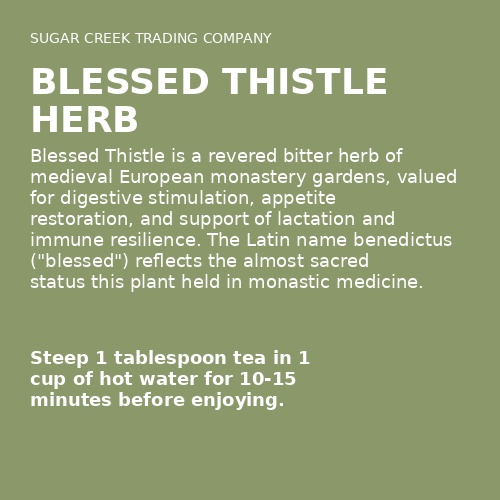
A revered bitter herb of medieval European monastery gardens, valued for digestive stimulation, appetite restoration, and support of lactation and immune resilience.
BOTANICAL IDENTIFICATION
Scientific Name: Cnicus benedictus L.
Common Names: Blessed Thistle, Holy Thistle, St. Benedict's Thistle, Spotted Thistle, Bitter Thistle, Carbenia Benedicta
Family: Asteraceae (Daisy/Composite family)
Blessed thistle is an annual herbaceous plant growing 20 to 60 centimeters tall, with branching, hairy stems and deeply lobed, spiny-toothed leaves covered in fine, sticky hairs. The leaves are dark green with conspicuous pale veining and clasp the stem at their base. Flower heads are small and yellow, surrounded by a dense whorl of spiny, leaf-like bracts interwoven with cobwebby hairs, giving the bloom a distinctive bristling appearance. The entire plant has a strongly bitter taste.
Native to the Mediterranean basin and western Asia, blessed thistle has naturalized across southern and central Europe, parts of North and South America, and Australia. It thrives in dry, rocky, and waste ground, preferring full sun and well-drained, even poor soils. This whole herb form includes the dried aerial parts -- stems, leaves, and flowering tops -- harvested during full bloom when the bitter principles are at their peak concentration.
CULTURAL AND HISTORICAL USE
Blessed thistle owes its name and enduring reputation to the Benedictine monks who cultivated it in monastery herb gardens throughout medieval Europe, prescribing it as a remedy for virtually every ailment. The Latin name benedictus ("blessed") reflects the almost sacred status this plant held in monastic medicine. During the great plague epidemics of the 14th through 17th centuries, blessed thistle was among the most frequently recommended preventive remedies, appearing in nearly every plague treatise of the era. Shakespeare referenced it in Much Ado About Nothing (Act III, Scene IV), where Margaret advises a heartbroken Beatrice to lay some blessed thistle to her heart, "the only thing for a qualm."
In the formal herbal tradition, blessed thistle was documented extensively by the great European herbalists. Hieronymus Bock (1539), Leonhart Fuchs (1542), and John Gerard (1597) all praised it for stimulating appetite, relieving flatulence, promoting sweating in fevers, and as a general strengthening tonic for weak and debilitated patients. Nicholas Culpeper, in his 1653 Complete Herbal, recommended it for strengthening the memory, alleviating melancholy, and supporting the liver. By the 16th century, the German physician and alchemist Paracelsus was championing blessed thistle as a panacea, reportedly declaring that only three remedies were necessary: blessed thistle, theriac, and mercury.
Blessed thistle also has a deep association with women's health, particularly in European and Latin American folk traditions. It has been used for centuries as a galactagogue -- a substance that promotes breast milk production -- often combined with fenugreek, fennel, or milk thistle. In traditional Mexican herbalism (curanderismo), it is known as cardo santo and used for digestive complaints, fever, and as a postpartum tonic. The German Commission E approved blessed thistle for loss of appetite and dyspeptic complaints, and it remains an important component of European bitter digestive formulas to this day.
KEY BIOACTIVE COMPOUNDS & BENEFITS
| Compound/Class | Location in Plant | Human Benefit | Role in Plant |
|---|---|---|---|
| Cnicin (sesquiterpene lactone) | Leaves, flowering tops, stems | Potent bitter digestive stimulant, anti-inflammatory, antibacterial, potential anti-tumor activity | Herbivore deterrent and antimicrobial defense |
| Polyacetylenes | Aerial parts and roots | Antimicrobial, anti-inflammatory, cytotoxic to abnormal cells | Chemical defense against pathogens and herbivores |
| Lignans (trachelogenin, arctigenin) | Seeds and aerial parts | Anti-inflammatory, antiviral, mild estrogenic modulation | Structural and defense compounds |
| Flavonoids (apigenin, luteolin) | Leaves and flowers | Antioxidant, anti-inflammatory, mild anxiolytic | UV protection, pollinator attraction |
| Volatile oils and tannins | Throughout aerial parts | Astringent, carminative, mild antimicrobial | Aromatic defense, tissue protection |
The dominant bioactive principle in blessed thistle is cnicin, an intensely bitter sesquiterpene lactone that accounts for much of the plant's digestive and anti-inflammatory activity. Cnicin is one of the most bitter naturally occurring compounds and is responsible for triggering the cascade of digestive secretions that makes blessed thistle such an effective appetite stimulant and digestive tonic. The supporting cast of polyacetylenes, lignans, and flavonoids adds antimicrobial, antioxidant, and hormonal-modulating dimensions that extend the herb's usefulness well beyond the gut.
HOW IT WORKS IN THE BODY
Blessed thistle exerts its primary effects through the bitter taste reflex and direct action on the digestive and immune systems, with secondary influences on inflammation and hormonal balance.
Digestive Stimulation and Appetite Restoration:
When blessed thistle's intensely bitter compounds contact the taste receptors on the tongue, they trigger a vagal reflex arc that stimulates the secretion of saliva, gastric acid, bile, and pancreatic enzymes. This "bitter reflex" is one of the most well-established mechanisms in herbal pharmacology. Cnicin acts as the primary trigger, activating bitter taste receptors (T2Rs) that are now known to exist not only on the tongue but throughout the gastrointestinal tract. The result is a comprehensive activation of digestive capacity -- increased appetite, improved breakdown and absorption of nutrients, reduced bloating and gas, and enhanced motility.
Anti-Inflammatory and Immune Support:
Cnicin and the polyacetylenes in blessed thistle inhibit NF-kB activation and reduce the production of pro-inflammatory prostaglandins and leukotrienes. This anti-inflammatory action supports the traditional use of blessed thistle for fever and inflammatory conditions. The herb also demonstrates antibacterial activity against several common pathogens, including Staphylococcus aureus and Bacillus subtilis, contributing to its historical use during plague epidemics as an antimicrobial bitter tonic.
Lactation Support:
The galactagogue effect of blessed thistle is likely mediated through multiple pathways, including the stimulation of prolactin release (potentially via bitter receptor signaling and its effects on the hypothalamic-pituitary axis) and improved overall digestive assimilation, which enhances the body's capacity to produce nutrient-rich breast milk. Clinical evidence, while primarily observational and traditional, consistently supports this use when blessed thistle is combined with fenugreek.
Hepatic and Choleretic Activity:
Like many bitters, blessed thistle promotes bile flow and supports liver function. The choleretic action aids in fat digestion, cholesterol metabolism, and the elimination of metabolic waste products through the bile. This hepatic support underlies its traditional reputation as a blood-purifying and detoxifying herb.
DOSE GUIDELINES
| Preparation Type | Typical Dose | Purpose |
|---|---|---|
| Infusion (herb tea) | 1.5-3 grams (1-2 teaspoons) dried herb steeped in 1 cup boiling water for 10-15 minutes; 1-3 cups daily, taken 30 minutes before meals | Digestive stimulation, appetite restoration, general tonic |
| Tincture (1:5, 45% alcohol) | 2-4 mL (40-80 drops), 2-3 times daily before meals | Concentrated bitter tonic, digestive and appetite support |
| Powdered herb (capsules) | 500-1000 mg, 2-3 times daily before meals | Convenient dosing for those who cannot tolerate the bitter taste (though direct bitter taste contact enhances efficacy) |
| Lactation support tea | 1-2 teaspoons blessed thistle combined with equal parts fenugreek and fennel; 2-3 cups daily | Breast milk production support |
The key to blessed thistle's digestive effectiveness is timing: take it 15 to 30 minutes before meals to allow the bitter reflex to fully activate the digestive cascade before food arrives. The bitter taste itself is therapeutically important -- swallowing capsules bypasses the tongue's bitter receptors and may reduce some of the herb's digestive benefit. For this reason, tea or tincture taken directly on the tongue is the preferred preparation for digestive purposes.
PREPARATION AND USES
For a standard bitter digestive tea, steep one to two teaspoons of the dried herb in a cup of just-boiled water for 10 to 15 minutes, covered to retain volatile oils. Strain and drink warm before meals. The tea is pronouncedly bitter -- this is the point, and the bitterness should be tasted rather than masked, though a small amount of honey or lemon can make it more palatable without eliminating the bitter effect. Blessed thistle combines beautifully with other digestive bitters such as gentian root, artichoke leaf, dandelion root, and chamomile in traditional European bitter formulas.
For tincture preparation, the dried herb extracts well in 40 to 50 percent alcohol. The tincture can be taken as drops in a small amount of water before meals. For lactation support, blessed thistle is most commonly used as part of a formula rather than alone, blended with fenugreek seed, fennel seed, and sometimes milk thistle or goat's rue. In historical European practice, blessed thistle was also applied externally as a poultice for wounds and skin ulcers, and a strong infusion was used as a wash for skin infections, reflecting its antimicrobial properties.
OPTIMAL CONTEXT FOR USE
Blessed thistle herb is especially well-suited for individuals experiencing:
Loss of appetite, poor digestion, or the feeling that food "sits like a stone" in the stomach -- where the potent bitter action can awaken and restore the full digestive cascade
Convalescence or recovery from illness, particularly when appetite and vitality have declined and the body needs help rebuilding nutritional intake
Insufficient breast milk production in nursing mothers, especially when combined with complementary galactagogues like fenugreek and fennel
Sluggish liver or gallbladder function, bloating, and poor fat digestion -- where the choleretic and bile-stimulating properties can support hepatic efficiency
Frequent minor infections or a desire to support immune resilience alongside digestive health, leveraging the herb's antimicrobial and anti-inflammatory compounds
Blessed thistle pairs well with gentian root, chamomile, and peppermint for comprehensive digestive support, and with fenugreek, fennel, and milk thistle for lactation formulas.
SUSTAINABILITY AND ETHICAL HARVESTING
Blessed thistle is an annual plant that produces abundant seed and self-sows readily in warm, dry conditions. It is cultivated commercially in parts of Europe, South America, and North America, and also grows wild as a naturalized weed in many temperate and Mediterranean-climate regions. There are no conservation concerns associated with Cnicus benedictus -- it is not endangered, threatened, or at risk from harvesting pressure. In some areas it is considered a mild agricultural weed.
Cultivation is straightforward, and the plant thrives in poor, dry soils where many other crops struggle, making it a useful addition to herb farms and permaculture plantings. The aerial parts are harvested during full bloom, when the bitter and aromatic principles are at their highest concentration, then dried quickly in shade or with gentle heat to preserve quality. As a self-seeding annual, responsible harvesting leaves ample plants to set seed for the following season.
SAFETY AND CAUTIONS
Blessed thistle is generally regarded as safe when used at recommended doses. The German Commission E and the European Medicines Agency both list it as a well-tolerated digestive bitter with a long history of safe use.
Individuals with known allergies to plants in the Asteraceae (daisy/composite) family should use blessed thistle with caution, as cross-reactivity is possible. Symptoms may include skin rash, itching, or respiratory irritation.
Very high doses (significantly exceeding recommended amounts) may cause nausea, vomiting, and stomach irritation due to the intensity of the bitter compounds. Use within the standard dose range.
Blessed thistle is widely used as a galactagogue during breastfeeding and is generally considered compatible with nursing at standard doses. However, it should be avoided during pregnancy due to its traditional reputation as an emmenagogue (menstruation-promoting herb) and its potential to stimulate uterine activity.
Due to its bile-stimulating properties, individuals with active gallstones or bile duct obstruction should consult a healthcare provider before using blessed thistle.
REFERENCES
Vanhaelen-Fastre, R. and Vanhaelen, M. "Antibiotic and cytotoxic activity of cnicin and its hydrolysis products." Planta Medica, 32(2): 159-166, 1976.
European Medicines Agency, Committee on Herbal Medicinal Products. "Assessment report on Cnicus benedictus L., herba." EMA/HMPC/278567/2015, 2017.
Ulbricht, C., et al. "An evidence-based systematic review of blessed thistle (Cnicus benedictus) by the Natural Standard Research Collaboration." Journal of Dietary Supplements, 5(4): 422-437, 2008.
Felter, H.W. and Lloyd, J.U. King's American Dispensatory. 18th ed., 1898. (Eclectic medical uses of Cnicus benedictus.)
Academy of Breastfeeding Medicine. "ABM Clinical Protocol #9: Use of Galactogogues in Initiating or Augmenting Maternal Milk Production." Breastfeeding Medicine, 13(5): 307-314, 2018.
FINAL NOTE
Blessed thistle is a bitter medicine in the truest sense -- an herb whose sharpness on the tongue is the very mechanism of its healing. Cultivated by monks, invoked by Shakespeare, and carried through plague and famine as a remedy of first resort, it embodies the ancient principle that bitter flavors awaken the body's deepest capacity to digest, assimilate, and thrive. Whether used to restore appetite after illness, support a nursing mother's milk, or simply bring fire back to a sluggish digestive system, blessed thistle is a humble and potent ally that has earned its name many times over.
Condividere