Sugar Creek Trading Company
Boswellia Serrata Pieces
Boswellia Serrata Pieces
Impossibile caricare la disponibilità di ritiro
BOSWELLIA SERRATA
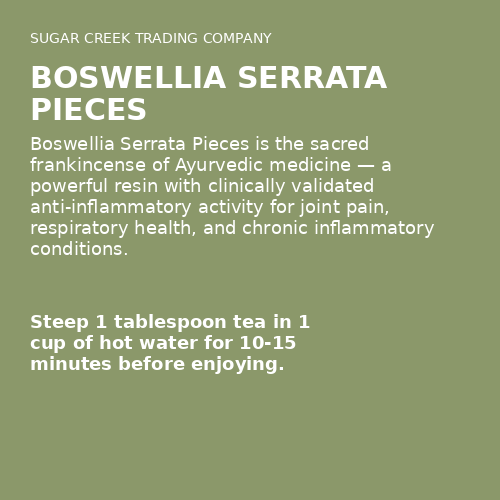
The sacred frankincense of Ayurvedic medicine — a powerful resin with clinically validated anti-inflammatory activity for joint pain, respiratory health, and chronic inflammatory conditions.
BOTANICAL IDENTIFICATION
Scientific Name: Boswellia serrata Roxb. ex Colebr.
Common Names: Indian Frankincense, Salai Guggul, Shallaki, Indian Olibanum, Boswellia, Dhup
Family: Burseraceae (Torchwood/Incense Tree family)
Boswellia serrata is a medium to large deciduous tree growing 12 to 18 meters tall with a spreading crown and papery, peeling bark that flakes off in thin, ash-colored sheets. The compound, pinnate leaves consist of 17 to 31 leaflets with serrated margins. Small, white to pale green flowers appear in axillary racemes, followed by three-valved fruit capsules. The medicinally prized oleo-gum resin, known as salai guggul, is harvested by making shallow incisions in the trunk bark, from which it exudes as a milky-white, viscous fluid that hardens into translucent, amber-to-golden tear-shaped pieces upon exposure to air.
Native to the dry, hilly regions of central and western India, particularly the states of Rajasthan, Madhya Pradesh, Gujarat, Jharkhand, and Chhattisgarh, Boswellia serrata thrives in arid to semi-arid climates on rocky, nutrient-poor slopes at elevations up to 1,200 meters. It is remarkably drought-tolerant and fire-resistant, making it a keystone species in India's dry deciduous forests.
CULTURAL AND HISTORICAL USE
Boswellia serrata holds a revered position in Ayurvedic medicine stretching back thousands of years. In the classical Ayurvedic texts, including the Charaka Samhita and Sushruta Samhita (dating to approximately 600 BCE), the resin is known as Shallaki and is prescribed for arthritis, diarrhea, pulmonary diseases, ringworm, and boils. In Ayurvedic terminology, it pacifies Vata and Kapha doshas, reduces Ama (metabolic toxins), and is classified as an analgesic (Vedana-sthapana), anti-inflammatory (Shotha-hara), and tissue-rejuvenating (Rasayana) substance. The resin has been used in Ayurvedic practice for joint diseases (Sandhivata/osteoarthritis and Amavata/rheumatoid arthritis) as one of its primary indications for millennia.
Frankincense resins from various Boswellia species have played central roles in religious, medicinal, and trade history across the ancient world. The incense routes that connected southern Arabia, India, and East Africa to the Mediterranean were among history's most important trade networks, and Boswellia resins were their most valuable commodity alongside myrrh. While the Biblical frankincense is primarily associated with Boswellia sacra from Arabia, Indian frankincense (B. serrata) served parallel sacred and medicinal functions on the subcontinent. It has been burned in Hindu temple ceremonies for purification and devotion for thousands of years, and its smoke is considered to sanctify sacred spaces and elevate spiritual practice.
In modern integrative medicine, Boswellia serrata has emerged as one of the most thoroughly studied botanical anti-inflammatories in the world. Beginning with German and Indian research in the 1980s and accelerating through the 2000s, clinical trials have demonstrated its efficacy for osteoarthritis, rheumatoid arthritis, inflammatory bowel disease, asthma, and other chronic inflammatory conditions. It is now one of the most widely recommended botanicals by both naturopathic physicians and conventional integrative practitioners for inflammatory joint disease.
KEY BIOACTIVE COMPOUNDS & BENEFITS
| Compound/Class | Location in Plant | Human Benefit | Role in Plant |
|---|---|---|---|
| Boswellic acids (AKBA, KBA, beta-boswellic acid, acetyl-beta-boswellic acid) | Oleo-gum resin (gum fraction) | Potent 5-LOX inhibition; anti-inflammatory, anti-arthritic, and anti-tumor activity | Triterpene defense compounds protecting wounded bark from infection |
| 3-O-Acetyl-11-keto-beta-boswellic acid (AKBA) | Oleo-gum resin | The most pharmacologically active boswellic acid; strongest and most selective 5-lipoxygenase inhibitor | Concentrated antimicrobial defense metabolite in resin |
| Essential oils (alpha-thujene, incensole, incensole acetate) | Volatile oil fraction of resin | Anxiolytic, neuroprotective, and mild analgesic effects; respiratory support | Volatile terpenes that deter insects and seal bark wounds |
| Polysaccharides (arabinogalactan-type gums) | Water-soluble gum fraction | Immune modulation and prebiotic activity | Hydrophilic sealant that protects trunk wounds during resin exudation |
| Tirucallic acids | Oleo-gum resin | Anti-inflammatory activity through NF-kB pathway modulation | Additional triterpene defense compounds in resin matrix |
The boswellic acids are the primary drivers of Boswellia's clinical reputation. Unlike NSAIDs, which primarily inhibit the cyclooxygenase (COX) pathway, boswellic acids target the 5-lipoxygenase (5-LOX) enzyme pathway — a distinct inflammatory cascade responsible for leukotriene production. This dual-pathway approach, combined with emerging evidence of NF-kB and TNF-alpha modulation, gives Boswellia a broad and mechanistically unique anti-inflammatory profile that complements rather than duplicates conventional anti-inflammatory drugs.
HOW IT WORKS IN THE BODY
Boswellia serrata resin exerts its therapeutic effects through multiple anti-inflammatory and tissue-protective mechanisms, with particular affinity for joint, respiratory, and gastrointestinal tissues.
5-Lipoxygenase (5-LOX) Inhibition:
The boswellic acids, particularly AKBA, are potent and specific inhibitors of 5-lipoxygenase, the enzyme that catalyzes the synthesis of leukotrienes from arachidonic acid. Leukotrienes are powerful inflammatory mediators involved in joint inflammation, bronchoconstriction, vascular permeability, and immune cell recruitment to inflamed tissues. By blocking 5-LOX, Boswellia reduces leukotriene production at the source, providing anti-inflammatory relief through a mechanism distinct from COX-inhibiting NSAIDs. This makes it particularly valuable for conditions where leukotrienes play a major pathological role, including asthma, inflammatory bowel disease, and chronic joint inflammation.
NF-kB Pathway Modulation:
Boswellic acids and tirucallic acids have been shown to inhibit nuclear factor kappa-B (NF-kB), a master transcription factor that controls the expression of hundreds of pro-inflammatory genes. By downregulating NF-kB activation, Boswellia reduces the production of TNF-alpha, interleukins (IL-1, IL-6), and other inflammatory cytokines. This provides broad-spectrum anti-inflammatory activity that complements its 5-LOX inhibition.
Joint and Cartilage Protection:
Clinical trials in osteoarthritis patients have demonstrated that Boswellia not only reduces pain and swelling but also inhibits the enzymatic degradation of cartilage. Boswellic acids have been shown to suppress matrix metalloproteinases (MMPs) and glycosaminoglycan-degrading enzymes that break down cartilage in arthritic joints. This suggests a disease-modifying potential beyond simple symptom relief.
Respiratory and Mucosal Support:
Through leukotriene inhibition, Boswellia reduces bronchoconstriction and airway inflammation. Clinical studies in asthma patients have shown improvements in lung function parameters (FEV1, peak flow) and reduced frequency of asthma attacks. The essential oil components, particularly incensole acetate, provide additional anti-inflammatory and potentially anxiolytic effects that may benefit respiratory conditions with a stress component.
DOSE GUIDELINES
| Preparation Type | Typical Dose | Purpose |
|---|---|---|
| Resin pieces (chewed or decocted) | 1-3 g of resin pieces, 2-3 times daily; chew directly or simmer in water for 15-20 minutes | Traditional Ayurvedic method; delivers full-spectrum resin constituents |
| Powdered resin | 1-3 g, 2-3 times daily, mixed with warm water, milk, or honey | Standard Ayurvedic dose for joint and inflammatory conditions |
| Decoction | 3-5 g of resin pieces simmered in 2 cups water for 15-20 minutes, strained; drink 1-2 times daily | Enhanced extraction of water-soluble gum polysaccharides alongside boswellic acids |
| Topical paste | Resin softened in warm water and applied as a poultice to affected joints | Traditional external application for localized joint pain and swelling |
Boswellia is best used consistently over weeks to months for chronic inflammatory conditions. Clinical trials demonstrating efficacy for osteoarthritis typically used treatment periods of 4 to 12 weeks. Anti-inflammatory benefits are cumulative and tend to build with continued use. Taking Boswellia with fat-containing foods or healthy oils may enhance the absorption of its lipophilic boswellic acids. Note: this product is whole resin pieces, not a standardized extract — dosing may need to be adjusted upward compared to concentrated extract formulations.
PREPARATION AND USES
Boswellia Serrata Pieces are the whole, natural oleo-gum resin in its traditional tear and chunk form. This is the closest to how the resin has been used for thousands of years in Ayurvedic practice. The pieces can be used in several ways. For internal use, small pieces can be chewed directly — they will soften in the mouth and release their aromatic, slightly bitter, balsamic flavor. Alternatively, pieces can be simmered gently in water for 15 to 20 minutes to make a decoction; the resin will partially dissolve, releasing both its water-soluble gum polysaccharides and a portion of its boswellic acids. Straining through cheesecloth removes any undissolved material.
For those who prefer a powder, the resin pieces can be ground in a spice grinder or mortar and pestle (chilling the resin first makes grinding easier, as it becomes brittle when cold). The powder can be mixed into warm milk with honey, a traditional Ayurvedic preparation called Shallaki Ksheerapaka, or encapsulated for convenient daily use. Externally, softened resin can be applied as a warm poultice to inflamed joints. The pieces are also prized for incense use — placing a piece on a charcoal disc releases the classic frankincense aroma used in meditation, spiritual practice, and aromatherapy, where the incensole acetate in the smoke has demonstrated anxiolytic properties in research.
OPTIMAL CONTEXT FOR USE
Boswellia Serrata resin pieces are especially well-suited for individuals experiencing:
Osteoarthritis or rheumatoid arthritis with joint pain, stiffness, and swelling, particularly as a complement to or alternative to long-term NSAID use
Chronic inflammatory conditions including inflammatory bowel disease (Crohn's, ulcerative colitis), asthma, or chronic bronchitis
Sports injuries, tendonitis, or repetitive strain conditions involving ongoing inflammation
Interest in traditional, whole-resin Ayurvedic preparations rather than standardized extracts, for those who value full-spectrum natural medicine
Spiritual or meditation practice, where Boswellia resin has been burned as sacred incense for thousands of years
Boswellia works especially well in combination with Turmeric (Curcuma longa) for synergistic anti-inflammatory support, as the two herbs target complementary inflammatory pathways. It is also traditionally combined with Ashwagandha for joint conditions with an underlying stress or autoimmune component, and with Ginger for enhanced bioavailability and digestive comfort.
SUSTAINABILITY AND ETHICAL HARVESTING
Boswellia serrata faces significant conservation challenges. The species is classified as Critically Endangered on the IUCN Red List in some assessment frameworks, primarily due to overharvesting, habitat degradation, poor natural regeneration, and the effects of fire and grazing in its dry forest habitat. Research published in Nature Sustainability has projected that Boswellia tree populations could decline by 50% or more within two decades without intervention, as many populations show extremely low rates of seedling survival and recruitment.
Responsible sourcing is critical. Sustainable tapping practices — limiting the number and depth of bark incisions per tree and allowing adequate rest periods between harvests — can maintain tree health and resin productivity over decades. Community-based forest management programs in India, particularly in Madhya Pradesh and Rajasthan, are working to establish sustainable harvesting protocols and improve the livelihoods of resin tappers. When purchasing Boswellia, choosing suppliers who can document their sourcing practices and support sustainable harvesting communities makes a meaningful difference for the survival of these ancient trees. Sugar Creek Trading Company is committed to sourcing Boswellia with attention to both quality and responsible supply chain practices.
SAFETY AND CAUTIONS
Boswellia serrata resin has a strong safety profile and is generally well-tolerated. The Indian Pharmacopoeia and the European Medicines Agency both recognize its traditional use. The following cautions apply:
Mild gastrointestinal effects (nausea, acid reflux, diarrhea) may occur in some individuals, particularly at higher doses. Taking with food usually mitigates these effects.
Boswellia may have mild blood-thinning properties. Individuals taking anticoagulant or antiplatelet medications (warfarin, aspirin, clopidogrel) should consult a healthcare provider before use.
May interact with anti-inflammatory medications (NSAIDs, corticosteroids) through additive effects. While this can be therapeutically beneficial under practitioner guidance, concurrent use should be monitored.
Pregnant and nursing individuals should consult a qualified healthcare provider before use, as Boswellia has traditionally been considered to have mild emmenagogue (menstruation-promoting) properties.
Individuals with known allergies to plants in the Burseraceae family should use caution.
REFERENCES
Ammon, H.P.T. "Boswellic Acids in Chronic Inflammatory Diseases." Planta Medica, 2006; 72(12): 1100-1116.
Sengupta, K., Alluri, K.V., Satish, A.R., et al. "A Double Blind, Randomized, Placebo Controlled Study of the Efficacy and Safety of 5-Loxin for Treatment of Osteoarthritis of the Knee." Arthritis Research & Therapy, 2008; 10(4): R85.
Siddiqui, M.Z. "Boswellia Serrata, A Potential Antiinflammatory Agent: An Overview." Indian Journal of Pharmaceutical Sciences, 2011; 73(3): 255-261.
Bongers, F., Groenendijk, P., Bekele, T., et al. "Frankincense in Peril." Nature Sustainability, 2019; 2: 602-610.
FINAL NOTE
Boswellia serrata resin is a rare convergence of ancient sacred tradition and modern clinical validation. Used for thousands of years in Ayurvedic medicine and temple ceremony, its anti-inflammatory mechanisms have now been mapped in precise biochemical detail, revealing a unique and potent action against the leukotriene pathway that drives so much chronic pain and inflammation. These whole resin pieces offer the most traditional and full-spectrum form of this extraordinary botanical, connecting the user directly to the same material that healers and priests have valued since antiquity.
Condividere