Sugar Creek Trading Company
Brahmi
Brahmi
Impossibile caricare la disponibilità di ritiro
BACOPA MONNIERI
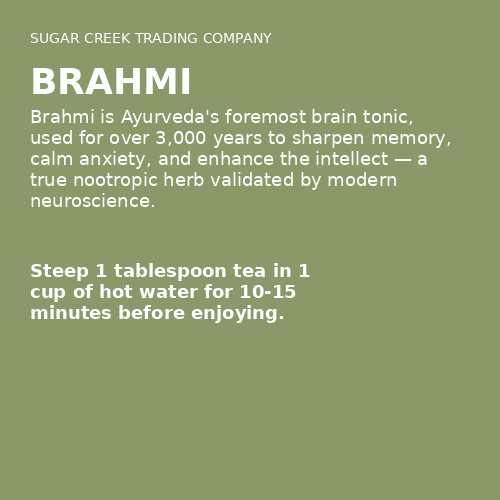
Ayurveda's foremost brain tonic, used for over 3,000 years to sharpen memory, calm anxiety, and enhance the intellect — a true nootropic herb validated by modern neuroscience.
BOTANICAL IDENTIFICATION
Scientific Name: Bacopa monnieri (L.) Wettst.
Common Names: Brahmi, Water Hyssop, Bacopa, Thyme-leaved Gratiola, Herb of Grace, Jalanimba, Neer Brahmi
Family: Plantaginaceae (Plantain family)
Bacopa monnieri is a small, creeping, succulent perennial herb that grows 10 to 30 centimeters in height, spreading laterally via runners that root at the nodes. The leaves are small, oblong to spatulate, fleshy, and arranged oppositely on the stem. The flowers are tiny, five-petaled, and typically white to pale blue or violet, blooming from the leaf axils. The entire plant has a slightly bitter, astringent taste and emits a mild, herbaceous aroma when crushed.
Brahmi is native to the wetlands, marshes, and riverbanks of tropical and subtropical regions across South and Southeast Asia, southern India, Sri Lanka, and northern Australia. It thrives in shallow, standing water or waterlogged soils and is frequently found growing along the edges of ponds, rice paddies, and irrigation channels. It has naturalized in parts of the southern United States, Central America, and Africa. The plant is highly adaptable and can grow submerged in aquarium conditions, in wet garden soil, or even as a terrarium plant.
CULTURAL AND HISTORICAL USE
Brahmi holds a position of extraordinary reverence in the Ayurvedic tradition, where its very name derives from Brahman — the Hindu concept of ultimate reality and universal consciousness. This naming reflects the ancient belief that the herb could expand awareness and connect the user to higher states of cognition. The Charaka Samhita (ca. 600 BCE) lists Brahmi as a medhya rasayana, a category reserved for herbs that specifically rejuvenate the mind and intellect. It was prescribed for improving memory, sharpening concentration, alleviating anxiety, and treating speech disorders, epilepsy, and insanity. Vedic scholars and students reportedly consumed Brahmi before extended periods of study to enhance their ability to memorize lengthy sacred texts.
In traditional Indian household practice, Brahmi was commonly given to children as a paste mixed with honey and ghee to promote intellectual development and calm hyperactive temperaments. It was also applied as a hair oil to cool the scalp and promote hair growth, and consumed as a juice or decoction for digestive complaints and skin conditions. In Siddha medicine of South India, Brahmi was used to treat epilepsy, asthma, and urinary disorders. The herb also appears in traditional Southeast Asian medicine systems, where it was used for similar cognitive and nervous system complaints.
Western scientific interest in Brahmi began in the 1960s when Indian researchers at the Central Drug Research Institute in Lucknow isolated the bacosides — the plant's primary active compounds — and demonstrated their memory-enhancing effects in animal models. Since then, more than a dozen randomized controlled human trials have been published, consistently showing improvements in memory consolidation, attention, and cognitive processing speed. Brahmi has become one of the most studied and validated nootropic herbs in the global pharmacopoeia, and its popularity has expanded far beyond its traditional South Asian base.
KEY BIOACTIVE COMPOUNDS & BENEFITS
| Compound/Class | Location in Plant | Human Benefit | Role in Plant |
|---|---|---|---|
| Bacosides A and B (bacoside A3, bacopaside I, II, X, bacopasaponin C) | Leaves and stems (whole herb) | Primary nootropic agents; enhance memory consolidation, synaptic transmission, and nerve repair | Saponin-based chemical defense against herbivores and pathogens |
| Bacopa saponins (jujubogenin and pseudojujubogenin glycosides) | Whole herb | Anxiolytic, antidepressant, and neuroprotective activity | Bitter deterrents against grazing |
| Brahmine and herpestine (alkaloids) | Whole herb | Mild sedative and cardiotonic effects; contribute to calming action | Nitrogen-containing defensive compounds |
| Apigenin, luteolin (flavonoids) | Leaves | Antioxidant, anti-inflammatory, anxiolytic via GABAergic modulation | UV protection and pollinator signaling |
| Betulinic acid (triterpenoid) | Whole herb | Anti-inflammatory, anti-tumor, and hepatoprotective | Structural defense compound |
The bacosides are the signature compounds responsible for Brahmi's cognitive-enhancing reputation. These dammarane-type triterpenoid saponins are structurally similar to ginsenosides found in Panax ginseng, suggesting convergent biochemical strategies for neuroprotection across unrelated plant families. The bacosides work synergistically with the herb's alkaloids and flavonoids to produce a calming yet mentally clarifying effect — a rare combination that distinguishes Brahmi from stimulant-based nootropics.
HOW IT WORKS IN THE BODY
Brahmi exerts its cognitive and neurological effects through multiple well-characterized mechanisms, acting on neurotransmitter systems, antioxidant defenses, and neuronal growth pathways simultaneously.
Synaptic Plasticity and Memory Consolidation:
Bacosides enhance the activity of kinases involved in synaptic plasticity, particularly in the hippocampus, the brain region most critical for forming new memories. They upregulate the expression of tryptophan hydroxylase (TPH2) and serotonin transporter (SERT) genes, strengthening serotonergic signaling in memory-related circuits. Human clinical trials have consistently shown that 12 weeks of Brahmi supplementation improves performance on tasks measuring verbal learning, memory consolidation, and speed of early information processing.
Cholinergic Enhancement:
Brahmi inhibits acetylcholinesterase, the enzyme that breaks down the neurotransmitter acetylcholine, thereby increasing acetylcholine availability in the synaptic cleft. Acetylcholine is the primary neurotransmitter involved in learning, attention, and memory formation. This mechanism parallels the action of pharmaceutical cholinesterase inhibitors used in Alzheimer's disease, though Brahmi's effect is gentler and accompanied by neuroprotective rather than neurotoxic activity.
Antioxidant Neuroprotection:
The brain is extraordinarily vulnerable to oxidative damage due to its high oxygen consumption and lipid-rich composition. Bacosides enhance the activity of endogenous antioxidant enzymes — superoxide dismutase (SOD), catalase, and glutathione peroxidase — in brain tissue. They also directly scavenge free radicals and chelate iron, reducing the oxidative burden on neurons. This antioxidant activity is particularly relevant for age-related cognitive decline and neurodegenerative conditions.
Anxiolytic and Stress-Modulating Effects:
Brahmi modulates GABAergic neurotransmission and has been shown to reduce cortisol and other stress markers in human subjects. Unlike many anxiolytics, Brahmi calms the nervous system without causing sedation or cognitive impairment — in fact, it simultaneously improves cognitive performance while reducing anxiety. This dual action makes it uniquely suited for individuals who experience stress-related cognitive dysfunction.
Dendritic Growth and Neural Repair:
Preclinical research has demonstrated that bacosides promote dendritic branching and length in hippocampal and cortical neurons, effectively increasing the brain's capacity for forming new synaptic connections. This neuroplasticity-enhancing effect may underlie the progressive improvements in memory that are observed with sustained use over weeks and months.
DOSE GUIDELINES
| Preparation Type | Typical Dose | Purpose |
|---|---|---|
| Dried whole herb powder | 3-6 grams daily, mixed in warm water, milk, ghee, or honey | Traditional Ayurvedic medhya rasayana; broad cognitive and calming support |
| Infusion (tea) | 1-2 teaspoons of dried herb per cup of hot water, steeped 10-15 minutes; 1-2 cups daily | Gentle daily nootropic and anxiolytic support |
| Tincture (1:3, 45% ethanol) | 3-5 mL, two to three times daily | Convenient liquid preparation for ongoing cognitive support |
| Capsules (whole herb powder) | 500-1,500 mg daily | Standardized daily supplementation |
Brahmi is a slow-building tonic herb, and its full cognitive benefits typically become apparent after 8 to 12 weeks of consistent daily use. This timeline aligns with the neurobiological processes of dendritic growth and synaptic remodeling. Traditional Ayurvedic practice recommends taking Brahmi with ghee or warm milk to enhance absorption of the fat-soluble bacosides. It can be taken morning or evening; some individuals prefer evening dosing for its calming properties, while others take it in the morning to support focus throughout the day.
PREPARATION AND USES
This whole dried Brahmi herb can be prepared in several ways. The simplest approach is to steep 1 to 2 teaspoons of the dried herb in hot water for 10 to 15 minutes, strain, and drink as a mildly bitter tea. Adding honey and a squeeze of lemon makes it more palatable. For the traditional Ayurvedic preparation, mix 1 teaspoon of the powdered or finely crumbled herb into warm milk with ghee and a pinch of cardamom — the lipid content of the milk and ghee significantly improves absorption of the bacosides. The dried herb can also be ground in a spice grinder and packed into capsules for convenient daily use.
To prepare a tincture, macerate the dried herb in 45% alcohol at a 1:3 ratio for 4 to 6 weeks, shaking daily, then strain and bottle. Brahmi combines particularly well with gotu kola (which is also sometimes called "brahmi" in North Indian traditions), shankhpushpi, and ashwagandha for comprehensive cognitive and nervous system support. It can be added to hair oil preparations by infusing the dried herb in coconut or sesame oil over low heat for several hours — a traditional use that is still widely practiced across India.
OPTIMAL CONTEXT FOR USE
Brahmi is especially well-suited for individuals experiencing:
Memory difficulties, mental fog, or declining cognitive performance, whether age-related or stress-induced, where gentle but sustained nootropic support is desired
Academic or professional demands requiring enhanced learning capacity, improved information retention, and sharper recall
Anxiety and stress that manifests as scattered thinking, difficulty concentrating, or an overactive mind — particularly where calming is needed without sedation
Attention deficit concerns, where improved focus and reduced impulsivity are goals alongside conventional treatment or as a standalone approach
Long-term neuroprotective strategies, especially for individuals with family histories of cognitive decline or neurodegenerative conditions
Brahmi pairs synergistically with gotu kola for enhanced cerebrovascular and cognitive support, with ashwagandha for combined stress resilience and mental clarity, and with lion's mane mushroom for comprehensive neuroplasticity and nerve growth factor stimulation.
SUSTAINABILITY AND ETHICAL HARVESTING
Bacopa monnieri is a fast-growing, highly adaptable wetland plant that reproduces readily through both seed and vegetative propagation, making it one of the more sustainable medicinal herbs in commercial trade. The majority of commercially available Brahmi is cultivated rather than wild-harvested, with major production in India, particularly in the southern and eastern states where wetland conditions are abundant. The plant can be grown in flooded paddies, pond margins, or even in containers, and a single planting can yield multiple harvests per year due to its vigorous regrowth from cut stems.
Wild populations of Bacopa monnieri remain widespread across tropical and subtropical wetlands globally, and the species is not currently listed as threatened by CITES or IUCN. However, wetland habitat destruction remains a broader ecological concern that affects all aquatic and semi-aquatic plant species. Supporting organically cultivated Brahmi helps ensure that production does not contribute to wetland degradation and that harvesting communities receive fair compensation for their labor.
SAFETY AND CAUTIONS
Brahmi has a long history of safe use in Ayurvedic medicine and has demonstrated a favorable safety profile in modern clinical trials lasting up to 12 weeks. However, the following precautions should be observed:
Gastrointestinal effects are the most commonly reported side effect, including nausea, stomach cramps, bloating, and diarrhea. These are typically mild and can be minimized by taking Brahmi with food or milk rather than on an empty stomach.
Brahmi may potentiate the effects of cholinergic medications, thyroid medications, calcium channel blockers, and sedative drugs. Individuals taking any of these should consult a healthcare provider before adding Brahmi to their regimen.
Pregnant and nursing women should exercise caution and consult a qualified practitioner before using Brahmi, as safety data during pregnancy is limited despite its long traditional use in children.
Due to its mild effect on thyroid hormone levels (some studies suggest it may increase T4), individuals with hyperthyroidism should use Brahmi under professional guidance.
REFERENCES
Stough, C., Lloyd, J., Clarke, J., et al. (2001). "The chronic effects of an extract of Bacopa monniera (Brahmi) on cognitive function in healthy human subjects." Psychopharmacology, 156(4), 481-484.
Roodenrys, S., Booth, D., Bulzomi, S., et al. (2002). "Chronic effects of Brahmi (Bacopa monnieri) on human memory." Neuropsychopharmacology, 27(2), 279-281.
Aguiar, S. & Borowski, T. (2013). "Neuropharmacological review of the nootropic herb Bacopa monnieri." Rejuvenation Research, 16(4), 313-326.
FINAL NOTE
Brahmi is that rare botanical that delivers on its ancient promises under the scrutiny of modern clinical trials. Where Vedic scholars used it to memorize entire scriptures, today's neuroscience confirms that the same bacosides promote synaptic plasticity, protect neurons from oxidative damage, and genuinely enhance memory consolidation over time. Its combination of cognitive enhancement with anxiolytic calm — sharpening the mind while settling the nervous system — is a profile that no synthetic nootropic has successfully replicated. In whole herb form, Brahmi offers the full phytochemical matrix that traditional practitioners have relied upon for three millennia.
Condividere