Sugar Creek Trading Company
California Poppy
California Poppy
Impossibile caricare la disponibilità di ritiro
ESCHSCHOLZIA CALIFORNICA
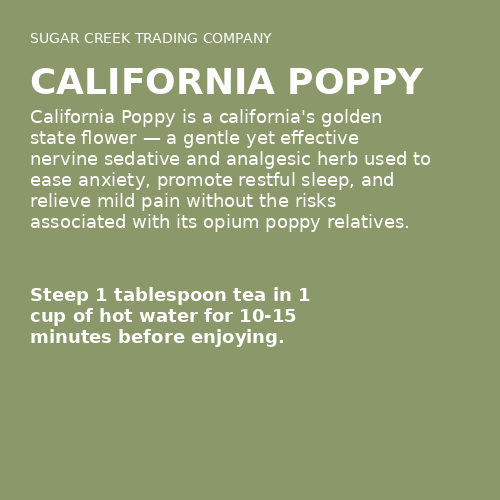
California's golden state flower — a gentle yet effective nervine sedative and analgesic herb used to ease anxiety, promote restful sleep, and relieve mild pain without the risks associated with its opium poppy relatives.
BOTANICAL IDENTIFICATION
Scientific Name: Eschscholzia californica Cham.
Common Names: California Poppy, Golden Poppy, Cup of Gold, Amapola de California, Escholtzia, California Sunlight
Family: Papaveraceae
Eschscholzia californica is a short-lived perennial (often grown as an annual) reaching 20 to 60 cm in height, with blue-green, finely dissected, fern-like foliage. The iconic four-petaled, silky flowers range from brilliant orange-gold to pale yellow and open in full sunlight, closing at night and on cloudy days. Each flower sits atop a slender stem and emerges from a distinctive, conical, pointed cap (calyptra) that pops off as the petals unfurl. The fruit is a long, slender capsule that splits open at maturity to scatter tiny, dark brown seeds.
Native to the western United States and northern Mexico, California poppy flourishes in grasslands, open hillsides, roadsides, and disturbed areas from sea level to 2,000 meters. It thrives in full sun with well-drained, even poor or sandy soils, and is remarkably drought-tolerant. It is the official state flower of California, where it carpets hillsides and valleys in breathtaking golden displays each spring.
CULTURAL AND HISTORICAL USE
California poppy was an important medicine for Indigenous peoples of the western United States long before European contact. The Costanoan, Pomo, Luiseno, Cahuilla, and other California nations used the plant's roots, leaves, and flowers for a variety of purposes, including as a sedative for colicky children, a remedy for toothache and headache, and a poultice for sores and wounds. The fresh sap from the root was applied directly to aching teeth for pain relief, and the aerial parts were prepared as a mild tea for calming restlessness and promoting sleep.
Early Spanish settlers in California documented the widespread golden blooms and observed Indigenous peoples' medicinal use of the plant. In the 19th and early 20th centuries, Eclectic physicians in America adopted California poppy as a safe, non-addictive alternative to opium for treating nervousness, insomnia, and minor pain — a reputation that persists in modern herbal practice. Importantly, though California poppy belongs to the same botanical family as the opium poppy (Papaver somniferum), it contains none of the addictive opiate alkaloids (morphine, codeine, thebaine) found in its notorious cousin.
In European phytotherapy, particularly in France and Germany, California poppy has gained significant recognition over the past century. The French pharmacopoeia includes it as a recognized sedative and anxiolytic herb, and it is a common ingredient in over-the-counter sleep and relaxation products throughout Europe. It is often combined with hawthorn, passionflower, and valerian in commercial formulations for anxiety and insomnia.
KEY BIOACTIVE COMPOUNDS & BENEFITS
| Compound/Class | Location in Plant | Human Benefit | Role in Plant |
|---|---|---|---|
| Protopine (isoquinoline alkaloid) | Whole plant, concentrated in roots | Smooth muscle relaxant, mild sedative, analgesic; modulates GABA receptors | Antimicrobial and anti-herbivory defense |
| Californidine (benzophenanthridine alkaloid) | Root and aerial parts | Anxiolytic and sedative effects; binds to benzodiazepine receptors without addiction potential | Chemical defense against pathogens and grazers |
| Escholtzine (pavine alkaloid) | Root and lower stem | Analgesic and antispasmodic activity; contributes to pain-relieving effects | Insecticidal defense compound |
| Allocryptopine | Whole plant | Antispasmodic, mild sedative, and hypotensive effects | Broad-spectrum chemical defense |
| Flavonoid glycosides (rutin and others) | Leaves and flowers | Antioxidant activity; vascular-protective and anti-inflammatory support | UV protection and pollinator signaling |
California poppy's therapeutic profile emerges from the collective action of its unique suite of isoquinoline alkaloids, none of which are opiates in the pharmacological sense. Rather than acting on opioid receptors as morphine does, these alkaloids interact with GABA-A and benzodiazepine receptors in the brain to produce calming, anxiolytic, and mildly analgesic effects. This distinction is critically important: California poppy calms and relieves pain without creating dependency, respiratory depression, or the euphoria that drives opiate addiction.
HOW IT WORKS IN THE BODY
California poppy acts primarily on the central nervous system through multiple, complementary mechanisms that produce its signature effects of gentle sedation, anxiety relief, and mild pain reduction.
GABAergic Sedation and Anxiolysis:
The alkaloids californidine, protopine, and allocryptopine have been demonstrated to bind to GABA-A benzodiazepine receptor sites, enhancing the inhibitory action of gamma-aminobutyric acid (GABA) in the central nervous system. This is the same receptor system targeted by pharmaceutical benzodiazepines (such as diazepam), but California poppy's alkaloids bind with much lower affinity, producing a gentler, non-addictive calming effect. This mechanism reduces neuronal excitability, quiets racing thoughts, and promotes the transition from wakefulness to sleep without the "hangover" grogginess associated with stronger sedatives.
Analgesic Pathways:
California poppy's pain-relieving effects appear to involve modulation of enkephalin degradation. Research suggests that certain alkaloids inhibit the enzymes that break down endogenous enkephalins (the body's own pain-relieving peptides), thereby prolonging their natural analgesic action. This differs fundamentally from opiates, which directly activate opioid receptors. The result is a mild but real reduction in pain perception, particularly effective for tension headaches, mild nerve pain, muscle aches, and menstrual cramps.
Antispasmodic and Smooth Muscle Effects:
Protopine and allocryptopine relax smooth muscle throughout the body, easing spasm in the gastrointestinal tract, blood vessels, and bronchial passages. This antispasmodic action contributes to California poppy's usefulness in conditions where pain is accompanied by muscular tension or spasm, such as irritable bowel cramping, tension-type headaches, and menstrual pain.
DOSE GUIDELINES
| Preparation Type | Typical Dose | Purpose |
|---|---|---|
| Dried herb tea (infusion) | 1-2 teaspoons of dried aerial parts steeped in 8 oz hot water for 10-15 minutes, 1-3 times daily | Mild anxiety relief, nervous tension, general calming |
| Tincture (1:5, 45-50% ethanol) | 2-4 mL (40-80 drops), 1-3 times daily; or 4-6 mL at bedtime for sleep | Insomnia, anxiety, mild pain relief |
| Dried herb capsules | 300-500 mg, 2-3 times daily | Convenient daily nervine support |
| Combined formula (with valerian, passionflower) | Per product directions | Enhanced sleep and anxiety support |
California poppy is appropriate for both acute and regular use. For sleep support, take the dose 30 to 60 minutes before bedtime. For daytime anxiety, lower doses (1 teaspoon tea or 1-2 mL tincture) provide calming effects without significant drowsiness. The herb has a cumulative effect with regular use, and many practitioners find that consistent daily use over 2 to 4 weeks produces the best results for chronic anxiety and sleep disruption. It combines synergistically with passionflower, valerian, hops, and lemon balm.
PREPARATION AND USES
The whole above-ground plant (leaves, stems, and flowers) is used medicinally, and in some traditions the root is included for stronger sedative and analgesic preparations. For a soothing evening tea, steep 1 to 2 teaspoons of dried California poppy in freshly boiled water, covered, for 10 to 15 minutes. The tea has a mild, slightly bitter, earthy flavor that blends well with chamomile, lemon balm, or lavender. Honey can be added to taste.
Tincture is the preferred preparation in clinical herbalism, as it extracts the alkaloids more efficiently than water infusion. A tincture made from the fresh or recently dried whole plant in 45 to 50 percent alcohol captures the full alkaloid spectrum. For topical pain relief, a poultice of the fresh or reconstituted dried herb can be applied to areas of minor pain or tension. California poppy also features in many commercial herbal sleep and relaxation formulas available in capsules, liquid extracts, and tea blends. It makes an excellent base for a custom sleep tincture when combined with equal parts passionflower, skullcap, or valerian.
OPTIMAL CONTEXT FOR USE
This herb is especially well-suited for individuals experiencing:
Difficulty falling asleep or staying asleep, particularly when driven by a busy, anxious mind that will not quiet at bedtime
Generalized anxiety, nervous tension, or stress-related restlessness that does not warrant pharmaceutical intervention
Mild to moderate pain — tension headaches, menstrual cramps, muscle aches, or minor nerve pain — where a gentle, non-addictive analgesic is desired
Children's restlessness, anxiety, or difficulty settling for sleep (California poppy is one of the gentlest child-appropriate sedative herbs)
Individuals seeking to transition away from pharmaceutical sleep aids or benzodiazepines under professional guidance
California poppy works best as part of a holistic approach to sleep and nervous system health, complemented by good sleep hygiene practices, regular exercise, stress management, and dietary awareness.
SUSTAINABILITY AND ETHICAL HARVESTING
California poppy is an abundant, resilient wildflower with no conservation concerns. It is native across a vast range of the western United States and has naturalized in temperate regions worldwide, including parts of South America, Europe, Australia, and South Africa. It self-seeds prolifically and thrives in disturbed soils, roadsides, and neglected fields — ecological niches that ensure its continued abundance.
It is important to note that while California poppy is the state flower of California, it is not illegal to harvest on private land with the landowner's permission. It is protected on state and federal lands in California, where picking or removing the plants is prohibited. Most commercially available California poppy is cultivated, often grown organically in fields dedicated to medicinal herb production. It is an easy plant to grow from seed in home gardens, requiring only full sun, decent drainage, and minimal water once established.
SAFETY AND CAUTIONS
California poppy has an excellent safety profile and is considered one of the gentlest sedative herbs in Western herbalism. It is widely used in European phytotherapy for both adults and children.
Not an opiate: Despite belonging to the poppy family (Papaveraceae), California poppy contains no morphine, codeine, thebaine, or other opiate alkaloids. It is not addictive and does not produce opiate-like euphoria or respiratory depression. It will not cause a positive result on standard drug tests for opiates.
Drowsiness: At higher doses, California poppy can cause significant drowsiness. Avoid driving or operating heavy machinery until you know how it affects you. Start with lower doses during the daytime.
Pregnancy and breastfeeding: Due to its alkaloid content and potential uterine-stimulating effects, California poppy is generally not recommended during pregnancy. Use during breastfeeding should be discussed with a qualified healthcare provider.
Drug interactions: California poppy may potentiate the effects of sedative medications including benzodiazepines, barbiturates, and sleep aids. It may also interact with monoamine oxidase inhibitors (MAOIs). Consult a healthcare provider if taking pharmaceutical sedatives, antidepressants, or anti-anxiety medications.
REFERENCES
Rolland, A., et al. "Behavioural Effects of the American Traditional Plant Eschscholzia californica: Sedative and Anxiolytic Properties." Planta Medica, 57(3): 212-216, 1991.
Fedurco, M., et al. "Modulatory Effects of Eschscholzia californica Alkaloids on Recombinant GABA-A Receptors." Biochemical Research International, 2015: Article ID 617620, 2015.
Hanus, M., Lafon, J., and Mathieu, M. "Double-blind, Randomised, Placebo-controlled Study to Evaluate the Efficacy and Safety of a Fixed Combination Containing Two Plant Extracts (Crataegus oxyacantha and Eschscholtzia californica) and Magnesium in Mild-to-moderate Anxiety Disorders." Current Medical Research and Opinion, 20(1): 63-71, 2004.
FINAL NOTE
California poppy is a gift from the western landscape — a golden, sun-loving wildflower that offers the nervous system exactly what modern life so often depletes: calm without numbness, pain relief without dependency, and sleep without morning fog. Its gentle but genuine sedative and analgesic effects make it one of the most important herbs in the Western herbalist's toolkit for anxiety, insomnia, and mild pain, suitable for the whole family from young children to the elderly. In a world where the pharmaceutical approach to sleep and anxiety comes with significant risks of dependency, California poppy stands as a safe, time-tested, and profoundly beautiful alternative.
Condividere