Sugar Creek Trading Company
Coltsfoot Leaf
Coltsfoot Leaf
Impossibile caricare la disponibilità di ritiro
TUSSILAGO FARFARA
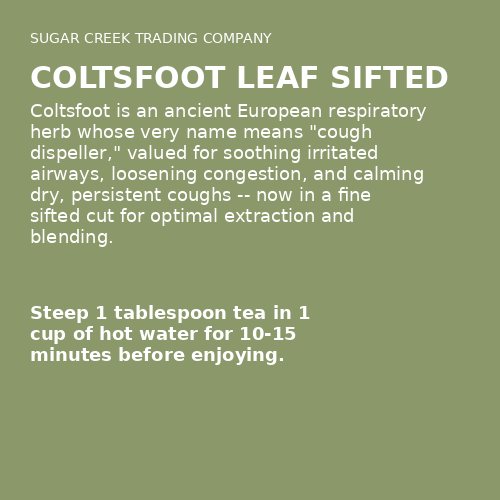
An ancient European respiratory herb whose very name means "cough dispeller," valued for soothing irritated airways, loosening congestion, and calming dry, persistent coughs -- now in a fine sifted cut for optimal extraction and blending.
BOTANICAL IDENTIFICATION
Scientific Name: Tussilago farfara L.
Common Names: Coltsfoot, Coughwort, Bull's Foot, Horsehoof, Foal's Foot, Son-Before-Father, Pas d'ane, Husten Lattich, Kuan Dong Hua (TCM)
Family: Asteraceae (Daisy family)
Coltsfoot is a low-growing perennial herb reaching 10 to 30 cm in height, notable for producing bright yellow, dandelion-like flower heads in early spring before its leaves emerge, an unusual trait that earned it the folk name "Son-Before-Father." The leaves are large, rounded to hoof-shaped with a toothed margin, dark green on top and covered with a dense white woolly felt on the underside. The thick, creeping rhizomes spread aggressively through moist, disturbed soils.
Native to Europe, northern Africa, and western and central Asia, Coltsfoot has naturalized throughout eastern North America. It thrives in damp clay soils, riverbanks, roadsides, waste ground, and disturbed habitats, often appearing as one of the first plants to colonize bare or compacted earth in early spring.
ABOUT THIS CUT: SIFTED LEAF
This sifted cut of Coltsfoot Leaf has been mechanically processed to a finer, more uniform particle size compared to the traditional whole or cut-and-sifted leaf. The sifted form offers faster extraction times in teas and infusions, more consistent dosing by volume, and easier blending into custom herbal formulas, encapsulation projects, and smoking blends. The finer texture increases surface area, allowing water or solvent to access the mucilage, flavonoids, and sesquiterpenes more efficiently. This cut is ideal for herbalists, formulators, and anyone who prefers a smoother, sediment-free tea experience.
CULTURAL AND HISTORICAL USE
Coltsfoot has one of the longest documented histories of any respiratory herb in Western medicine. Its Latin genus name, Tussilago, derives directly from "tussis" (cough) and "ago" (to drive away), and this singular identity as a cough remedy has defined its use for over 2,500 years. Hippocrates recommended inhaling the smoke of dried Coltsfoot leaves for coughs and respiratory distress. Dioscorides, Pliny the Elder, and Galen all recorded its use for lung conditions. In medieval Europe, the Coltsfoot flower was used as the traditional apothecary symbol for pharmacies in France and elsewhere, painted on shop signs to indicate that remedies were sold within.
In Traditional Chinese Medicine, the flower buds (Kuan Dong Hua) are classified as a warm, acrid-sweet herb that enters the Lung meridian, used to moisten the Lungs, redirect rebellious Lung Qi downward, and transform phlegm. It appears in classical formulas for chronic cough, asthma, and wheezing, often paired with Zi Wan (Aster root) and Bai Bu (Stemona). In European folk traditions, Coltsfoot leaves were widely smoked in herbal tobacco blends or brewed as tea for bronchitis, asthma, and whooping cough. British herbalists prescribed Coltsfoot Rock, a traditional candy made from Coltsfoot extract, as a lozenge for sore throats and coughs well into the 20th century.
Indigenous peoples of eastern North America adopted Coltsfoot after its naturalization, incorporating the leaves into smoking mixtures and respiratory teas. The Iroquois and other nations used leaf poultices for skin inflammations and burns. Throughout its history, Coltsfoot has maintained an almost singular reputation: wherever it grows, it is known first and foremost as the cough plant.
KEY BIOACTIVE COMPOUNDS & BENEFITS
| Compound/Class | Location in Plant | Human Benefit | Role in Plant |
|---|---|---|---|
| Mucilage polysaccharides (up to 8%) | Leaves and flowers | Demulcent action soothes inflamed mucous membranes in the throat and bronchi | Water retention and tissue protection against desiccation |
| Tussilagone and related sesquiterpenes | Flower buds and leaves | Antitussive (cough-suppressing) and anti-inflammatory activity in respiratory tissue | Chemical defense against herbivores and pathogens |
| Flavonoids (rutin, quercetin, hyperoside, isoquercetin) | Leaves and flowers | Antioxidant protection, anti-inflammatory support, capillary strengthening | UV protection and pollinator signaling |
| Phenolic acids (caffeic acid, ferulic acid, chlorogenic acid) | Leaves | Antioxidant, mild antimicrobial, and anti-inflammatory effects | Defense against microbial infection and oxidative stress |
| Zinc, potassium, and trace minerals | Whole plant | Support for immune function and tissue repair | Essential mineral uptake for growth and metabolism |
The therapeutic profile of Coltsfoot centers on the interplay between its mucilage content and its sesquiterpene compounds. The mucilage coats and soothes irritated respiratory tissue, while tussilagone acts on the cough reflex itself, providing both symptomatic relief and anti-inflammatory action. The flavonoid and phenolic acid content adds antioxidant depth, helping to protect damaged tissue during acute respiratory episodes. The sifted cut releases these compounds more rapidly during extraction, making it well-suited for quick infusions and formula blending.
HOW IT WORKS IN THE BODY
Coltsfoot works through complementary mechanisms that target multiple aspects of respiratory distress, combining physical mucosal protection with biochemical modulation of inflammation and cough signaling.
Respiratory Soothing and Demulcent Action:
The high mucilage content of Coltsfoot leaves forms a protective, gel-like film over inflamed mucous membranes in the throat, larynx, and bronchial passages. This physical barrier reduces irritation from dry air, allergens, and inflammatory secretions, directly calming the urge to cough. This demulcent mechanism is particularly effective for dry, nonproductive coughs where the tissue itself is the source of irritation.
Antitussive and Bronchial Relaxation:
Tussilagone, the primary sesquiterpene in Coltsfoot, has demonstrated dose-dependent antitussive activity in pharmacological studies. It appears to act on peripheral cough receptors and may also influence central cough-mediating pathways. Additionally, tussilagone exhibits bronchodilatory effects, relaxing smooth muscle in the airways and facilitating easier breathing during episodes of bronchospasm or constriction.
Anti-Inflammatory and Immune Support:
Flavonoids and phenolic acids in Coltsfoot inhibit the release of pro-inflammatory mediators including certain prostaglandins and histamine, reducing swelling and hypersecretion in the respiratory tract. This anti-inflammatory action complements the demulcent effect by addressing the underlying tissue inflammation rather than merely masking symptoms.
Expectorant Support:
While primarily demulcent, Coltsfoot also has mild expectorant properties that help loosen and mobilize thick, sticky mucus in the lower airways. This dual action, soothing upper airway irritation while promoting productive expectoration from the lower airways, makes it effective across a range of cough presentations.
DOSE GUIDELINES
| Preparation Type | Typical Dose | Purpose |
|---|---|---|
| Infusion (tea) | 1-2 teaspoons (2-4 g) sifted leaf steeped in hot water for 8-12 minutes, 3 times daily | Soothing coughs, sore throats, and upper respiratory irritation |
| Tincture (1:5, 40% ethanol) | 2-4 mL, 3 times daily | Convenient antitussive and respiratory support |
| Syrup | 5-10 mL, 3-4 times daily | Cough relief with enhanced palatability; traditional preparation |
| Encapsulation | 1-3 g powdered sifted leaf daily in capsules | Standardized dosing for those who prefer capsule form |
Coltsfoot is traditionally used as a short-term acute remedy during active coughs and respiratory infections rather than as a daily tonic. Most Western and TCM herbalists recommend limiting continuous use to 4 to 6 weeks at a time. The sifted cut extracts slightly faster than whole leaf, so steep times can be reduced by a few minutes. It is frequently combined with other respiratory herbs such as Mullein, Marshmallow Root, Elecampane, or Thyme to build comprehensive respiratory formulas.
PREPARATION AND USES
The sifted leaf is ideal for hot infusions, steeped covered for 8 to 12 minutes, producing a smooth tea with less plant debris than the whole-leaf form. The resulting brew has a mildly bitter, slightly sweet flavor that blends well with honey and lemon. For maximum mucilage extraction, a cold infusion can be prepared by soaking the sifted leaf in room-temperature water for several hours, which draws out the soothing polysaccharides while minimizing tannin content.
The fine, uniform particle size of this sifted cut makes it particularly well-suited for blending into custom tea formulas, filling capsules, and incorporating into cough syrup preparations. It mixes evenly with other sifted herbs like Mullein Leaf, Marshmallow Root, Plantain Leaf, and Wild Cherry Bark for respiratory blends. The sifted form also works well in herbal smoking blends, where its fine texture ensures an even, smooth burn alongside Mullein or other base herbs.
OPTIMAL CONTEXT FOR USE
Coltsfoot leaf is especially well-suited for individuals experiencing:
Dry, irritating, nonproductive coughs where the throat and bronchi feel raw and inflamed
Acute bronchitis, laryngitis, or tracheitis with persistent coughing and sore throat
Chronic coughs or lingering post-cold coughs that persist after the primary infection has resolved
Smoker's cough or environmental irritation from dust, dry air, or allergens
Mild asthmatic symptoms or seasonal respiratory sensitivity requiring gentle bronchial support
Coltsfoot works well as part of a broader respiratory care approach that includes hydration, steam inhalation, rest, and complementary herbs such as Thyme, Mullein, Elecampane, or Licorice Root. The sifted form is especially convenient for herbalists building multi-herb respiratory protocols where consistent blending and extraction are priorities.
SUSTAINABILITY AND ETHICAL HARVESTING
Coltsfoot is an abundant, vigorous plant with no significant conservation concerns. It is classified as a common weed in much of its native European range and across its naturalized territory in North America, where it readily colonizes disturbed ground, roadsides, stream banks, and construction sites. Its aggressive rhizome system makes it one of the most resilient and self-propagating plants in the temperate flora.
Commercially, Coltsfoot leaf is primarily wild-harvested in Eastern Europe (particularly Bulgaria, Albania, and Poland) and cultivated in China for the TCM flower bud market. Because of its abundance, overharvesting is not a concern for this species. When sourcing, the primary quality considerations are ensuring clean harvesting sites free from roadside contaminants and heavy metals, and proper drying to preserve mucilage content. Sugar Creek Trading Company sources Coltsfoot leaf with attention to purity, potency, and responsible harvesting practices.
SAFETY AND CAUTIONS
Coltsfoot has been used safely for millennia as a short-term respiratory remedy, but awareness of its pyrrolizidine alkaloid (PA) content is important for informed use.
Coltsfoot contains trace amounts of pyrrolizidine alkaloids (primarily senkirkine and senecionine), which are hepatotoxic in concentrated or prolonged exposure. Most commercial Coltsfoot leaf contains very low PA levels, and traditional short-term use (under 4-6 weeks) at standard doses is generally considered low risk. PA-free cultivars (e.g., 'Wien') have been developed in Europe.
Not recommended during pregnancy or nursing due to the presence of pyrrolizidine alkaloids.
Individuals with pre-existing liver disease or compromised liver function should avoid Coltsfoot or use only certified PA-free preparations.
May interact with hepatotoxic medications or other PA-containing herbs (Comfrey, Borage, certain Senecio species). Avoid concurrent use with drugs metabolized heavily by the liver.
Individuals with known allergies to Asteraceae (daisy family) plants may experience cross-reactivity.
REFERENCES
European Medicines Agency (EMA). "Assessment Report on Tussilago farfara L., folium." Committee on Herbal Medicinal Products (HMPC), 2014.
Hoffmann, D. Medical Herbalism: The Science and Practice of Herbal Medicine. Healing Arts Press, 2003.
Li, Y.P., & Wang, Y.M. "Evaluation of Tussilagone: A Sesquiterpene from Tussilago farfara, on Antitussive and Anti-inflammatory Activities." Journal of Ethnopharmacology, 2016; 183: 1-8.
Bensky, D., Clavey, S., & Stoger, E. Chinese Herbal Medicine: Materia Medica, 3rd Ed. Eastland Press, 2004.
FINAL NOTE
Coltsfoot leaf is one of the oldest and most specifically targeted respiratory herbs in the Western and Chinese pharmacopoeias, a plant whose very name is a promise of cough relief. Its combination of soothing mucilage, anti-inflammatory flavonoids, and the antitussive compound tussilagone creates a multi-layered approach to respiratory comfort that few single herbs can match. This sifted cut delivers the full therapeutic profile of Coltsfoot in a form optimized for blending, encapsulation, and quick-extracting teas, making it an essential ingredient for any herbal respiratory formula.
Condividere