Sugar Creek Trading Company
Echinacea Purpurea
Echinacea Purpurea
Impossibile caricare la disponibilità di ritiro
ECHINACEA PURPUREA
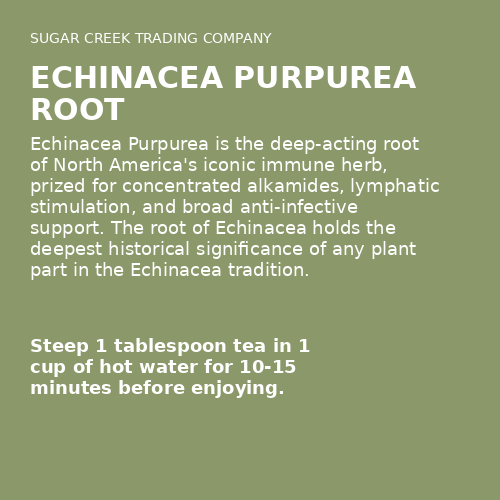
The deep-acting root of North America's iconic immune herb, prized for concentrated alkamides, lymphatic stimulation, and broad anti-infective support.
BOTANICAL IDENTIFICATION
Scientific Name: Echinacea purpurea (L.) Moench
Common Names: Echinacea Root, Purple Coneflower Root, Coneflower Root, Snakeroot
Family: Asteraceae (Daisy/Composite family)
Plant Part: Root and rhizome
Echinacea purpurea is a robust perennial herb growing 60 to 120 cm tall with coarsely hairy stems, broadly ovate basal leaves, and striking composite flower heads featuring drooping pinkish-purple ray florets around a prominent, spiny central cone. The root system consists of a thick, branching taproot and fibrous lateral roots, typically dark brown to black externally and pale to yellowish internally. The roots are harvested from plants at least two to three years old, when alkamide and polysaccharide concentrations have reached their peak.
Native to the prairies and open woodlands of the central and eastern United States, Echinacea purpurea is now widely cultivated across North America and Europe. It adapts well to a variety of temperate soils and climates, preferring full sun and well-drained conditions. The root is typically harvested in autumn after the aerial parts have died back, when the plant has concentrated its bioactive compounds below ground for winter dormancy.
CULTURAL AND HISTORICAL USE
The root of Echinacea holds the deepest historical significance of any plant part in the Echinacea tradition. It was the root that Indigenous peoples of the Great Plains, including the Cheyenne, Comanche, Lakota, Pawnee, Omaha, and Delaware nations, relied upon most heavily for their most serious medicinal applications. Root preparations were applied to snakebites, venomous stings, infected wounds, toothaches, and sore throats. The root was chewed fresh to numb pain or made into poultices and washes for external infections. Several nations also used Echinacea root internally as a remedy for coughs, stomach cramps, and general malaise. The Lakota considered the root one of their most important medicines, using it for a wider range of conditions than almost any other plant.
When Eclectic physicians adopted Echinacea in the late 19th century, it was the root they standardized on. Dr. H.C.F. Meyer, who first commercialized Echinacea in the 1870s, used a root tincture he called "Meyer's Blood Purifier," claiming efficacy against blood poisoning, snakebites, and septic conditions. John King, Harvey Wickes Felter, and John Uri Lloyd, the leading Eclectic authorities, validated root preparations as alteratives (blood cleansers) and anti-infective agents, making Echinacea root one of the most prescribed botanicals in American medicine between 1880 and 1930.
In the European phytotherapy tradition, both the root and aerial parts have been extensively studied. The German Commission E approved Echinacea purpurea root as a supportive therapy for recurring infections of the respiratory and urinary tracts. European research, particularly from Germany and Switzerland, has produced the bulk of clinical trial data on Echinacea root preparations, establishing it as one of the most evidence-supported immune herbs in the Western pharmacopoeia.
KEY BIOACTIVE COMPOUNDS & BENEFITS
| Compound/Class | Location in Plant | Human Benefit | Role in Plant |
|---|---|---|---|
| Alkamides (isobutylamides, especially dodeca-2E,4E,8Z,10E/Z-tetraenoic acid isobutylamides) | Highly concentrated in roots | Immunomodulation via CB2 receptor activation; anti-inflammatory activity; enhanced bioavailability of other compounds | Insecticidal and antifungal defense of root tissue against soil pathogens |
| Polysaccharides (arabinogalactans, heteroglycans) | Root parenchyma | Macrophage and dendritic cell activation; enhanced phagocytosis; cytokine stimulation | Structural cell wall components and water/nutrient storage |
| Chicoric acid and caftaric acid | Present in roots (lower concentration than aerial parts) | Antiviral activity; antioxidant protection; hyaluronidase inhibition | Phenylpropanoid antimicrobial defense compounds |
| Polyacetylenes (especially 8-hydroxy pentadeca-9E,13Z-dien-11-yn-2-one) | Roots | Direct antimicrobial and antifungal activity | Chemical defense against soil-dwelling pathogens and fungi |
| Essential oil (humulene, caryophyllene, germacrene D) | Root tissue | Anti-inflammatory and mild antimicrobial support | Volatile terpenoid defense compounds |
The root of Echinacea purpurea is distinguished from the aerial parts by its significantly higher concentration of alkamides and polyacetylenes, compounds that are produced in the root system as chemical defenses against soil-borne pathogens. These alkamides are rapidly absorbed through oral mucosa and the GI tract, making root preparations particularly fast-acting. The root's unique compound profile gives it a deeper, more systemic action compared to the aerial parts, with stronger emphasis on lymphatic stimulation and anti-infective support.
HOW IT WORKS IN THE BODY
Echinacea purpurea root operates through a distinct but complementary set of mechanisms compared to the aerial parts, with particular strengths in deep immune modulation, lymphatic activation, and direct anti-infective activity.
Immune Modulation via Alkamide-CB2 Interaction:
The alkamides in Echinacea root are structural analogs of endocannabinoids (anandamide) and bind to CB2 cannabinoid receptors on immune cells. This interaction modulates NF-kB signaling and cytokine production, allowing the immune system to mount a calibrated response: upregulating defense when needed during infection while helping to prevent excessive, tissue-damaging inflammation. This bidirectional immunomodulatory effect distinguishes Echinacea root from simple immune stimulants.
Macrophage Activation and Phagocytosis:
The high-molecular-weight polysaccharides in the root activate macrophages and dendritic cells through pattern recognition receptor binding, triggering enhanced phagocytosis (pathogen engulfment), increased reactive oxygen species production, and upregulation of nitric oxide for microbial killing. Studies have demonstrated that Echinacea root polysaccharides can increase macrophage activity by 20 to 30 percent above baseline levels.
Lymphatic Stimulation and Detoxification:
Echinacea root has a longstanding reputation as a lymphatic stimulant, supporting the movement of lymph fluid through the lymphatic system and enhancing the filtration and presentation of antigens to immune cells in lymph nodes. This action helps clear metabolic waste and microbial debris from tissues, supporting the resolution of infections and the reduction of swollen, congested lymph nodes.
Direct Antimicrobial Activity:
The polyacetylenes concentrated in the root have demonstrated direct antifungal activity against Candida species and antibacterial effects against Staphylococcus aureus and Streptococcus pyogenes in vitro. While these effects are modest compared to pharmaceutical antibiotics, they add a layer of direct antimicrobial support to the root's broader immune-enhancing actions.
DOSE GUIDELINES
| Preparation Type | Typical Dose | Purpose |
|---|---|---|
| Decoction (dried root) | 1-2 g simmered in 240 mL water for 10-15 minutes, 3 times daily | Acute immune support; deep lymphatic stimulation |
| Tincture (1:5, 45-60% ethanol) | 2-5 mL, 3 times daily | Concentrated immune modulation; fast absorption of alkamides |
| Powdered root (capsules) | 500-1,000 mg, 3 times daily | Standardized dosing for acute immune support |
| Chewed fresh or dried root | Small piece (1-2 g) chewed and held in mouth | Traditional method for sore throat, toothache, and direct mucosal immune activation |
Echinacea purpurea root is used primarily as an acute-phase remedy. For maximum effect, begin dosing at the earliest sign of infection and maintain frequent doses (every 2 to 3 hours on the first day, then 3 times daily) for 7 to 14 days. Tincture is often the preferred preparation for the root because the alkamides are best extracted by alcohol and are rapidly absorbed through the oral mucosa. The distinctive tingling and numbing sensation on the tongue when taking a quality root tincture or chewing the root is a hallmark indicator of alkamide potency.
PREPARATION AND USES
Dried Echinacea purpurea root is most effectively prepared as a decoction, simmered (not steeped) for 10 to 15 minutes to extract the polysaccharides, polyacetylenes, and alkamides from the dense root tissue. The resulting tea is earthy, slightly bitter, and produces the characteristic tingling sensation on the tongue. A decoction can be combined with honey, lemon, ginger, or elderberry for a potent immune-support tea blend. For sore throats, the decoction can be used as a warm gargle before swallowing.
Tinctures of the root are considered the gold standard in clinical herbalism because alcohol efficiently extracts the lipophilic alkamides, which are the root's most pharmacologically active compounds. Many practitioners recommend holding the tincture (diluted in a small amount of water) in the mouth for 30 seconds before swallowing to maximize mucosal absorption. For topical applications, a strong root decoction or diluted tincture can be used as a wound wash, compress, or mouth rinse, drawing on the root's antimicrobial and anti-inflammatory properties. Powdered root can be encapsulated for those who prefer to avoid the taste or alcohol content of tinctures.
OPTIMAL CONTEXT FOR USE
Echinacea purpurea root is especially well-suited for individuals experiencing:
Acute onset of cold, flu, sore throat, or upper respiratory infections where rapid, deep immune activation is needed
Recurrent or lingering infections, swollen lymph nodes, or slow recovery from illness, suggesting the need for lymphatic support
Oral and dental infections, gum inflammation, or mouth sores where direct mucosal application of anti-infective compounds is beneficial
Urinary tract infections as an adjunct to conventional treatment, consistent with Commission E indications
Minor wounds, skin infections, or boils where topical antimicrobial and immune-stimulating applications are appropriate
Echinacea root works powerfully in combination with other immune-active herbs. Classic pairings include baptisia (wild indigo) and thuja for deep-seated infections; elderberry and andrographis for antiviral reinforcement; and astragalus for long-term immune building between acute episodes. The root and aerial parts of Echinacea purpurea can also be combined for a fuller spectrum of compounds.
SUSTAINABILITY AND ETHICAL HARVESTING
Echinacea purpurea is the most sustainable Echinacea species for commercial use because it is readily cultivated and produces sizeable roots within two to three growing seasons. Unlike Echinacea angustifolia, whose slow growth and deep taproots make it difficult to farm and vulnerable to overharvesting from wild prairie populations, E. purpurea adapts well to agricultural cultivation across a wide range of climates and soil types. The vast majority of commercial E. purpurea root comes from cultivated sources in the United States, Canada, and Europe.
Root harvesting requires uprooting the entire plant, which is a more resource-intensive practice than harvesting aerial parts. Responsible cultivators rotate Echinacea plots, maintain genetic diversity through seed propagation, and replant to ensure continued supply. Wild Echinacea populations across the Great Plains remain under pressure from habitat loss and historical overcollection, making cultivated sourcing the ethical choice. Sugar Creek Trading Company sources Echinacea purpurea root from cultivated stock, prioritizing quality, sustainability, and consistent potency.
SAFETY AND CAUTIONS
Echinacea purpurea root is generally considered safe and well-tolerated, with a strong safety record across numerous clinical trials and centuries of traditional use.
Individuals with allergies to the Asteraceae (Compositae) family, including ragweed, chrysanthemums, and daisies, should exercise caution, as allergic reactions, while uncommon, can occur and may range from mild skin irritation to rare anaphylaxis.
Those with autoimmune conditions (lupus, rheumatoid arthritis, multiple sclerosis) should consult a healthcare provider before use, as immune stimulation may theoretically exacerbate autoimmune activity. However, the alkamide-mediated immunomodulatory action of the root may be more balancing than purely stimulating.
Potential interactions exist with immunosuppressive medications (cyclosporine, corticosteroids, biologics). Individuals taking such medications should seek professional guidance before combining with Echinacea.
Pregnant and nursing individuals should consult a healthcare provider before use. A large prospective study (Motherisk Program) found no increase in adverse outcomes with Echinacea use during pregnancy, but professional guidance is still recommended.
REFERENCES
Woelkart, K., Xu, W., Pei, Y., et al. "The Endocannabinoid System as a Target for Alkamides from Echinacea angustifolia Roots." Planta Medica, 2005; 71(8): 701-705.
Barnes, J., Anderson, L.A., Gibbons, S., & Phillipson, J.D. "Echinacea Species: A Review of Their Chemistry, Pharmacology, and Clinical Properties." Journal of Pharmacy and Pharmacology, 2005; 57(8): 929-954.
Blumenthal, M., et al. The Complete German Commission E Monographs: Therapeutic Guide to Herbal Medicines. American Botanical Council, 1998.
Goel, V., Chang, C., Slama, J.V., et al. "Alkylamides of Echinacea purpurea Stimulate Alveolar Macrophage Function in Normal Rats." International Immunopharmacology, 2002; 2(2-3): 381-387.
FINAL NOTE
Echinacea purpurea root is the deepest-acting form of this iconic immune herb, carrying the highest concentration of alkamides and the strongest tradition of use for serious infections and lymphatic stagnation. Where the aerial parts excel at broad, surface-level immune activation, the root reaches deeper into the body's defense systems, modulating immune response through endocannabinoid pathways and mobilizing lymphatic clearance. For acute immune crises, recurring infections, or any situation demanding the full power of this extraordinary plant, the root is where the medicine runs deepest.
Condividere