Sugar Creek Trading Company
Ginger root (Gambia)
Ginger root (Gambia)
Impossibile caricare la disponibilità di ritiro
ZINGIBER OFFICINALE
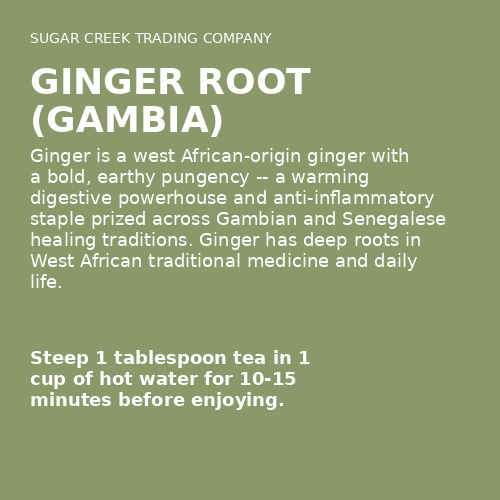
West African-origin ginger with a bold, earthy pungency -- a warming digestive powerhouse and anti-inflammatory staple prized across Gambian and Senegalese healing traditions.
BOTANICAL IDENTIFICATION
Scientific Name: Zingiber officinale Roscoe
Common Names: Ginger, Gambian Ginger, West African Ginger, Ginger Root, Jinjero (Mandinka), Ciitaaru (Fula/Pulaar), Adrak (Hindi), Sheng Jiang (TCM)
Family: Zingiberaceae (Ginger family)
Zingiber officinale is a tropical perennial herb growing 60 to 120 cm tall from a thick, knobby, aromatic rhizome. The plant produces narrow, lance-shaped leaves on reed-like pseudostems and occasionally bears pale yellow flower spikes with purple-lipped margins. The rhizome has a pale yellow interior, fibrous texture, and characteristically pungent, warm flavor. Gambian-grown ginger tends to produce smaller, more compact rhizomes with a notably intense aroma and sharp pungency, reflecting the terroir of West African soils and growing conditions.
Ginger originated in the tropical forests of South and Southeast Asia and was introduced to West Africa centuries ago through Indian Ocean and trans-Saharan trade networks. In The Gambia and neighboring Senegal, Guinea-Bissau, and Sierra Leone, ginger thrives in the warm, humid lowland conditions and laterite soils of the sub-Saharan tropics. West African ginger is increasingly recognized in the global spice trade for its distinctive flavor profile and high oleoresin content.
CULTURAL AND HISTORICAL USE
Ginger has deep roots in West African traditional medicine and daily life. In The Gambia, ginger is central to both culinary practice and indigenous healing systems. Gambian healers use ginger root as a warming digestive remedy, a treatment for coughs and chest congestion, and a general tonic for vitality and strength. Ginger tea, often prepared with honey and lemon or combined with lemongrass and mint, is a ubiquitous household remedy across the Senegambia region. In Mandinka and Wolof healing traditions, ginger is valued for its ability to "warm the blood" and expel cold from the body, a conceptual framework strikingly parallel to its use in TCM and Ayurveda.
West African ginger also occupies a significant cultural role in the production of ginger juice drinks, a beloved beverage across The Gambia, Senegal, and the broader Sahel. Fresh ginger is grated or pounded, strained with water, and sweetened to create a fiery, refreshing drink served at social gatherings, naming ceremonies, and religious celebrations. This preparation is considered both a pleasure drink and a health tonic, reflecting the integrated food-as-medicine philosophy of West African cultures. Ginger is also used in traditional postpartum care, where warming ginger preparations are given to new mothers to restore strength and promote recovery.
Globally, ginger's medicinal use spans over 5,000 years across Ayurvedic, Chinese, Greek, Arabic, and European traditions. It is mentioned in the earliest Ayurvedic texts as "vishwabhesaj" (universal medicine) and in the Chinese Shennong Ben Cao Jing as a foundational warming herb. The Gambian expression of this ancient plant brings its own terroir, tradition, and character to a heritage that stretches across continents and millennia.
KEY BIOACTIVE COMPOUNDS & BENEFITS
| Compound/Class | Location in Plant | Human Benefit | Role in Plant |
|---|---|---|---|
| Gingerols (6-gingerol, 8-gingerol, 10-gingerol) | Rhizome oleoresin | Anti-inflammatory, analgesic, antiemetic, antioxidant, and thermogenic effects | Pungent phenolic compounds that deter herbivory and inhibit microbial colonization |
| Shogaols (6-shogaol, 8-shogaol) | Rhizome (concentrated during drying) | Enhanced anti-inflammatory and anticancer activity; stronger warming effect than gingerols | Dehydration products of gingerols that intensify chemical defense in dried tissue |
| Volatile oils (zingiberene, beta-bisabolene, ar-curcumene, citral) | Rhizome oil glands | Carminative, antimicrobial, and aromatic digestive stimulation | Terpene-based defense against insects, fungi, and soil pathogens |
| Zingerone | Rhizome (formed during cooking/drying) | Antidiarrheal, antioxidant, anti-inflammatory activity | Thermal degradation product contributing to chemical defense profile |
| Paradols | Rhizome oleoresin | Metabolic support, antioxidant, and anti-adipogenic properties | Phenolic compounds related to gingerols with antimicrobial function |
Gambian ginger shares the same core phytochemical profile as ginger from other origins, but growing conditions, soil composition, and post-harvest handling can influence the relative concentration of these compounds. West African ginger is generally noted for its strong pungency and robust volatile oil content, suggesting favorable levels of gingerols and aromatic terpenes. The drying process used in Gambian production converts a portion of gingerols to shogaols, enhancing the warming, anti-inflammatory character of the dried root.
HOW IT WORKS IN THE BODY
Ginger acts through multiple pharmacological pathways, with its effects centering on the digestive, inflammatory, circulatory, and immune systems.
Digestive Support and Antiemetic Action:
Gingerols and shogaols act on serotonin (5-HT3) receptors in the gastrointestinal tract and the chemoreceptor trigger zone in the brainstem, reducing nausea at its neurological source. Ginger simultaneously promotes gastric motility through cholinergic pathways, accelerating gastric emptying and reducing bloating. Its volatile oils relax intestinal smooth muscle, relieving gas and cramping. This multi-target digestive action explains its effectiveness across diverse causes of nausea, from motion sickness to morning sickness to post-surgical recovery.
Anti-Inflammatory and Pain Relief:
6-Gingerol and 6-shogaol inhibit both cyclooxygenase-2 (COX-2) and 5-lipoxygenase (5-LOX) enzymes, suppressing the production of inflammatory prostaglandins and leukotrienes through a dual pathway that parallels but broadens the mechanism of conventional NSAIDs. Ginger also suppresses NF-kB signaling and reduces circulating levels of TNF-alpha and IL-6, key pro-inflammatory cytokines. Clinical trials support its use for osteoarthritis pain, menstrual pain, and exercise-induced muscle soreness.
Circulatory and Warming Effects:
Ginger promotes peripheral vasodilation and increases blood flow to the extremities, producing its characteristic warming sensation. It mildly inhibits platelet aggregation through thromboxane synthetase inhibition, supporting healthy circulation. These properties align with its traditional use in West African and Asian medicine for "warming the blood" and addressing cold constitutions.
Immune and Respiratory Function:
Ginger's volatile oils and phenolic compounds demonstrate broad antimicrobial activity against respiratory pathogens. In West African traditional medicine, ginger tea with honey and lemon is a first-line response to colds, coughs, and chest congestion, working through a combination of warming action, mucolytic stimulation, and direct antimicrobial effects.
DOSE GUIDELINES
| Preparation Type | Typical Dose | Purpose |
|---|---|---|
| Dried root powder | 1-3 g daily, divided into 2-3 doses | Anti-inflammatory support, digestive tonic, circulatory warming |
| Tea/Infusion (dried root) | 1-2 g steeped in hot water for 10-15 minutes | Digestive comfort, nausea relief, warming tonic |
| Decoction (simmered) | 3-5 g simmered in water for 15-20 minutes | Stronger extraction for cold/flu support, deep warming, pain relief |
| Tincture (1:5, 60% ethanol) | 1.5-3 mL, 2-3 times daily | Convenient daily anti-inflammatory and digestive support |
Ginger works well as both an acute remedy and a long-term daily tonic. For nausea, 1-1.5 g dried ginger taken 30 minutes before a triggering event is most effective. For chronic inflammatory conditions, consistent daily use at 2-3 g per day over 4-12 weeks is typical in clinical studies. Gambian ginger's notable pungency means some individuals may prefer to start at the lower end of the dose range and adjust upward to comfort.
PREPARATION AND USES
Dried Gambian ginger root can be prepared as a simple tea by steeping 1-2 grams in hot water for 10-15 minutes, enhanced with honey and lemon for a classic warming tonic. For a stronger preparation, simmer the dried root for 15-20 minutes as a decoction. The powder can be encapsulated for standardized dosing, blended into smoothies or golden milk, or mixed into warm water with honey as a quick digestive aid. In the West African tradition, ginger is pounded or grated and strained with water to create a spicy ginger juice drink that can be sweetened to taste, served cold or warm.
Ginger integrates seamlessly into cooking, and its medicinal and culinary applications overlap extensively. It is a foundation spice across West African, Asian, Indian, Caribbean, and Middle Eastern cuisines. Topically, warm ginger compresses or ginger-infused oil can be applied to sore muscles, stiff joints, or areas of poor circulation. In Gambian postpartum traditions, warming ginger preparations are given to new mothers, and ginger baths are used to restore strength and promote recovery after childbirth.
OPTIMAL CONTEXT FOR USE
Gambian ginger root is especially well-suited for individuals experiencing:
Nausea from any cause, including motion sickness, morning sickness, chemotherapy-related nausea, or post-operative discomfort
Chronic inflammation, joint pain, or osteoarthritis where daily anti-inflammatory support is desired
Sluggish digestion marked by bloating, gas, poor appetite, or slow gastric emptying
Cold extremities, poor peripheral circulation, or a constitutional pattern of feeling perpetually cold
Early-stage colds, coughs, and upper respiratory infections, especially those presenting with chills and congestion
Ginger pairs powerfully with turmeric for enhanced anti-inflammatory effect, with lemongrass and mint for a traditional West African digestive blend, with cinnamon and cardamom for warming chai preparations, and with honey and lemon for immune-supportive tonics. Its broad safety profile makes it suitable for most people as an everyday dietary herb.
SUSTAINABILITY AND ETHICAL HARVESTING
Ginger is one of the world's most widely cultivated spice crops, grown exclusively through vegetative propagation and harvested as an annual root crop. It presents minimal conservation concerns, as it does not rely on wild harvesting. In The Gambia, ginger is grown primarily by smallholder farmers as part of diversified agricultural systems, providing important income for rural communities. West African ginger production supports local livelihoods and contributes to agricultural diversity in the Senegambia region.
Sugar Creek Trading Company sources Gambian ginger root with attention to quality, potency, and the integrity of its West African origin. Supporting Gambian ginger producers helps sustain traditional agricultural knowledge and provides economic benefit to farming communities in one of Africa's smallest nations.
SAFETY AND CAUTIONS
Ginger is classified as Generally Recognized as Safe (GRAS) by the U.S. FDA and holds an exceptional safety record spanning thousands of years of daily use as food and medicine. The American Herbal Products Association (AHPA) rates it Class 1 (safe when used appropriately).
At doses above 5-6 g daily, ginger may cause heartburn, mouth irritation, or mild gastrointestinal discomfort. Gambian ginger's strong pungency means sensitive individuals may benefit from starting with smaller doses.
Ginger has mild antiplatelet activity. Individuals taking anticoagulant or antiplatelet medications (warfarin, aspirin, clopidogrel) should consult a healthcare provider, particularly before surgical procedures. Clinically significant interactions at normal dietary and supplemental doses are rare.
Clinical trials support ginger's safety during pregnancy at doses up to 1-1.5 g dried root daily for nausea relief. Pregnant individuals should consult their healthcare provider before use and avoid excessive doses.
Individuals with gallstones or gallbladder disease should exercise caution, as ginger stimulates bile secretion. Consult a healthcare provider if gallbladder conditions are present.
REFERENCES
Bodagh, M.N., Maleki, I., & Hekmatdoost, A. "Ginger in Gastrointestinal Disorders: A Systematic Review of Clinical Trials." Food Science & Nutrition, 2019; 7(1): 96-108.
Bartels, E.M., Folmer, V.N., Bliddal, H., et al. "Efficacy and Safety of Ginger in Osteoarthritis Patients: A Meta-Analysis of Randomized Placebo-Controlled Trials." Osteoarthritis and Cartilage, 2015; 23(1): 13-21.
Nwinyi, O.C., & Buba, J. "Ethno-botanical Uses and Phytochemical Analysis of Ginger (Zingiber officinale) in West Africa." Journal of Medicinal Plants Research, 2013; 7(27): 2025-2030.
World Health Organization. WHO Monographs on Selected Medicinal Plants, Volume 1: Rhizoma Zingiberis. Geneva, 1999.
FINAL NOTE
Gambian ginger root brings a distinctive West African character to one of the world's most indispensable healing plants. Grown in the warm soils of the Senegambia region by smallholder farmers carrying forward centuries of agricultural tradition, this ginger delivers the same broad-spectrum digestive, anti-inflammatory, and circulatory benefits that have made Zingiber officinale a cornerstone of every major medicine system on Earth. Its bold pungency and robust volatile oil profile make it a standout choice for those who value intensity and depth in their ginger, whether brewed as a fiery tea, stirred into a healing broth, or taken daily to support whole-body wellness.
Condividere