Sugar Creek Trading Company
Ginseng (american)
Ginseng (american)
Impossibile caricare la disponibilità di ritiro
PANAX QUINQUEFOLIUS
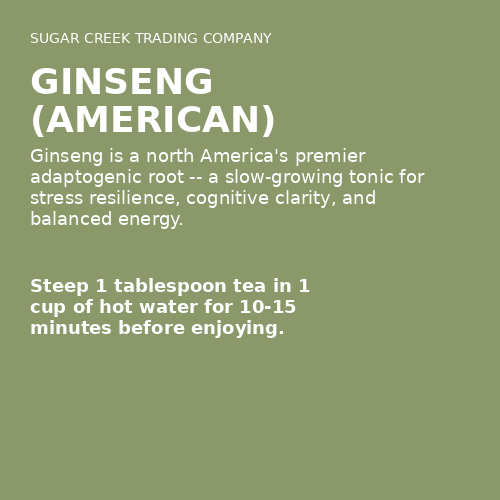
North America's premier adaptogenic root -- a slow-growing tonic for stress resilience, cognitive clarity, and balanced energy.
BOTANICAL IDENTIFICATION
Scientific Name: Panax quinquefolius L.
Common Names: American Ginseng, Sang, Five-Fingers, Garantoquen, Red Berry
Family: Araliaceae (Ivy family)
American Ginseng is a slow-growing perennial herb that reaches 30-60 cm in height. It produces a cluster of three to five palmately compound leaves, each with five serrated leaflets, and bears small greenish-white flowers in summer followed by bright red berry clusters in autumn. The prized root is fleshy, spindle-shaped, and often forked, developing its characteristic gnarled form over many years of growth.
Native to the deciduous hardwood forests of eastern North America, from southern Quebec to Georgia and west to Minnesota, American Ginseng thrives in rich, moist, well-drained soils under the dappled shade of mature hardwood canopy. It is most commonly found on north- or east-facing slopes where cool temperatures and consistent moisture prevail.
CULTURAL AND HISTORICAL USE
Long before European contact, numerous Indigenous nations -- including the Cherokee, Iroquois, Meskwaki, and Menominee -- used American Ginseng as a medicine and ceremonial plant. Cherokee healers valued the root as a general tonic and for digestive complaints, while the Iroquois recognized its ability to strengthen the body during periods of fatigue or illness. The root was considered a powerful plant ally, often gathered with prayers and offerings of tobacco to honor the spirit of the woodland it inhabited.
European settlers learned of ginseng through Indigenous peoples, and by the early 1700s a Jesuit priest named Joseph-Francois Lafitau identified the plant as a close relative of Asian Ginseng (Panax ginseng), which had been a cornerstone of Traditional Chinese Medicine for thousands of years. This discovery ignited a lucrative export trade to China, where American Ginseng was prized for its "cool" or yin-nourishing properties -- considered complementary to the more warming, yang-stimulating nature of Asian Ginseng. In TCM, American Ginseng (Xi Yang Shen) is classified as a qi and yin tonic, prescribed for conditions involving heat, thirst, and depleted fluids.
In Western herbalism, American Ginseng became recognized as a gentle adaptogen suited to individuals who run hot, stressed, or overstimulated -- contrasting with the more stimulating reputation of its Asian cousin. By the 19th and 20th centuries, "sang hunting" became a deeply rooted Appalachian tradition, with families passing down knowledge of secret ginseng patches through generations. Today, American Ginseng remains one of the most culturally and economically significant medicinal plants in North America.
KEY BIOACTIVE COMPOUNDS & BENEFITS
| Compound/Class | Location in Plant | Human Benefit | Role in Plant |
|---|---|---|---|
| Ginsenosides (Rb1, Rg1, Re, Rd) | Root (highest concentration) | Adaptogenic stress modulation, neuroprotection, immune regulation, anti-fatigue | Triterpene saponins that serve as chemical defense against herbivores and pathogens |
| Polysaccharides (ginsenans) | Root | Immune system stimulation, blood sugar regulation | Structural carbohydrates and energy storage |
| Polyacetylenes (panaxynol, panaxydol) | Root | Antimicrobial and cytotoxic activity against abnormal cells | Antifungal defense compounds produced in response to soil pathogens |
| Flavonoids | Leaves and root | Antioxidant protection, cardiovascular support | UV protection and pollinator attraction |
| Peptides and amino acids | Root | Support neurotransmitter synthesis and cellular repair | Nitrogen storage and metabolic building blocks |
American Ginseng's therapeutic profile is primarily driven by its unique ginsenoside composition. Compared to Asian Ginseng, it contains a higher ratio of Rb1-group ginsenosides relative to Rg1-group, which accounts for its more calming, yin-nourishing character. This biochemical distinction underpins its reputation as a cooling adaptogen -- one that restores energy without overstimulation. The polysaccharides and polyacetylenes add broad immune-modulating and antimicrobial dimensions to the root's overall activity.
HOW IT WORKS IN THE BODY
American Ginseng acts on multiple physiological systems simultaneously, characteristic of a true adaptogen that helps normalize body functions under stress.
HPA Axis and Stress Response:
Ginsenosides modulate the hypothalamic-pituitary-adrenal (HPA) axis, helping regulate cortisol output during periods of chronic stress. Rather than simply stimulating or suppressing adrenal function, they promote a balanced stress response -- reducing excessive cortisol while supporting adequate output when needed. This bidirectional activity is the hallmark of adaptogenic action.
Cognitive Function and Neuroprotection:
Ginsenosides Rb1 and Rg1 cross the blood-brain barrier, where they enhance cholinergic neurotransmission, support synaptic plasticity, and protect neurons from oxidative damage. Clinical trials have demonstrated improvements in working memory, reaction time, and mental clarity, particularly under conditions of fatigue or cognitive load.
Blood Sugar Regulation:
American Ginseng has shown consistent ability to reduce postprandial blood glucose levels in both diabetic and non-diabetic individuals. The polysaccharides and ginsenosides appear to improve insulin sensitivity and modulate glucose uptake at the cellular level, making this one of the better-studied herbs for glycemic support.
Immune Modulation:
The polysaccharide fraction stimulates macrophage activity and enhances natural killer cell function, while ginsenosides help regulate inflammatory cytokine production. Clinical research, particularly the COLD-fX studies using a standardized extract, has shown reduced frequency and severity of upper respiratory infections with regular use.
DOSE GUIDELINES
| Preparation Type | Typical Dose | Purpose |
|---|---|---|
| Dried root tea (decoction) | 1-2 g simmered in 250 mL water for 15-20 min, 1-2 times daily | General tonic, stress support, cognitive enhancement |
| Dried root powder | 500 mg - 2 g daily in capsules or stirred into warm water | Adaptogenic support, blood sugar regulation |
| Tincture (1:5, 60% ethanol) | 2-4 mL, 2-3 times daily | Convenient daily adaptogenic use |
| Sliced root (chewed or food) | 1-3 thin slices chewed slowly or added to soups | Traditional tonic use, mild daily support |
American Ginseng is best used as a long-term tonic, taken consistently for weeks to months to build its full adaptogenic effect. Many traditional practitioners recommend cycling use -- for example, three weeks on and one week off -- to maintain the body's responsiveness. For blood sugar support, taking it 30-40 minutes before meals has shown the best results in clinical studies.
PREPARATION AND USES
The most traditional preparation is a gentle decoction: simmer 1-2 grams of dried sliced root in a cup of water for 15-20 minutes, strain, and drink warm. This produces a mildly sweet, slightly bitter tea that can be enjoyed on its own or blended with honey and lemon. The spent root slices can be re-simmered once or twice before discarding, as the ginsenosides extract gradually. For a stronger preparation, some practitioners simmer the root in a double boiler or slow cooker for several hours.
American Ginseng root can also be ground to a fine powder and encapsulated, stirred into smoothies, or blended into warm water or broth. In culinary traditions -- especially Chinese and Korean cooking -- the root is added to chicken soups, congee, and herbal broths where it imparts a subtle sweet-bitter flavor. Tinctures offer a convenient alternative for daily use and have a long shelf life. Topically, ginseng is sometimes included in skincare formulations for its antioxidant properties, though internal use remains the primary application.
OPTIMAL CONTEXT FOR USE
American Ginseng is especially well-suited for individuals experiencing:
Chronic stress, burnout, or adrenal fatigue -- particularly when accompanied by feelings of being "wired but tired" or overheated
Cognitive fog, difficulty concentrating, or mental fatigue from sustained intellectual work or aging
Blood sugar fluctuations or prediabetic patterns, especially postprandial glucose spikes
Recurrent upper respiratory infections or a weakened immune response during cold and flu season
Recovery from illness, surgery, or prolonged physical exertion where the body needs gentle rebuilding without stimulation
American Ginseng pairs well with other adaptogens like Ashwagandha or Eleuthero for comprehensive stress support, and with herbs like Astragalus for enhanced immune function. It is an excellent choice for people who find Asian Ginseng too stimulating or warming.
SUSTAINABILITY AND ETHICAL HARVESTING
Wild American Ginseng is listed under CITES Appendix II and is classified as vulnerable or threatened across much of its native range due to centuries of intensive wild harvesting driven by the lucrative Asian export market. Overharvesting, habitat loss from logging and development, and deer browse pressure have significantly reduced wild populations. In the United States, wild harvest is regulated at the state level, with most states requiring permits, designated harvest seasons (typically September through November), and minimum plant age or size requirements -- generally five years or older with at least three prongs.
Cultivated and woods-grown American Ginseng programs offer a more sustainable path forward. Woods-cultivated ginseng -- grown under natural forest canopy with minimal intervention -- produces roots that closely approximate wild quality while relieving pressure on wild populations. When purchasing American Ginseng, look for cultivated or woods-grown sources, and support vendors who can verify sustainable sourcing. Sugar Creek Trading Company is committed to offering responsibly sourced ginseng that supports both the plant's long-term survival and the rural communities that steward it.
SAFETY AND CAUTIONS
American Ginseng is generally regarded as safe and well-tolerated when used at recommended doses. It has a long history of human use and a favorable safety profile in clinical trials.
Allergies: Rare, but individuals with known allergies to plants in the Araliaceae family should exercise caution. Discontinue use if any rash, itching, or gastrointestinal upset occurs.
Drug interactions: May interact with blood-thinning medications (warfarin), as some studies suggest ginseng can affect INR values. May enhance the effects of hypoglycemic medications, requiring blood sugar monitoring. Consult a healthcare provider if taking immunosuppressants, as ginseng has immune-stimulating properties.
Pregnancy and nursing: Insufficient safety data during pregnancy and lactation. Most practitioners recommend avoiding use during these periods as a precaution.
Caffeine and stimulants: While American Ginseng is less stimulating than Asian Ginseng, sensitive individuals may experience mild insomnia or restlessness, especially when combined with caffeine. Start with lower doses and take earlier in the day if this occurs.
REFERENCES
Qi, L. W., Wang, C. Z., & Yuan, C. S. (2011). Ginsenosides from American ginseng: Chemical and pharmacological diversity. Phytochemistry, 72(8), 689-699.
Vuksan, V., et al. (2000). American ginseng (Panax quinquefolius L) reduces postprandial glycemia in nondiabetic subjects and subjects with type 2 diabetes mellitus. Archives of Internal Medicine, 160(7), 1009-1013.
Predy, G. N., et al. (2005). Efficacy of an extract of North American ginseng containing poly-furanosyl-pyranosyl-saccharides for preventing upper respiratory tract infections. Canadian Medical Association Journal, 173(9), 1043-1048.
FINAL NOTE
American Ginseng embodies the quiet strength of the eastern woodlands where it grows -- patient, deeply rooted, and profoundly restorative. Where many adaptogens push the body forward, this root gently lifts from beneath, replenishing depleted reserves without the heat or agitation that can accompany stronger tonics. For anyone navigating the demands of modern life while seeking a grounded, sustainable source of vitality, American Ginseng remains one of the most balanced and time-honored allies in the plant kingdom.
Condividere