Sugar Creek Trading Company
Goji Berry
Goji Berry
Impossibile caricare la disponibilità di ritiro
LYCIUM BARBARUM
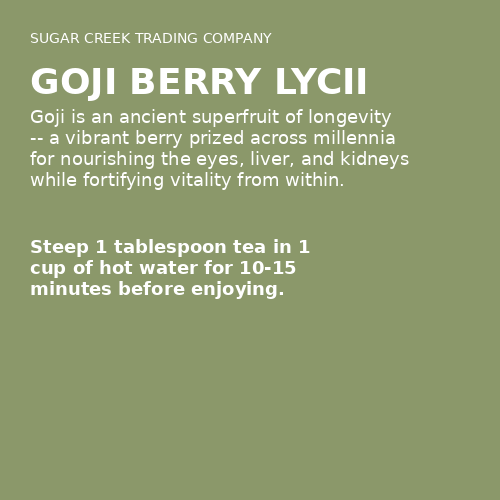
Ancient superfruit of longevity -- a vibrant berry prized across millennia for nourishing the eyes, liver, and kidneys while fortifying vitality from within.
BOTANICAL IDENTIFICATION
Scientific Name: Lycium barbarum L. (also Lycium chinense Mill.)
Common Names: Goji Berry, Wolfberry, Lycii Berry, Gou Qi Zi, Matrimony Vine Berry, Duke of Argyll's Tea Tree
Family: Solanaceae (Nightshade family)
Goji is a deciduous woody shrub that grows 1-3 meters tall with long, arching, sometimes thorny branches. The leaves are lance-shaped and grey-green, and the plant produces small, funnel-shaped purple flowers from late spring through summer. The fruit is a bright orange-red, oval berry approximately 1-2 cm long that ripens in late summer and autumn, drying to a deep reddish-orange with a sweet, slightly tangy flavor.
Native to the arid and semi-arid regions of northwestern China, Mongolia, and the Tibetan Plateau, Goji is remarkably hardy and drought-tolerant. It thrives in alkaline soils and full sun at elevations ranging from lowland valleys to mountain slopes above 2,500 meters. The Ningxia Hui Autonomous Region of China is considered the premier growing region, where the Yellow River's mineral-rich alluvial soils produce berries of exceptional quality.
CULTURAL AND HISTORICAL USE
Goji Berry holds an almost mythic status in Traditional Chinese Medicine, where it has been used continuously for over 2,000 years. First recorded in the Shen Nong Ben Cao Jing (Divine Farmer's Materia Medica), one of the oldest herbal texts in existence, Goji was classified as a superior-grade herb -- meaning it could be taken daily over a lifetime to promote longevity without toxicity. In TCM, Gou Qi Zi nourishes Liver and Kidney yin, tonifies blood, and brightens the eyes. It is one of the most frequently prescribed herbs for conditions involving blurred vision, dizziness, lower back weakness, and premature aging.
Chinese folklore is rich with stories linking Goji to extraordinary longevity. One well-known legend describes Li Qing Yuen, a herbalist said to have lived over 250 years, who attributed his lifespan in part to daily consumption of Goji berries. While such tales are apocryphal, they reflect the deep cultural reverence for this berry as a life-extending food. In traditional practice, Goji berries are commonly added to soups, porridges, teas, and herbal wine, and are also paired with Chrysanthemum flowers in a classic tea for eye health.
Beyond China, Goji berries have been used in Tibetan and Mongolian medicine for kidney support and vitality. In the early 2000s, Goji gained widespread Western attention as a "superfood," driven by its remarkable antioxidant density and nutrient profile. While some of the marketing hype has been exaggerated, the underlying traditional and scientific evidence for Goji's health benefits is genuinely robust, and the berry has earned a lasting place in both Eastern and Western herbal traditions.
KEY BIOACTIVE COMPOUNDS & BENEFITS
| Compound/Class | Location in Plant | Human Benefit | Role in Plant |
|---|---|---|---|
| Lycium barbarum polysaccharides (LBP) | Fruit | Immune modulation, antioxidant, neuroprotection, blood sugar regulation | Complex carbohydrates involved in cell wall structure and energy storage |
| Zeaxanthin (and lutein) | Fruit | Macular protection, reduces risk of age-related vision loss | Carotenoid pigments that protect plant tissues from UV and photo-oxidative damage |
| Beta-carotene and other carotenoids | Fruit | Provitamin A activity, skin health, antioxidant protection | Light-harvesting pigments and photoprotection |
| Betaine | Fruit | Liver protection, supports methylation and homocysteine metabolism | Osmotic stress protectant in arid growing conditions |
| Vitamins C, B1, B2 and minerals (iron, zinc, selenium) | Fruit | Broad nutritional support, antioxidant defense, immune function | Essential cofactors for plant enzyme systems and metabolic processes |
Goji Berry's therapeutic power centers on its Lycium barbarum polysaccharides (LBP), which represent 5-8% of the dried fruit's weight and have been the subject of extensive research. These complex sugar molecules are responsible for many of the berry's immune-modulating, anti-aging, and neuroprotective effects. Combined with one of the highest natural concentrations of zeaxanthin found in any food, a rich carotenoid profile, and meaningful levels of essential vitamins and trace minerals, Goji delivers an unusually broad spectrum of bioactive nutrition in a single, palatable fruit.
HOW IT WORKS IN THE BODY
Goji Berry acts as a nutritive tonic that supports multiple organ systems through both direct biochemical activity and broad-spectrum nutritional fortification.
Eye Health and Vision Protection:
Goji berries are among the richest natural sources of zeaxanthin, a carotenoid that accumulates in the macula of the eye where it filters harmful blue light and neutralizes free radicals. Regular consumption increases plasma zeaxanthin levels and macular pigment optical density, helping protect against age-related macular degeneration and oxidative damage to the retina. This mechanism directly underlies the TCM use of Goji for "brightening the eyes."
Immune System Support:
LBP polysaccharides stimulate the proliferation and activity of lymphocytes, macrophages, and natural killer cells. They also promote the production of cytokines like interleukin-2 and tumor necrosis factor-alpha, enhancing the body's innate and adaptive immune responses. This immunomodulatory activity appears to be balanced rather than purely stimulatory, helping the immune system respond more effectively without driving excessive inflammation.
Antioxidant and Anti-Aging Activity:
The combined antioxidant capacity of LBP, carotenoids, vitamin C, and selenium gives Goji one of the highest ORAC (Oxygen Radical Absorbance Capacity) scores among dried fruits. These compounds work synergistically to neutralize reactive oxygen species, reduce oxidative damage to DNA and cell membranes, and support the body's endogenous antioxidant enzyme systems including superoxide dismutase (SOD) and glutathione peroxidase.
Liver and Kidney Nourishment:
Betaine supports liver function by acting as a methyl donor in the conversion of homocysteine to methionine, a critical detoxification and methylation pathway. LBP has shown hepatoprotective effects in animal models, reducing liver enzyme elevation and oxidative damage. These mechanisms align with the TCM classification of Goji as a Liver and Kidney yin tonic.
DOSE GUIDELINES
| Preparation Type | Typical Dose | Purpose |
|---|---|---|
| Dried berries (eaten whole) | 15-30 g (a small handful) daily | General tonic, eye health, nutritional support |
| Berry tea/infusion | 15-30 g steeped in hot water for 10-15 min, drink tea and eat berries | Gentle daily tonic, hydration, vision support |
| Decoction (in soups/broths) | 15-45 g added to cooking liquid | Deep nourishment, Liver/Kidney yin tonification |
| Powder | 3-10 g daily in smoothies, oatmeal, or capsules | Concentrated nutritional and antioxidant support |
Goji Berry is a food-grade tonic meant for consistent, long-term daily use. In TCM, it is typically taken for months or years as part of a nourishing regimen. The berries are mild enough to be eaten as a snack, blended into trail mix, or added to virtually any meal. For therapeutic eye support, consistent daily intake of at least 15 g of dried berries (or equivalent) over several months is recommended based on clinical research.
PREPARATION AND USES
Dried Goji berries are the most common form and are wonderfully versatile. They can be eaten straight from the bag as a chewy, mildly sweet snack, or soaked in hot water for 10-15 minutes to make a simple tea -- drink the infusion and eat the softened berries for full benefit. In cooking, add them to oatmeal, granola, trail mix, rice porridge (congee), soups, stir-fries, and baked goods. A classic Chinese preparation combines Goji berries with Chrysanthemum flowers and hot water for a traditional eye-nourishing tea. They also pair beautifully with Jujube dates, Astragalus root, and Codonopsis in tonic herbal soups.
For more concentrated use, Goji berries can be ground into a powder and added to smoothies, encapsulated, or blended into energy balls. Goji-infused honey, vinegar, and herbal wines are traditional preparations that extract the berries' compounds over time. The berries can also be rehydrated and blended into sauces, dressings, or jam. Whatever the form, the key is daily consistency -- Goji reveals its full potential as a tonic when used as a regular part of the diet rather than an occasional supplement.
OPTIMAL CONTEXT FOR USE
Goji Berry is especially well-suited for individuals experiencing:
Eye strain, blurred vision, or early signs of age-related macular degeneration -- particularly for those who spend long hours at screens
General fatigue, low vitality, or a feeling of being depleted and run-down, especially from overwork or aging
Weakened immune function or frequent susceptibility to colds and infections
Premature aging concerns, including skin dullness, low antioxidant status, and oxidative stress
Lower back pain, dizziness, or night sweats associated with Kidney yin deficiency in TCM terms
Goji berries combine beautifully with Chrysanthemum for eye health, with Astragalus and Reishi for immune support, and with Schisandra and He Shou Wu for anti-aging and vitality protocols. As a gentle, nourishing food-herb, they can be safely integrated into almost any wellness regimen.
SUSTAINABILITY AND ETHICAL HARVESTING
Goji Berry is primarily a cultivated crop with no significant conservation concerns regarding wild populations. The vast majority of commercially available Goji berries come from large-scale cultivation in China's Ningxia, Gansu, Qinghai, and Xinjiang provinces, with Ningxia producing the most prized berries. The plant is also increasingly grown in North America, Europe, and other regions as interest in the fruit has expanded globally.
When sourcing Goji berries, quality and purity are the primary ethical considerations. Look for berries that are free of excessive sulfite treatment (sometimes used to preserve bright color), heavy metals, and pesticide residues. Organic certification and third-party lab testing provide the most reliable assurance of quality. Sugar Creek Trading Company selects Goji berries that meet rigorous quality standards, ensuring you receive a clean, potent product that honors this ancient fruit's heritage.
SAFETY AND CAUTIONS
Goji Berry is a food-grade herb with an excellent safety profile and thousands of years of continuous dietary use. It is generally well-tolerated by the vast majority of people.
Nightshade sensitivity: Goji belongs to the Solanaceae (nightshade) family. Individuals with known sensitivities to nightshades (tomatoes, peppers, eggplant) should introduce Goji cautiously and monitor for any digestive discomfort or inflammatory reactions.
Blood-thinning medications: Goji berries may interact with warfarin and other anticoagulants, potentially increasing the risk of bleeding. Several case reports have documented elevated INR values in patients consuming Goji while on warfarin. Consult your healthcare provider before regular use if you take blood thinners.
Blood pressure and diabetes medications: Because Goji may modestly lower blood pressure and blood sugar, those on antihypertensive or hypoglycemic drugs should monitor their levels and consult a practitioner to avoid additive effects.
Pregnancy and nursing: While Goji has been consumed as a food during pregnancy in traditional cultures, some TCM practitioners advise moderation. Betaine may have mild uterine-stimulating properties at very high doses. Consult a qualified practitioner for guidance during pregnancy.
REFERENCES
Amagase, H., & Farnsworth, N. R. (2011). A review of botanical characteristics, phytochemistry, clinical relevance in efficacy and safety of Lycium barbarum fruit (Goji). Food Research International, 44(7), 1702-1717.
Cheng, C. Y., et al. (2005). Fasting plasma zeaxanthin response to Fructus barbarum L. (wolfberry; Kei Tze) in a food-based human supplementation trial. British Journal of Nutrition, 93(1), 123-130.
Gan, L., et al. (2004). Immunomodulation and antitumor activity by a polysaccharide-protein complex from Lycium barbarum. International Immunopharmacology, 4(4), 563-569.
FINAL NOTE
Goji Berry is one of those rare botanicals that straddles the line between food and medicine so gracefully that the distinction almost disappears. Its sweetness makes it accessible, its nutrient density makes it nourishing, and its millennia of documented use make it trustworthy. Whether stirred into morning oatmeal or simmered into an evening broth, Goji quietly goes to work -- brightening the eyes, steadying the blood, and building the deep reserves of vitality that sustain us through the long arc of a well-lived life.
Condividere