Sugar Creek Trading Company
Gravel Root
Gravel Root
Impossibile caricare la disponibilità di ritiro
EUPATORIUM PURPUREUM
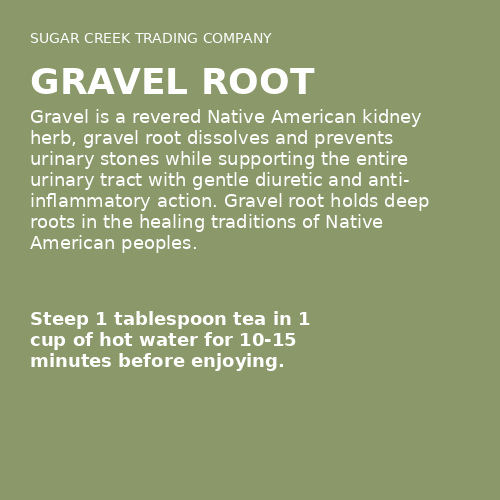
A revered Native American kidney herb, gravel root dissolves and prevents urinary stones while supporting the entire urinary tract with gentle diuretic and anti-inflammatory action.
BOTANICAL IDENTIFICATION
Scientific Name: Eupatorium purpureum L. (syn. Eutrochium purpureum)
Common Names: Gravel Root, Joe Pye Weed, Queen of the Meadow, Kidney Root, Purple Boneset, Trumpet Weed
Family: Asteraceae (Compositae)
Eupatorium purpureum is a striking, tall perennial herb reaching 1 to 3 meters in height, with sturdy, hollow, purple-spotted stems and whorls of lance-shaped, serrated leaves arranged in groups of three to five. In late summer, it produces dense, dome-shaped clusters of dusty pink to purple flowers that attract a profusion of butterflies and pollinators. The root system is a thick, fibrous, woody rhizome with a distinctive vanilla-like aroma when fresh.
Native to eastern North America, gravel root thrives in moist meadows, stream banks, woodland edges, and damp thickets from southern Canada through the eastern United States. It prefers rich, moist soil with partial shade to full sun and is often found growing alongside boneset, ironweed, and other moisture-loving natives.
CULTURAL AND HISTORICAL USE
Gravel root holds deep roots in the healing traditions of Native American peoples. The Cherokee, Iroquois, and other Eastern Woodland nations used root decoctions extensively for urinary complaints, kidney stones, and bladder infections. The common name "Joe Pye Weed" is believed to reference a Mohican healer named Joe Pye (or Jopi), who gained fame in colonial New England for using the plant to treat typhus fever and urinary ailments. The name "gravel root" directly references its traditional application for dissolving urinary gravel and kidney stones.
Eclectic physicians of the 19th century, including John King, Harvey Wickes Felter, and John Uri Lloyd, regarded gravel root as one of the most important kidney remedies in the American materia medica. King's American Dispensatory described it as a reliable treatment for chronic kidney and bladder irritation, dropsy, and stone formation. The Eclectics valued it particularly for its ability to soothe irritated urinary mucosa while simultaneously promoting the passage of calculi.
In Appalachian folk medicine, gravel root tea was a household remedy for "the gravel" (kidney stones), painful urination, and water retention. It was often combined with corn silk, marshmallow root, or hydrangea root for comprehensive urinary support. This tradition of use has continued largely unbroken into modern Western herbalism, where gravel root remains a first-line botanical for urinary lithiasis and chronic urinary tract conditions.
KEY BIOACTIVE COMPOUNDS & BENEFITS
| Compound/Class | Location in Plant | Human Benefit | Role in Plant |
|---|---|---|---|
| Euparin and eupatorin (benzofurans/flavonoids) | Root, rhizome | Anti-inflammatory to urinary mucosa; mild antimicrobial activity against urinary pathogens | Defense compounds against soil pathogens and herbivores |
| Essential oil (including eupatol) | Root, leaves | Gentle diuretic action; supports renal blood flow; mild antiseptic to urinary passages | Volatile defense and communication compounds |
| Flavonoids (quercetin, kaempferol glycosides) | Leaves, flowers, root | Antioxidant protection of renal tissue; anti-inflammatory; support vascular integrity in kidneys | UV protection; pollinator attraction; antioxidant defense |
| Resin and oleoresin complex | Root | Thought to contribute to stone-dissolving properties; supports passage of urinary sediment | Wound-sealing and antimicrobial defense at root surface |
| Tannins | Root, stem | Astringent and tissue-toning to urinary mucosa; reduces excess mucus and bleeding | Structural defense; deters herbivory; antimicrobial |
Gravel root's therapeutic profile reflects a carefully balanced combination of gentle diuresis, anti-inflammatory soothing of urinary mucosa, and a still-incompletely-understood ability to discourage the crystallization and aggregation of mineral salts in the urinary tract. The Eclectic physicians observed that it both eased the passage of existing stones and helped prevent new formation, a dual action that modern research has yet to fully characterize but clinical experience continues to confirm.
HOW IT WORKS IN THE BODY
Gravel root acts primarily on the urinary system, with supporting effects on fluid balance and musculoskeletal comfort.
Urinary Stone Prevention and Dissolution:
The root's resinous and flavonoid compounds appear to alter the pH and mineral saturation of urine in ways that discourage crystal nucleation and aggregation, particularly of calcium oxalate and uric acid stones. By increasing urine volume through gentle diuresis and altering urinary chemistry, gravel root creates conditions less favorable to stone formation. Traditional use and clinical observation suggest it also helps relax the smooth muscle of the ureters, facilitating the passage of small stones and gravel.
Anti-Inflammatory and Mucosal Soothing:
Euparin and related benzofuran compounds reduce inflammation in the urothelium (the mucosal lining of the urinary tract), providing relief from the burning, urgency, and discomfort associated with chronic cystitis, urethritis, and the irritation caused by passing crystalline sediment. This soothing action distinguishes gravel root from purely diuretic herbs.
Diuretic Action:
Gravel root promotes increased urine production through a gentle, non-depleting mechanism that does not aggressively flush electrolytes. This increased urine flow dilutes mineral concentrations, reduces urinary stasis, and helps flush bacteria and debris from the urinary passages. The diuretic effect also makes it useful for mild edema and fluid retention.
Musculoskeletal Support:
Traditional use includes application for joint pain and rheumatic complaints, likely related to the herb's ability to promote uric acid excretion and reduce inflammatory load. Gout and gouty arthritis were among the conditions the Eclectic physicians addressed with gravel root.
DOSE GUIDELINES
| Preparation Type | Typical Dose | Purpose |
|---|---|---|
| Decoction (root) | 1-2 teaspoons dried root per cup, simmered 15-20 minutes; 2-3 cups daily | Kidney stone prevention and passage; chronic urinary support |
| Tincture (1:5, 40% alcohol) | 2-4 mL (40-80 drops), 3 times daily | Convenient daily urinary tract support |
| Capsules (powdered root) | 500-1,000 mg, 2-3 times daily | Maintenance dose for stone prevention |
| Cold infusion (overnight) | 1 tablespoon root in 1 pint cold water, steeped overnight | Gentle extraction preserving volatile compounds; for sensitive individuals |
Gravel root is typically used in sustained courses of 4-12 weeks for stone prevention and chronic urinary conditions. During acute stone episodes, it may be combined with antispasmodic herbs and used more frequently under practitioner supervision. Adequate water intake (at least 8-10 glasses daily) is essential when using gravel root to maximize its diuretic and stone-preventing effects.
PREPARATION AND USES
The most traditional and effective preparation is a root decoction. Simmer 1-2 teaspoons of dried, chopped gravel root in 10-12 ounces of water for 15-20 minutes, then strain. The resulting tea has a mild, slightly sweet, vanilla-tinged flavor that most people find pleasant. Drink 2-3 cups daily between meals for kidney and urinary support. For enhanced stone-dissolving protocols, gravel root decoction is often combined with hydrangea root, marshmallow root, and corn silk in equal parts.
Tincture preparations are convenient for long-term use and travel. Powdered root can be encapsulated for those who prefer not to prepare teas. For acute urinary tract infections, gravel root is often combined with uva ursi, juniper berry, or pipsissewa in short-term formulas. Some herbalists prepare a gravel root syrup with honey for more palatable long-term dosing. The root should be harvested in autumn after the aerial parts die back, when the underground portions are at peak potency.
OPTIMAL CONTEXT FOR USE
Gravel root is especially well-suited for individuals experiencing:
History of kidney stones or urinary gravel, particularly calcium oxalate or uric acid stones, seeking prevention of recurrence
Chronic urinary tract irritation, interstitial cystitis, or recurrent urinary infections with burning and discomfort
Mild to moderate fluid retention, edema, or puffy swelling in the lower extremities
Gout, elevated uric acid levels, or rheumatic joint pain related to poor waste elimination through the kidneys
Prostate-related urinary difficulty in men, as a supportive diuretic and anti-inflammatory
Gravel root works synergistically with marshmallow root (for mucosal soothing), hydrangea root (for stone dissolution), corn silk (for gentle diuresis), and nettle leaf (for kidney tonic support). Dietary modifications, particularly increased water intake and reduced oxalate-rich foods, should accompany any stone prevention protocol.
SUSTAINABILITY AND ETHICAL HARVESTING
Eupatorium purpureum is native to eastern North America and remains relatively common in its preferred moist meadow and woodland edge habitats. However, habitat loss due to wetland drainage, development, and agricultural conversion has reduced wild populations in some regions. Responsible wildcrafting should harvest only a portion of root from established colonies, leaving the majority of plants undisturbed to maintain population viability.
Gravel root is readily cultivated in garden settings and is increasingly grown by herb farms, which is the preferred sourcing method. It is also a beautiful, wildlife-supporting ornamental that attracts butterflies and beneficial insects. Supporting cultivated sources reduces pressure on wild populations and encourages the expansion of this ecologically valuable native plant. United Plant Savers lists it on the "To Watch" list, indicating that responsible stewardship is warranted.
SAFETY AND CAUTIONS
Gravel root is considered safe for most adults when used at recommended doses for appropriate durations.
Contains trace amounts of pyrrolizidine alkaloids (PAs), though at significantly lower levels than hepatotoxic Senecio or Symphytum species. Extended use beyond 4-6 weeks at high doses should be discussed with a healthcare provider. Choose products tested for PA content when possible.
Individuals with kidney disease or severe renal impairment should consult a healthcare provider before using any diuretic herb, including gravel root.
Pregnant and nursing women should avoid gravel root due to insufficient safety data and the theoretical concern regarding pyrrolizidine alkaloid content.
Those with allergies to plants in the Asteraceae (daisy) family may experience cross-reactive sensitivity. Discontinue use if any allergic reaction occurs.
Large kidney stones may require medical intervention. Gravel root should not be used as a substitute for medical care in cases of severe pain, urinary obstruction, or infection with fever.
REFERENCES
Felter, H.W. & Lloyd, J.U. (1898). King's American Dispensatory. Ohio Valley Company. (Entry on Eupatorium purpureum.)
Moerman, D.E. (1998). Native American Ethnobotany. Timber Press. (Documented uses of E. purpureum by Cherokee, Iroquois, and other nations.)
Hoffmann, D. (2003). Medical Herbalism: The Science and Practice of Herbal Medicine. Healing Arts Press. (Section on urinary system herbs including gravel root.)
FINAL NOTE
Gravel root is one of those rare botanicals whose common name tells you exactly what it does. For centuries, the peoples of eastern North America have turned to this tall, stately meadow herb when the kidneys needed help moving mineral sediment and the urinary tract needed relief from chronic irritation. In an era when kidney stone prevalence is rising due to diet and dehydration, the gentle wisdom of gravel root remains as relevant as it was when Joe Pye first shared it with colonial settlers. It is a kidney ally in the truest sense, working not through force but through patient, sustained support of the body's own eliminative intelligence.
Condividere