Sugar Creek Trading Company
Harsinger Herb Night Jasmine
Harsinger Herb Night Jasmine
Impossibile caricare la disponibilità di ritiro
NYCTANTHES ARBOR-TRISTIS
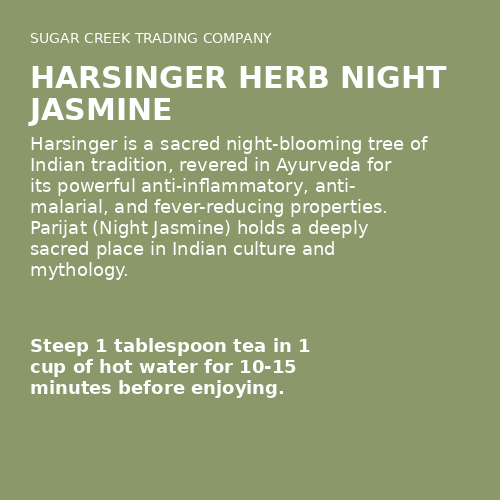
A sacred night-blooming tree of Indian tradition, revered in Ayurveda for its powerful anti-inflammatory, anti-malarial, and fever-reducing properties.
BOTANICAL IDENTIFICATION
Scientific Name: Nyctanthes arbor-tristis L.
Common Names: Harsinger, Night Jasmine, Parijat, Parijata, Shefali, Har Singar, Coral Jasmine, Tree of Sorrow, Queen of the Night
Family: Oleaceae (Olive family)
Nyctanthes arbor-tristis is a small deciduous tree or large shrub growing 10 to 30 feet tall with rough, flaky gray bark and opposite, simple leaves that are broadly ovate with a coarsely toothed margin. Its most distinctive feature is its intensely fragrant white flowers with vivid orange-red tubular stalks (pedicels), which bloom only at night and drop to the ground by dawn, carpeting the earth beneath the tree in white and orange.
Native to the Indian subcontinent, from the sub-Himalayan regions across South and Southeast Asia, the tree thrives in tropical and subtropical climates at low to moderate elevations. It grows in a wide range of soils but prefers well-drained conditions with moderate moisture. The tree is commonly found in temple gardens, courtyards, and roadsides throughout India, Nepal, Thailand, and Indonesia.
CULTURAL AND HISTORICAL USE
Parijat (Night Jasmine) holds a deeply sacred place in Indian culture and mythology. In Hindu tradition, the tree is believed to have emerged from the churning of the cosmic ocean (Samudra Manthan) and was a source of conflict between the gods Indra and Krishna. According to the Bhagavata Purana, Krishna brought the parijat tree from heaven to earth to please his wife Satyabhama. The tree's habit of blooming at night and shedding its flowers by morning has inspired the poetic name "Tree of Sorrow" (arbor-tristis), evoking themes of beauty, impermanence, and devotion.
In Ayurvedic medicine, the leaves, flowers, bark, and seeds of Nyctanthes arbor-tristis have been used for centuries as a potent remedy for fevers, particularly intermittent fevers associated with malaria. The Bhavaprakash Nighantu, a classical Ayurvedic text, describes parijat as bitter, astringent, and heating, with the ability to pacify Kapha and Vata doshas. Village healers across India have long prepared a decoction of the leaves as a frontline treatment for febrile illness, joint pain, and intestinal worms.
In folk medicine traditions of Nepal, Bangladesh, and Indonesia, the plant is used similarly for fever, sciatica, arthritis, and fungal infections. The bright orange pedicels of the flowers have traditionally been used as a natural dye for coloring silk and cotton fabrics, as well as for making sacred tilak markings and offerings in Hindu temples. The plant thus bridges the medicinal, spiritual, and artistic dimensions of South Asian culture.
KEY BIOACTIVE COMPOUNDS & BENEFITS
| Compound/Class | Location in Plant | Human Benefit | Role in Plant |
|---|---|---|---|
| Iridoid Glycosides (Arbortristoside-A, -B, -C, Nyctanthoside) | Leaves & Seeds | Anti-malarial, anti-leishmanial, anti-inflammatory, immune-modulating | Chemical defense against herbivores and pathogens |
| Nyctanthic Acid | Leaves | Anti-inflammatory, fever reduction, analgesic | Stress-response compound in leaf tissue |
| Crocin & Crocetin (Carotenoid pigments) | Flower pedicels (orange tubes) | Antioxidant, neuroprotective, mood-enhancing (related to saffron compounds) | Pigmentation for pollinator signaling |
| Flavonoids (Astragalin, Nicotiflorin, Quercetin) | Leaves & Flowers | Antioxidant, anti-inflammatory, hepatoprotective | UV protection and antimicrobial defense |
| Tannic Acid & Phenolic Compounds | Bark & Leaves | Astringent, antimicrobial, anti-diarrheal | Herbivore deterrent and wound-sealing compounds |
The signature compounds of Night Jasmine are its iridoid glycosides—particularly the arbortristosides—which are largely unique to this species and are responsible for its remarkable anti-malarial, anti-inflammatory, and anti-parasitic activity. The presence of crocin (the same pigment found in saffron) in the flower pedicels adds an unusual antioxidant and neuroprotective dimension rarely found in other medicinal plants.
HOW IT WORKS IN THE BODY
Night Jasmine's therapeutic effects center on immune modulation, inflammation control, and direct antimicrobial activity, reflecting its primary traditional use as a fever and infection remedy.
Anti-malarial and Antiparasitic Activity:
The arbortristoside compounds have demonstrated significant activity against Plasmodium falciparum (the malaria parasite) in both in vitro and in vivo studies. They interfere with the parasite's ability to replicate within red blood cells. This pharmacological action validates centuries of Ayurvedic use of parijat leaf decoction as a first-line treatment for intermittent fevers. The iridoid glycosides also show activity against Leishmania parasites and intestinal helminths (worms).
Anti-inflammatory and Analgesic Effects:
Nyctanthic acid and the iridoid glycosides inhibit pro-inflammatory mediators including prostaglandins and leukotrienes, providing measurable reduction in inflammation and pain. Research has shown activity comparable to standard anti-inflammatory drugs in animal models of arthritis and edema. This supports the traditional use of parijat for sciatica, joint pain, and arthritis.
Immunomodulation:
Rather than simply suppressing or stimulating the immune system, Night Jasmine appears to modulate immune function—enhancing it when needed (as in fighting infection) and regulating excessive responses (as in inflammatory and autoimmune conditions). Studies have shown increased macrophage activity and adjusted T-cell responses in animal models.
Hepatoprotective and Antioxidant Support:
The flavonoids and phenolic compounds in Night Jasmine protect liver cells from oxidative damage and support healthy liver enzyme function. Crocin and crocetin contribute potent antioxidant activity that extends to neuroprotective effects, potentially supporting cognitive health and mood.
DOSE GUIDELINES
| Preparation Type | Typical Dose | Purpose |
|---|---|---|
| Leaf decoction (traditional) | 2–3 fresh or dried leaves simmered in 1 cup water for 10–15 min | Fever reduction, anti-malarial, general immune support |
| Dried leaf powder | 1–3 g powder, 1–2 times daily with warm water or honey | Anti-inflammatory, joint pain, digestive parasites |
| Infusion (flowers and leaves) | 1–2 tsp dried herb per cup boiling water, steep 10–15 min | Mild daily immune tonic, antioxidant support |
| Bark decoction | ½–1 tsp dried bark powder simmered in water | Stronger astringent and antimicrobial applications |
For acute fever or infection, the traditional approach is to take a strong leaf decoction 2–3 times daily for 3–7 days. For chronic conditions such as arthritis or sciatica, lower doses taken consistently over several weeks are preferred. Night Jasmine is most commonly used as a short-to-medium-course remedy rather than a lifelong daily tonic, though mild tea preparations can be enjoyed more regularly.
PREPARATION AND USES
The most traditional preparation is a simple leaf decoction: take 2–3 dried leaves (or the equivalent in dried powder), add to one cup of water, bring to a gentle boil, and simmer for 10–15 minutes. Strain and drink warm, optionally with honey to offset the bitter taste. This is the classic Ayurvedic preparation for fevers and is best taken on an empty stomach in the morning for maximum absorption.
The dried leaf powder can be encapsulated for those who find the bitter taste challenging, or mixed into honey paste (a preparation known as "lehyam" in Ayurvedic pharmacy). The orange flower pedicels can be steeped in warm water to make a golden-colored tea with mild antioxidant properties and a faint, pleasant floral aroma. For joint pain and sciatica, some practitioners prepare a paste of the leaves with sesame oil for external application to affected areas, combining internal and external use for enhanced benefit.
OPTIMAL CONTEXT FOR USE
This herb is especially well-suited for individuals experiencing:
Recurrent or intermittent fevers, particularly where conventional anti-malarial support is desired alongside or in place of standard treatment
Chronic joint inflammation, sciatica, or arthritis seeking a traditional anti-inflammatory botanical alternative
Intestinal parasites or worms, as a traditional antiparasitic remedy
General immune support during seasonal illness or when exposed to infectious environments
Interest in Ayurvedic rasayana and traditional Indian medicine for overall vitality and resilience
Night Jasmine combines well with turmeric and ginger for enhanced anti-inflammatory and circulatory effects, with neem for broader antimicrobial support, and with ashwagandha for immune modulation during recovery from illness. In Ayurvedic practice, it is often combined with black pepper or long pepper (pippali) to improve bioavailability.
SUSTAINABILITY AND ETHICAL HARVESTING
Nyctanthes arbor-tristis is widely distributed across South and Southeast Asia and is commonly cultivated as an ornamental and medicinal tree in home gardens, temple grounds, and community plantations. It is not currently listed as threatened or endangered by any conservation body. The tree propagates readily from seeds and cuttings, grows relatively quickly, and begins flowering within 2–3 years of planting.
Leaf harvesting, the primary method for medicinal use, does not harm the tree and can be done sustainably throughout the growing season. The flowers fall naturally each morning and can be gathered from the ground without any impact on the tree. Supporting cultivation programs in rural India and Southeast Asia helps preserve traditional botanical knowledge while providing supplemental income for farming communities.
SAFETY AND CAUTIONS
Night Jasmine has a long history of traditional use with a generally favorable safety profile, but as a potent medicinal herb, it should be used with appropriate awareness.
Pregnancy and nursing: Night Jasmine is traditionally avoided during pregnancy due to potential uterotonic effects. The arbortristoside compounds have not been adequately studied for safety during pregnancy and lactation. Avoid use during pregnancy and consult a practitioner if nursing.
Blood sugar effects: Some research suggests hypoglycemic activity. Individuals taking diabetes medications should monitor blood sugar and consult a healthcare provider before regular use.
Gastrointestinal sensitivity: The bitter iridoid compounds may cause nausea or stomach upset in sensitive individuals, particularly at higher doses or on an empty stomach. Start with a low dose and take with food if needed.
Autoimmune conditions: Due to its immunomodulatory effects, individuals with autoimmune conditions should use with caution and under practitioner guidance, as immune-modulating herbs can sometimes exacerbate certain autoimmune presentations.
REFERENCES
Saxena, R. S., Gupta, B., Saxena, K. K., Singh, R. C., & Prasad, D. N. (1984). "Study of anti-inflammatory activity in the leaves of Nyctanthes arbor-tristis Linn.—An Indian medicinal plant." Journal of Ethnopharmacology, 11(3), 319–330.
Rathore, B., Paul, B., Chaudhury, B. P., Saxena, A. K., Sahu, A. P., & Gupta, Y. K. (2007). "Comparative studies of different organs of Nyctanthes arbor-tristis in modulation of cytokines in murine model of arthritis." Biomedical and Environmental Sciences, 20(2), 154–159.
Jain, R., & Mittal, M. (2011). "A review on pharmacological and chemical documentation of Nyctanthes arbor-tristis." International Research Journal of Pharmacy, 2(9), 10–14.
FINAL NOTE
Night Jasmine is a plant that bridges worlds—between the sacred and the medicinal, between the beauty of its fragrant night-blooming flowers and the potency of its fever-breaking leaves. In a culture that placed it in the hands of gods and in the prescriptions of village healers alike, parijat earned its reputation through millennia of real-world results. Its unique iridoid glycosides, validated by modern research for anti-malarial and anti-inflammatory activity, confirm what Ayurvedic practitioners have always known: this is a plant of extraordinary healing power, delivered in the humblest of forms—a simple leaf decoction, taken with faith and warm water.
Condividere