Sugar Creek Trading Company
Hawthorn Leaf & Flower
Hawthorn Leaf & Flower
Impossibile caricare la disponibilità di ritiro
CRATAEGUS SPP.
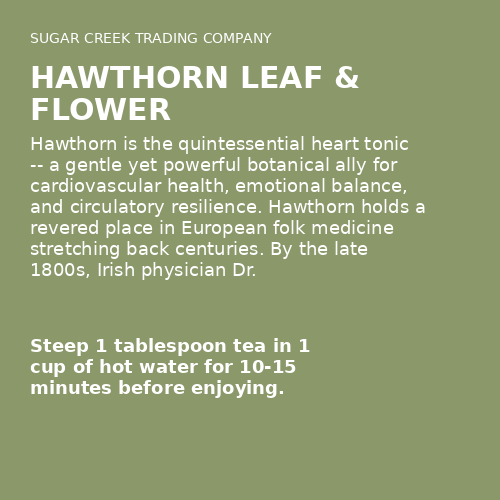
The quintessential heart tonic -- a gentle yet powerful botanical ally for cardiovascular health, emotional balance, and circulatory resilience.
BOTANICAL IDENTIFICATION
Scientific Name: Crataegus monogyna Jacq., C. laevigata (Poir.) DC., and related species
Common Names: Hawthorn, May tree, Whitethorn, Haw, Mayblossom, Quickthorn, Hedgethorn
Family: Rosaceae (Rose family)
Hawthorn is a thorny, deciduous shrub or small tree growing 5 to 15 meters tall with deeply lobed, dark green leaves and clusters of small white to pink five-petaled flowers that bloom in late spring. The branches bear sharp thorns, and by autumn the tree produces small, dark red to nearly black berries (haws). The leaves are alternate, typically 2 to 6 cm long, with 3 to 7 lobes and serrated margins.
Native to temperate regions of Europe, North Africa, and western Asia, hawthorn has naturalized across North America and thrives in hedgerows, woodland edges, and open scrubland. It tolerates a wide range of soils and conditions, from full sun to partial shade, and is remarkably hardy once established.
CULTURAL AND HISTORICAL USE
Hawthorn holds a revered place in European folk medicine stretching back centuries. By the late 1800s, Irish physician Dr. Green of Ennis became famous for his secret heart remedy -- which was revealed after his death to be a tincture of hawthorn berry. From that point forward, hawthorn entered the formal Western herbal pharmacopoeia as a premier cardiovascular herb. In Celtic and Anglo-Saxon traditions, the hawthorn was considered a sacred tree of the faerie realm, marking boundaries between worlds. Maypoles were traditionally made of hawthorn, and the blooming of the May tree signaled the arrival of Beltane.
In Traditional Chinese Medicine, the closely related species Crataegus pinnatifida (shan zha) has been used for centuries to promote digestion, resolve food stagnation (particularly from meat and greasy foods), and invigorate blood circulation. TCM practitioners classify it as sour and slightly warm, entering the spleen, stomach, and liver meridians.
European herbalists from the Eclectic tradition through modern phytotherapy have consistently employed hawthorn leaf, flower, and berry preparations for heart weakness, high blood pressure, anxiety with heart palpitations, and age-related cardiovascular decline. The German Commission E and the European Medicines Agency both recognize hawthorn leaf and flower as a traditional herbal medicine for declining cardiac performance corresponding to functional class II of the New York Heart Association classification.
KEY BIOACTIVE COMPOUNDS & BENEFITS
| Compound/Class | Location in Plant | Human Benefit | Role in Plant |
|---|---|---|---|
| Oligomeric proanthocyanidins (OPCs) | Leaves, flowers, berries | Strengthen blood vessel walls, reduce oxidative damage to the cardiovascular system, improve microcirculation | UV protection and defense against herbivory |
| Vitexin and hyperoside (flavonoids) | Leaves and flowers (highest concentration) | Vasodilatory effects, improved coronary blood flow, antioxidant protection of cardiac tissue | UV-screening pigments and pollinator attractants |
| Epicatechin and catechin | Leaves and flowers | Anti-inflammatory, endothelial function support, blood pressure regulation | Antimicrobial defense compounds |
| Triterpenic acids (ursolic, oleanolic) | Leaves and fruit skin | Anti-inflammatory, cardioprotective, mild lipid-lowering activity | Waxy surface protection against pathogens and desiccation |
| Chlorogenic acid | Leaves and flowers | Antioxidant, supports healthy blood sugar metabolism, hepatoprotective | Stress-response compound synthesized under environmental pressure |
Taken together, hawthorn leaf and flower provide a synergistic blend of flavonoids, procyanidins, and phenolic acids that collectively tone and protect the cardiovascular system. The OPCs and flavonoids are considered the primary active constituents, and European standardized extracts are typically calibrated to flavonoid content (often 2.2% or higher) or OPC content. This makes the leaf and flower preparation particularly rich in the compounds most directly associated with cardiac benefit.
HOW IT WORKS IN THE BODY
Hawthorn leaf and flower exert their effects through multiple, complementary cardiovascular mechanisms that work gently over time.
Cardiac Performance and Contractility:
Hawthorn flavonoids and OPCs appear to increase the force of heart muscle contraction (positive inotropic effect) while simultaneously reducing vascular resistance, allowing the heart to pump more efficiently with less strain. This mechanism is believed to involve inhibition of phosphodiesterase and enhanced cAMP signaling in cardiac myocytes, as well as increased sensitivity of the myofilaments to calcium. Unlike pharmaceutical cardiac glycosides, hawthorn achieves this effect without the narrow therapeutic window or toxicity risks.
Vascular Tone and Blood Pressure:
The flavonoids in hawthorn -- particularly vitexin and hyperoside -- promote endothelium-dependent vasodilation by stimulating nitric oxide (NO) release from vascular endothelial cells. This relaxes smooth muscle in arterial walls, improving blood flow and reducing peripheral resistance. Over weeks of consistent use, this mechanism contributes to a modest but meaningful reduction in both systolic and diastolic blood pressure.
Antioxidant Protection of Cardiovascular Tissue:
OPCs and flavonoids scavenge free radicals and inhibit lipid peroxidation within blood vessel walls, helping to prevent the oxidative damage that drives atherosclerotic plaque formation. By protecting LDL cholesterol from oxidation, hawthorn may slow the progression of arterial hardening.
Nervous System and Emotional Heart:
Hawthorn has a long traditional reputation as a remedy for grief, anxiety, and emotional heartbreak. Mild anxiolytic activity may relate to its ability to modulate autonomic nervous system tone, calming sympathetic overdrive that manifests as palpitations, restlessness, and chest tightness during periods of emotional stress.
DOSE GUIDELINES
| Preparation Type | Typical Dose | Purpose |
|---|---|---|
| Dried leaf and flower tea (infusion) | 1 to 2 teaspoons (1.5-3 g) per cup, steeped 10-15 minutes, 2-3 times daily | General cardiovascular tonic, mild blood pressure support, calming |
| Tincture (1:5 in 45% alcohol) | 2-4 mL (40-80 drops), 3 times daily | Concentrated cardiovascular support, anxiety with palpitations |
| Standardized extract (capsule/tablet) | 160-900 mg daily (standardized to 2.2% flavonoids or 18.75% OPCs), divided into 2-3 doses | Clinically studied dose range for heart failure support and blood pressure |
| Cold infusion (overnight) | 2-3 teaspoons in 1 cup cold water, steeped 8-12 hours, then gently warmed | Maximizes extraction of delicate flavonoids; gentle daily tonic |
Hawthorn is a slow-acting tonic herb. Meaningful cardiovascular effects typically develop over 4 to 12 weeks of consistent daily use. It is best taken as a long-term supportive remedy rather than an acute intervention. Many herbalists recommend committing to at least 3 months of daily use before evaluating results.
PREPARATION AND USES
The most common preparation for hawthorn leaf and flower is a simple hot infusion (tea). Use 1 to 2 teaspoons of dried leaf and flower per cup of just-boiled water, cover, and steep for 10 to 15 minutes to extract the water-soluble flavonoids and phenolic acids. The tea has a mild, slightly astringent, faintly sweet taste that blends well with hibiscus, rose, linden flower, or lemon balm. For a stronger preparation, a tincture made with 45% alcohol effectively captures both water-soluble and alcohol-soluble constituents.
Hawthorn leaf and flower can also be encapsulated as a powder, blended into heart-supportive tea formulas, or combined with hawthorn berry for a full-spectrum preparation. Some herbalists prepare a syrup by simmering the tea with honey, which makes a pleasant daily dose. In traditional practice, hawthorn leaf and flower are frequently combined with motherwort for palpitations, linden flower for hypertension with anxiety, or with garlic and ginkgo for broader cardiovascular formulas.
OPTIMAL CONTEXT FOR USE
Hawthorn leaf and flower is especially well-suited for individuals experiencing:
Mild to moderate high blood pressure, particularly when associated with stress or tension
Age-related decline in cardiovascular function, including reduced exercise tolerance, mild shortness of breath on exertion, or general circulatory weakness
Heart palpitations, chest tightness, or rapid heartbeat triggered by anxiety, grief, or emotional stress
Early-stage or mild congestive heart failure (NYHA class II) as an adjunct to conventional care under practitioner supervision
A desire for long-term cardiovascular maintenance and prevention in those with family history of heart disease
For best results, hawthorn leaf and flower should be part of a holistic approach that includes regular physical activity, a whole-foods diet rich in vegetables and healthy fats, stress management, and appropriate medical monitoring of cardiovascular health.
SUSTAINABILITY AND ETHICAL HARVESTING
Hawthorn is an abundant and ecologically resilient species with no significant conservation concerns. It is widely cultivated as a hedgerow plant throughout Europe and North America, and wild populations are robust and self-sustaining. In many regions, hawthorn is so prolific it is considered a common landscape plant. Sustainable wild harvesting of leaves and flowers is straightforward, as the trees regenerate readily and pruning can actually benefit the plant's form and health.
Ethical sourcing involves harvesting leaves and flower clusters in late spring during peak bloom, when flavonoid content is highest. Responsible harvesters take only a portion of the flowers from any given tree to ensure continued fruit production for wildlife. Commercial supplies are predominantly sourced from cultivated or managed hedgerow populations in Europe, making this a highly sustainable botanical.
SAFETY AND CAUTIONS
Hawthorn leaf and flower is widely regarded as one of the safest cardiovascular herbs, with an excellent safety profile demonstrated across numerous clinical trials involving thousands of participants.
Drug interactions: Hawthorn may potentiate the effects of cardiac glycosides (digoxin), antihypertensive medications, and blood-thinning drugs. If you are taking any heart medication, consult your healthcare provider before adding hawthorn to your regimen. Dosage adjustments to pharmaceuticals may be needed over time.
Hypotension risk: In sensitive individuals or at high doses, hawthorn may lower blood pressure more than expected. Start with a moderate dose and increase gradually, especially if already taking blood pressure medication.
Pregnancy and nursing: There is insufficient safety data for use during pregnancy and lactation. Traditional use suggests it is likely safe, but caution is advised. Consult a qualified practitioner.
Not a replacement for acute care: Hawthorn is a slow-acting tonic. It is not appropriate as a sole treatment for serious or acute heart conditions. Chest pain, severe shortness of breath, or symptoms of heart attack require immediate medical attention.
REFERENCES
Pittler, M.H., Guo, R., & Ernst, E. (2008). Hawthorn extract for treating chronic heart failure. Cochrane Database of Systematic Reviews, (1), CD005312.
European Medicines Agency (EMA). (2016). European Union herbal monograph on Crataegus spp., folium cum flore. EMA/HMPC/159076/2014.
Holubarsch, C.J.F., et al. (2008). The efficacy and safety of Crataegus extract WS 1442 in patients with heart failure: The SPICE trial. European Journal of Heart Failure, 10(12), 1255-1263.
FINAL NOTE
Hawthorn leaf and flower is the cornerstone herb for anyone seeking to nourish and protect the heart -- both the physical organ and the emotional center. Where many cardiovascular agents act forcefully and narrowly, hawthorn works gently across multiple pathways, strengthening the heart's contraction, easing vascular tension, and offering a quiet calm to an anxious chest. It is the kind of herb you build a relationship with over months and years, and it rewards that patience with steady, lasting support.
Condividere