Sugar Creek Trading Company
Holy Basil Tulsi 2.5% Ursolic
Holy Basil Tulsi 2.5% Ursolic
Impossibile caricare la disponibilità di ritiro
OCIMUM TENUIFLORUM
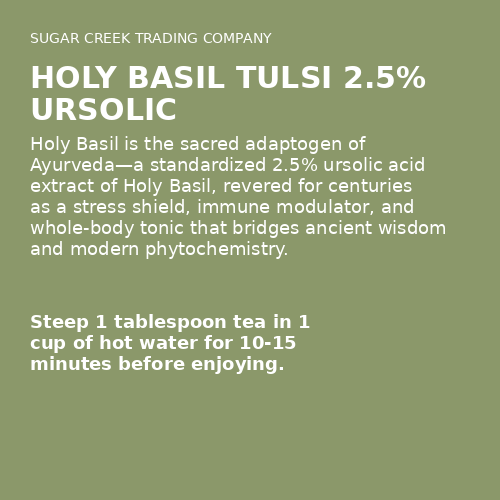
The sacred adaptogen of Ayurveda—a standardized 2.5% ursolic acid extract of Holy Basil, revered for centuries as a stress shield, immune modulator, and whole-body tonic that bridges ancient wisdom and modern phytochemistry.
BOTANICAL IDENTIFICATION
Scientific Name: Ocimum tenuiflorum L. (syn. Ocimum sanctum L.)
Common Names: Holy basil, tulsi, tulasi, sacred basil, hot basil, the incomparable one, the queen of herbs
Family: Lamiaceae (mint family)
Ocimum tenuiflorum is an aromatic, erect, multi-branched subshrub growing 30 to 100 cm tall, with opposite, ovate to elliptic leaves that are slightly toothed and often tinged purple, particularly in the Krishna (dark) variety. The stems are hairy and quadrangular—characteristic of the mint family—and bear terminal racemes of small, purplish-white to lavender flowers arranged in whorls. The entire plant is intensely fragrant, releasing a complex, warm, clove-like aroma when bruised, owing to its high essential oil content.
Tulsi is native to the Indian subcontinent and Southeast Asia, where it thrives in tropical and subtropical climates with well-drained soil and full sun. It is widely cultivated throughout India—nearly every Hindu household maintains a tulsi plant as a living shrine—and has been introduced to warm-climate regions worldwide. The three principal cultivated varieties are Rama tulsi (green leaf, milder flavor), Krishna tulsi (purple leaf, more pungent), and Vana tulsi (wild forest variety, O. gratissimum).
CULTURAL AND HISTORICAL USE
No other herb occupies a position in any medical tradition quite like tulsi occupies in Ayurveda. The name tulasi derives from the Sanskrit root meaning "the incomparable one," and the plant is considered an earthly manifestation of the goddess Lakshmi (or, in some traditions, Vrinda Devi). For at least 3,000 years, tulsi has stood at the intersection of medicine and devotion in Indian culture—planted in courtyards, woven into prayer beads (tulsi mala), offered in temple rituals, and consumed daily as a tea (tulsi chai) for health and spiritual clarity. The Charaka Samhita and Sushruta Samhita, foundational texts of Ayurveda dating to approximately 1000–500 BCE, classify tulsi as a rasayana (rejuvenative tonic) with the capacity to promote longevity, balance all three doshas, and protect the body against environmental and psychological stressors.
In Ayurvedic pharmacology, tulsi is described as pungent and bitter in taste (rasa), heating in energy (virya), and pungent in post-digestive effect (vipaka). It is prescribed for respiratory conditions (cough, cold, asthma, bronchitis), digestive sluggishness, fevers, skin disorders, and as a daily adaptogenic tonic. The juice of fresh tulsi leaves mixed with honey and ginger remains one of the most widely used home remedies across India for upper respiratory infections.
Beyond India, tulsi has a presence in Thai cuisine and Southeast Asian folk medicine (where it is known as kraphao), and has been adopted enthusiastically by Western herbalism since the late 20th century, where it is classified alongside ashwagandha, rhodiola, and eleuthero as a premier adaptogen. Modern herbalists value tulsi for its capacity to modulate the hypothalamic-pituitary-adrenal (HPA) axis, normalize cortisol, and support cognitive clarity under chronic stress—applications that align seamlessly with its Ayurvedic classification as a medhya rasayana (brain tonic).
KEY BIOACTIVE COMPOUNDS & BENEFITS
| Compound/Class | Location in Plant | Human Benefit | Role in Plant |
|---|---|---|---|
| Ursolic acid (pentacyclic triterpenoid) | Leaves, stems (standardized to 2.5% in this extract) | Anti-inflammatory; inhibits NF-κB and COX-2 pathways; supports muscle preservation; hepatoprotective; anticancer activity in vitro | Waxy cuticle defense; antimicrobial and anti-herbivore deterrent |
| Eugenol (phenylpropanoid) | Essential oil, leaves | Analgesic; anti-inflammatory; COX-1 and COX-2 inhibition; antimicrobial; antioxidant | Volatile defense compound; pollinator attractant |
| Rosmarinic acid (polyphenol) | Leaves, flowering tops | Potent antioxidant; anti-allergic; inhibits complement activation; neuroprotective | UV protection and antimicrobial defense |
| Ocimumosides A & B (triterpenoid glycosides) | Leaves | Adaptogenic; normalize cortisol and corticosterone under stress; anxiolytic | Stress signaling and membrane stabilization |
| Oleanolic acid (pentacyclic triterpenoid) | Leaves, stems | Hepatoprotective; anti-inflammatory; supports healthy blood sugar metabolism | Structural cuticle component; antimicrobial |
This extract is standardized to 2.5% ursolic acid, ensuring a consistent and clinically meaningful concentration of the triterpenoid most associated with tulsi's anti-inflammatory, muscle-preserving, and metabolic benefits. Ursolic acid works in concert with the herb's broader phytochemical matrix—eugenol for acute inflammation and pain, rosmarinic acid for antioxidant depth and allergy modulation, and the ocimumosides for HPA-axis balancing—to produce a full-spectrum adaptogenic profile that single-compound supplements cannot replicate.
HOW IT WORKS IN THE BODY
Ocimum tenuiflorum standardized extract acts through multiple converging pathways, functioning as a true adaptogen that modulates the stress response while providing broad anti-inflammatory and metabolic support.
Stress Adaptation and HPA-Axis Modulation:
The ocimumosides and triterpenoids (ursolic acid, oleanolic acid) normalize the activity of the hypothalamic-pituitary-adrenal axis under chronic stress conditions. They reduce elevated corticosterone and cortisol levels, modulate neurotransmitter enzymes in the brain (including serotonin and dopamine pathways), and protect the hippocampus from stress-induced oxidative damage. The net effect is improved stress resilience, reduced anxiety, enhanced mental clarity, and better sleep quality—the hallmark actions of a classical adaptogen.
Inflammation and Immune Modulation:
Ursolic acid is a potent inhibitor of NF-κB, the master transcription factor that drives inflammatory gene expression. It also suppresses COX-2 and lipoxygenase (LOX) enzyme activity, reducing prostaglandin and leukotriene production. Eugenol contributes additional COX inhibition through a mechanism similar to aspirin. Together, these compounds provide broad anti-inflammatory coverage without the gastrointestinal risks of synthetic NSAIDs. Simultaneously, tulsi enhances natural killer (NK) cell activity and T-helper cell function, making it an immune modulator rather than a simple immune stimulant.
Metabolic and Cardiovascular Support:
Ursolic acid and oleanolic acid activate AMPK (AMP-activated protein kinase), a cellular energy sensor involved in glucose uptake, fatty acid oxidation, and mitochondrial biogenesis. Clinical studies have shown tulsi extract can reduce fasting blood glucose, improve lipid profiles (reducing total cholesterol and LDL while raising HDL), and support healthy body composition. Ursolic acid has also attracted attention for its ability to promote lean muscle maintenance by inhibiting muscle atrophy pathways (atrogin-1, MuRF1).
Neuroprotection and Cognitive Support:
Rosmarinic acid crosses the blood-brain barrier and exerts direct antioxidant protection on neural tissue, scavenging reactive oxygen species and chelating pro-oxidant metals. Combined with the cortisol-normalizing effects of the triterpenoids, this produces measurable improvements in memory, attention, and cognitive processing speed in human trials—consistent with tulsi's Ayurvedic classification as a medhya rasayana.
DOSE GUIDELINES
| Preparation Type | Typical Dose | Purpose |
|---|---|---|
| Standardized extract (2.5% ursolic acid) — capsule or powder | 300–600 mg, 1–2 times daily | Adaptogenic support, anti-inflammatory, metabolic health |
| Infusion (dried leaf, non-standardized) | 1–2 teaspoons dried tulsi per cup, steeped 5–10 minutes; up to 3 cups daily | Daily tonic, mild stress support, respiratory wellness |
| Tincture (1:5, 40–50% ethanol) | 2–3 mL, 2–3 times daily | Concentrated adaptogenic and immune support |
| Fresh juice (traditional Ayurvedic) | 5–10 mL fresh leaf juice with honey, 1–2 times daily | Respiratory infections, fever, acute immune support |
As an adaptogen, tulsi's benefits are cumulative and best realized with consistent daily use over a period of weeks to months. The standardized 2.5% ursolic acid extract offers a more targeted approach for those seeking specific anti-inflammatory, metabolic, or body-composition benefits, while whole-leaf preparations provide the full aromatic and polyphenol spectrum for general tonic use. Many practitioners recommend cycling adaptogenic herbs (e.g., 6 weeks on, 1 week off) to maintain sensitivity to their effects.
PREPARATION AND USES
This standardized extract (2.5% ursolic acid) is most commonly taken as a powder blended into smoothies, warm water, or encapsulated for precise dosing. The powder has a mildly bitter, herbaceous flavor with warm, clove-like undertones. For those who wish to combine the extract's potency with the ritual pleasure of tea, it can be stirred into hot water alongside honey and fresh ginger—an approximation of the traditional tulsi kadha (decoction) used across Indian households during cold and flu season.
For topical applications, tulsi extract can be mixed into carrier oils or salves for its antimicrobial and anti-inflammatory properties, benefiting acne-prone or irritated skin. In Ayurvedic practice, tulsi is also used as a component of nasya (nasal oil) preparations and as an ingredient in herbal tooth powders due to eugenol's analgesic and antimicrobial effects on oral tissue. The standardized extract pairs well with ashwagandha for deepened adaptogenic support, with turmeric for synergistic anti-inflammatory action, or with bacopa for enhanced cognitive and memory benefits.
OPTIMAL CONTEXT FOR USE
This herb is especially well-suited for individuals experiencing:
Chronic stress, adrenal fatigue, elevated cortisol, or the cognitive fog and emotional depletion that accompany prolonged periods of overwork, caregiving, or life upheaval
Chronic low-grade inflammation, joint stiffness, or inflammatory conditions where NF-κB modulation is a therapeutic goal
Metabolic imbalances including elevated blood sugar, unfavorable lipid profiles, or difficulty maintaining lean body composition
Recurrent upper respiratory infections, seasonal allergies, or a desire to strengthen baseline immune resilience
A need for sustained cognitive clarity, mental endurance, and memory support—particularly under stressful academic or professional demands
Holy basil pairs powerfully with other adaptogens and nervines. Combine with ashwagandha for deep stress recovery, with rhodiola for mental stamina, with turmeric for systemic inflammation, or with lemon balm for anxious presentations with digestive involvement.
SUSTAINABILITY AND ETHICAL HARVESTING
Ocimum tenuiflorum is one of the most widely cultivated medicinal plants in the world. It is an annual-to-short-lived perennial that grows rapidly, sets seed prolifically, and is cultivated on a massive commercial scale across India, Thailand, and other tropical regions. It faces no conservation concerns and is not listed on any threatened species registry. The plant's cultural and religious significance in India has, paradoxically, been one of its greatest conservation advantages—millions of households actively cultivate and protect it.
Sugar Creek Trading Company sources its standardized holy basil extract from suppliers who employ sustainable agricultural practices, including organic cultivation methods where available. Standardized extracts require controlled growing conditions and careful post-harvest processing (typically hydroethanolic extraction followed by concentration) to achieve consistent ursolic acid levels, and our supply chain prioritizes producers who pay fair wages and use environmentally responsible extraction solvents.
SAFETY AND CAUTIONS
Holy basil is classified as generally safe and well-tolerated, with thousands of years of daily dietary use across India and a growing body of modern clinical trial data supporting its safety profile. The following considerations apply:
Blood sugar modulation: Tulsi has demonstrated hypoglycemic effects in clinical studies. Individuals taking insulin or oral hypoglycemic agents should monitor blood sugar closely and consult a healthcare provider, as dose adjustments to medication may be necessary.
Blood-thinning effects: Eugenol has mild antiplatelet activity. Exercise caution if taking warfarin, aspirin, or other anticoagulant/antiplatelet medications, and discontinue use at least two weeks before scheduled surgery.
Fertility considerations: Animal studies have suggested that high-dose tulsi extract may have anti-fertility effects (reduced sperm motility in males, anti-implantation effects in females). While these findings have not been confirmed in humans at standard supplemental doses, couples actively trying to conceive may wish to exercise caution.
Pregnancy and nursing: Due to its traditional use as an emmenagogue (menstrual flow promoter) and the animal fertility data noted above, tulsi supplementation is not recommended during pregnancy. Consult a qualified practitioner before use during breastfeeding.
Thyroid medications: Some preliminary evidence suggests tulsi may influence thyroid hormone levels. Those on thyroid medication should consult their healthcare provider.
REFERENCES
Cohen, Marc Maurice. “Tulsi – Ocimum sanctum: A herb for all reasons.” Journal of Ayurveda and Integrative Medicine, vol. 5, no. 4, 2014, pp. 251–259.
Jamshidi, Negar, and Marc M. Cohen. “The clinical efficacy and safety of tulsi in humans: A systematic review of the literature.” Evidence-Based Complementary and Alternative Medicine, vol. 2017, Article ID 9217567.
Kashyap, C. P., et al. “Ursolic acid: A promising phytochemical and its pharmacological effects.” Asian Journal of Pharmaceutical and Clinical Research, vol. 9, no. 1, 2016, pp. 1–7.
FINAL NOTE
Holy basil is not merely an herb—it is an entire medical philosophy distilled into a single plant. Ayurveda calls it "the incomparable one" not because of any single dramatic action, but because of its quiet, persistent ability to restore balance across virtually every system of the body under stress. This standardized 2.5% ursolic acid extract concentrates one of tulsi's most researched and potent triterpenoids while preserving the synergistic matrix that makes the whole herb greater than the sum of its parts. For the modern person navigating chronic stress, inflammatory burden, and metabolic challenge, tulsi remains as relevant today as it was three thousand years ago in the courtyards of ancient India.
Condividere