Sugar Creek Trading Company
Horny Goat Weed Yin Yang Huo
Horny Goat Weed Yin Yang Huo
Impossibile caricare la disponibilità di ritiro
EPIMEDIUM SPP. (YIN YANG HUO)
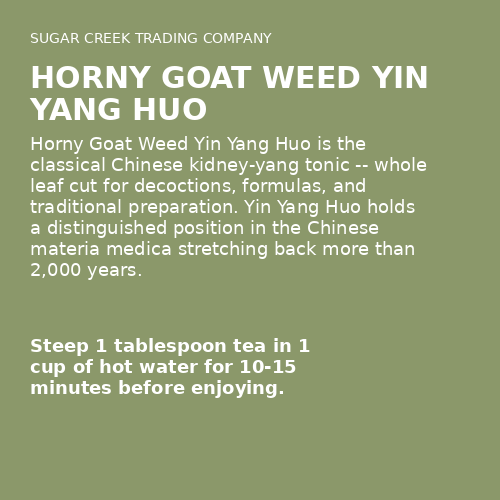
The classical Chinese kidney-yang tonic -- whole leaf cut for decoctions, formulas, and traditional preparation.
BOTANICAL IDENTIFICATION
Scientific Name: Epimedium brevicornu Maxim., E. sagittatum (Sieb. & Zucc.) Maxim., E. pubescens Maxim., E. koreanum Nakai, and related species
Common Names: Yin Yang Huo, Horny Goat Weed, Epimedium, Xian Ling Pi, Barrenwort, Fairy Wings, Bishop's Hat
Family: Berberidaceae (Barberry family)
Epimedium species are clumping, rhizomatous perennials growing 20 to 50 cm tall in woodland understory. The compound leaves feature distinctive heart-shaped leaflets, often with serrated or spiny margins, that emerge bronze or reddish in spring before turning green. Delicate, spurred flowers in yellow, white, pink, or purple appear in loose racemes during spring. This product consists of the dried whole leaf, cut to a coarse tea-grade size, preserving the traditional form used in Chinese herbal pharmacy.
The medicinal species originate from the temperate and subtropical forests of China, Korea, and Japan. They grow naturally in shaded, moist woodland habitats with rich, well-drained soil. The name Yin Yang Huo translates roughly to "licentious goat plant," referencing the legend of its discovery, and Xian Ling Pi means "immortal spirit spleen," pointing to its tonic reputation.
CULTURAL AND HISTORICAL USE
Yin Yang Huo holds a distinguished position in the Chinese materia medica stretching back more than 2,000 years. It was first recorded in the Shennong Bencao Jing (Divine Farmer's Classic of Materia Medica), where it was classified among the middle-grade herbs suitable for long-term use to strengthen the body. The famous Tang Dynasty physician Sun Simiao included it in formulations for impotence and infertility, and the Ming Dynasty's Bencao Gangmu (Compendium of Materia Medica) by Li Shizhen elaborated extensively on its properties and applications.
In TCM theory, Yin Yang Huo is classified as warm in nature with acrid and sweet flavors. It enters the Kidney and Liver meridians, where its primary actions are to tonify kidney yang, strengthen bone and sinew, and expel wind-dampness. Classical indications include impotence, spermatorrhea, frequent urination, weakness and pain in the lower back and knees, cold limbs, numbness, and wind-damp bi syndrome (painful obstruction of the joints). It is considered one of the premier herbs for restoring the "ministerial fire" of the kidneys.
Traditional processing (pao zhi) plays an important role in how this herb is used. The raw leaf (sheng Yin Yang Huo) is used for expelling wind-dampness and relieving joint pain, while the lamb-fat-fried preparation (zhi Yin Yang Huo) intensifies the kidney-yang-tonifying and sexual-vitality-enhancing properties. This whole leaf cut is the standard form used in traditional Chinese herbal pharmacies for preparing decoctions and inclusion in multi-herb formulas.
KEY BIOACTIVE COMPOUNDS & BENEFITS
| Compound/Class | Location in Plant | Human Benefit | Role in Plant |
|---|---|---|---|
| Icariin (prenylated flavonol glycoside) | Leaves | Supports vascular function, bone density, and reproductive vitality through PDE5 inhibition and osteoblast stimulation | UV defense and antifungal protection |
| Icariside II / Baohuoside I | Leaves | Bioactive metabolite of icariin with enhanced absorption; neuroprotective, anti-inflammatory, and pro-osteogenic | Secondary defense metabolite |
| Epimedin A, B, C | Leaves and stems | Synergistic flavonoid glycosides supporting cardiovascular, immune, and skeletal systems | Broad-spectrum chemical deterrent |
| Icaritin (aglycone) | Leaves (formed via metabolism) | Potent anti-inflammatory and estrogen-receptor-modulating activity; supports hormonal balance | Core flavonoid skeleton |
| Polysaccharides | Leaves and rhizomes | Immune modulation, antioxidant protection, and prebiotic-like supportive activity | Energy storage and cell structure |
The whole leaf retains the full spectrum of Epimedium's bioactive constituents, including the complete range of prenylated flavonoids and their glycoside variants. This matters because the compounds work synergistically: icariin, epimedin A/B/C, and their metabolites each contribute overlapping and complementary activities across the vascular, skeletal, nervous, and endocrine systems. The whole leaf cut is the form most consistent with how the herb has been used in traditional decoctions for centuries.
HOW IT WORKS IN THE BODY
Yin Yang Huo acts on multiple systems simultaneously, consistent with its TCM classification as a kidney-yang and bone-sinew tonic with wind-damp-dispelling properties.
Kidney-Yang Tonification (Reproductive and Endocrine Support):
Icariin and its metabolites support reproductive vitality through several converging mechanisms. PDE5 inhibition promotes nitric oxide-mediated vasodilation in erectile tissue. Research also suggests modulation of testosterone metabolism and hypothalamic-pituitary-gonadal axis signaling, supporting the TCM concept of "warming the gate of vitality." These actions address both male and female aspects of sexual health and hormonal balance.
Strengthening Bone and Sinew (Musculoskeletal Support):
Icariin is one of the most extensively studied natural osteogenic compounds. It promotes osteoblast differentiation through the BMP-2/Smad and Wnt/beta-catenin signaling pathways while simultaneously inhibiting osteoclast-mediated bone resorption via RANKL/OPG modulation. Icariside II enhances these effects with improved bioavailability. These mechanisms directly parallel the traditional indication of strengthening bone and sinew.
Expelling Wind-Dampness (Anti-inflammatory and Joint Support):
The flavonoid complex in Epimedium modulates NF-kB and COX-2 inflammatory pathways, reduces pro-inflammatory cytokines (TNF-alpha, IL-6, IL-1beta), and provides antioxidant protection to joint tissues. This anti-inflammatory and analgesic activity corresponds to the classical use for wind-damp bi syndrome.
Neuroprotective and Cognitive Support:
Icariin and icariside II cross the blood-brain barrier and protect neurons from oxidative damage, beta-amyloid toxicity, and inflammatory injury. They also promote nerve growth factor expression and support synaptic plasticity, aligning with the traditional use for forgetfulness and kidney-essence-related cognitive decline.
DOSE GUIDELINES
| Preparation Type | Typical Dose | Purpose |
|---|---|---|
| Decoction (traditional) | 6-15 grams dried leaf simmered in 3-4 cups water for 20-30 minutes, taken in 2-3 divided doses daily | Full-spectrum kidney-yang tonification, bone support, joint comfort |
| Tincture (1:5, 40-50% ethanol) | 3-5 mL, 2-3 times daily | Concentrated tonic support |
| Capsules (powdered leaf) | 500-1,000 mg, 2-3 times daily | Convenient daily supplementation |
| Formula ingredient | 6-15 grams as part of a multi-herb decoction | Balanced TCM formula use (e.g., with Du Zhong, Rou Cong Rong, Shu Di Huang) |
In traditional practice, Yin Yang Huo is typically used as a long-term tonic taken in cycles of 4-8 weeks, often with short rest periods. Dosage within the classical range of 6-15 grams per day depends on the individual's constitution and the balance of the formula. As a warming herb, higher doses are appropriate for pronounced cold/yang-deficiency patterns, while lower doses may suffice when combined with other warming tonics.
PREPARATION AND USES
The traditional and most effective preparation for whole leaf Yin Yang Huo is a decoction: add 6-15 grams of the dried cut leaf to 3-4 cups of cold water, bring to a boil, reduce heat, and simmer covered for 20-30 minutes. Strain and drink in 2-3 portions throughout the day. In multi-herb formulas, add Yin Yang Huo at the beginning of the decoction with other hard or fibrous ingredients. The decoction method extracts the full range of flavonoid glycosides and polysaccharides.
For a warming medicinal wine (yao jiu), steep 30-60 grams of dried leaf in 750 mL of rice wine or grain alcohol for 2-4 weeks, shaking periodically. Take 15-30 mL (1-2 tablespoons) once or twice daily. This preparation is traditional for yang-deficiency patterns and joint pain. Yin Yang Huo combines classically with Du Zhong (Eucommia bark) for back and knee pain, with Ba Ji Tian (Morinda root) and Rou Cong Rong (Cistanche) for impotence and infertility, and with Dang Gui (Angelica sinensis) and Shu Di Huang (prepared Rehmannia) for more balanced kidney yin-yang support.
OPTIMAL CONTEXT FOR USE
Yin Yang Huo whole leaf is especially well-suited for individuals experiencing:
Kidney-yang deficiency patterns: low libido, erectile difficulties, cold extremities, frequent urination, and lower back weakness
Age-related bone density concerns, particularly when seeking a natural complement to conventional approaches
Joint pain, stiffness, and reduced mobility associated with cold, damp conditions (wind-damp bi syndrome)
General fatigue, low vitality, and a feeling of depletion, especially in middle-aged and older adults
A preference for traditional whole-herb preparations in decoctions and formulas rather than standardized extracts
This whole leaf cut is the preferred form for practitioners and individuals who prepare traditional Chinese herbal decoctions and who value the full-spectrum chemistry of the complete plant material. It integrates seamlessly into classical TCM formulas and is ideal for those who want the herb in its most time-tested form.
SUSTAINABILITY AND ETHICAL HARVESTING
Wild Epimedium populations in China face increasing pressure from commercial harvest as global demand for the herb has grown significantly over the past two decades. Some species, particularly E. brevicornu and E. koreanum, have experienced notable population declines in certain regions. In response, cultivation programs have expanded in Sichuan, Guizhou, Shaanxi, and other provinces, producing material that is consistent in quality and icariin content.
Responsible sourcing prioritizes cultivated Epimedium from farms that follow Good Agricultural Practices (GAP) standards. Buyers should seek suppliers who can document the species identity and cultivation or harvest origin of their material. Supporting sustainable cultivation not only protects wild populations but also ensures a more consistent and contaminant-free product.
SAFETY AND CAUTIONS
Yin Yang Huo has a well-established safety profile within the traditional dose range of 6-15 grams per day in decoction. However, the following precautions apply:
Individuals with yin-deficiency heat signs (night sweats, hot flashes, dry mouth, irritability, insomnia) should use Yin Yang Huo cautiously and in balanced formulas that include yin-nourishing herbs, as its warm nature may exacerbate heat symptoms.
Those taking blood-thinning medications (warfarin, heparin, aspirin, clopidogrel) should consult their healthcare provider, as Epimedium flavonoids may enhance anticoagulant effects.
Epimedium should not be combined with PDE5 inhibitor medications (sildenafil, tadalafil, etc.) or nitrate drugs due to the risk of additive blood pressure-lowering effects.
Pregnant and nursing women should avoid this herb due to its hormonal activity and strong warming nature.
Rare cases of dizziness, rapid heartbeat, or nosebleed have been reported at excessive doses. Stay within the recommended range and reduce the dose if any discomfort occurs.
REFERENCES
Chinese Pharmacopoeia Commission. (2020). Pharmacopoeia of the People's Republic of China, Volume I. China Medical Science Press.
Ma, H., et al. (2011). "The genus Epimedium: An ethnopharmacological and phytochemical review." Journal of Ethnopharmacology, 134(3), 519-541.
Tan, H.L., et al. (2016). "Icariin: A review of its effects on bone metabolism." Drug Design, Development and Therapy, 10, 3455-3468.
FINAL NOTE
Yin Yang Huo in its traditional whole leaf form represents the herb as Chinese medicine has known it for over two thousand years -- a warming, vitalizing tonic that restores the deep fire of the kidneys while strengthening the structural framework of bone and sinew. This cut is for the practitioner and the informed herbalist who values the full complexity of the plant as it was meant to be prepared: simmered slowly into a rich decoction, releasing its full spectrum of compounds in the manner that has sustained its reputation across millennia of continuous clinical use.
Condividere