Sugar Creek Trading Company
Hyssop Herb
Hyssop Herb
Impossibile caricare la disponibilità di ritiro
HYSSOPUS OFFICINALIS
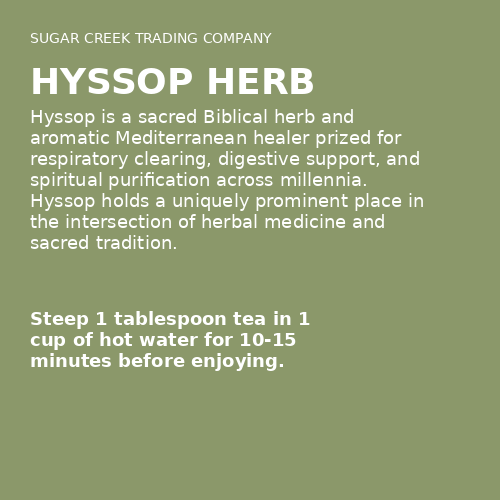
A sacred Biblical herb and aromatic Mediterranean healer prized for respiratory clearing, digestive support, and spiritual purification across millennia.
BOTANICAL IDENTIFICATION
Scientific Name: Hyssopus officinalis L.
Common Names: Hyssop, Common Hyssop, Garden Hyssop, Hyssop Herb, Ezob (Hebrew)
Family: Lamiaceae (Mint family)
Hyssopus officinalis is a semi-evergreen, bushy perennial subshrub that grows 30 to 60 cm tall, forming dense, upright clumps of square, woody stems bearing small, narrow, lance-shaped, opposite leaves 2 to 4 cm long. The leaves are dark green, aromatic when crushed, and dotted with tiny oil glands. From midsummer into early autumn, the plant produces dense, one-sided terminal spikes of small, tubular, two-lipped flowers, most commonly deep blue-violet but occasionally pink or white, which are intensely attractive to bees and butterflies.
Native to the rocky, dry, calcareous soils of southern Europe, the Mediterranean basin, and western Asia, hyssop thrives in full sun, well-drained, alkaline soil, and dry to moderate conditions. It is highly drought-tolerant once established and has been cultivated throughout Europe, the Middle East, and North America for centuries as a medicinal, culinary, and ornamental herb. It naturalizes readily in temperate climates and is cold-hardy to USDA zone 3.
CULTURAL AND HISTORICAL USE
Hyssop holds a uniquely prominent place in the intersection of herbal medicine and sacred tradition. It is mentioned multiple times in the Bible, most famously in Psalm 51:7: "Purge me with hyssop, and I shall be clean; wash me, and I shall be whiter than snow." In the Book of Exodus, hyssop branches were used to sprinkle lamb's blood on doorposts during Passover, and in Leviticus, hyssop was integral to purification rites for leprosy and ritual uncleanness. While scholars debate whether the Biblical "ezob" refers precisely to Hyssopus officinalis or a related Middle Eastern species such as Origanum syriacum, the cultural association has endured for over three millennia, making hyssop one of the most symbolically charged plants in Western spiritual and herbal tradition.
In the classical Mediterranean world, Hippocrates recommended hyssop for chest complaints and pleurisy, and Dioscorides described it as a remedy for coughs, asthma, and catarrhal congestion. Throughout the Middle Ages, hyssop was a staple of the monastic herb garden, cultivated by Benedictine monks as both a strewing herb to purify the air and a medicine for respiratory ailments, digestive disorders, and wounds. It was a key ingredient in medieval plague preventatives and was infused into wines, vinegars, and syrups. The famous Chartreuse and Benedictine liqueurs, first developed in French monasteries, include hyssop as a component herb.
In Traditional Arabic medicine (Unani), hyssop (zufa yabis) has been used for centuries to treat coughs, bronchial congestion, and digestive sluggishness. European folk medicine across France, Germany, Spain, and Italy consistently valued it as a respiratory expectorant, digestive bitter, and nervine. In modern Western herbalism, hyssop remains a primary herb for upper and lower respiratory infections, particularly where there is copious mucus, spasmodic coughing, and bronchial inflammation. It is also recognized for its carminative, diaphoretic, and mild nervine properties.
KEY BIOACTIVE COMPOUNDS & BENEFITS
| Compound/Class | Location in Plant | Human Benefit | Role in Plant |
|---|---|---|---|
| Essential oil (pinocamphone, isopinocamphone, beta-pinene, limonene, 1,8-cineole) | Leaf oil glands and flowering tops | Expectorant, antispasmodic, antimicrobial, and mucolytic action in the respiratory tract | Volatile aromatic defense against herbivores, pathogens, and competing plants |
| Flavonoids (diosmin, hesperidin, apigenin, luteolin) | Leaves and flowers | Antioxidant, anti-inflammatory, capillary-strengthening, and antiviral activity | UV-protective pigments and pollinator visual signals |
| Rosmarinic acid and other phenolic acids | Leaves and stems | Potent antioxidant, anti-inflammatory, and antiviral activity; supports respiratory and immune health | Chemical defense against microbial infection and oxidative stress |
| Tannins (condensed and hydrolyzable) | Leaves and stems | Astringent, antimicrobial, and tissue-tightening action; supports wound healing and reduces excessive secretions | Defense against herbivory and fungal invasion |
| Marrubiin (diterpene lactone) | Aerial herb | Expectorant and mucolytic activity; promotes productive coughing to clear congested airways | Bitter-tasting feeding deterrent |
Hyssop's therapeutic profile is built around the synergy between its aromatic essential oil and its polyphenolic compounds. The volatile oils deliver immediate antimicrobial, expectorant, and antispasmodic effects in the respiratory tract, while rosmarinic acid and the flavonoid suite provide sustained anti-inflammatory, antioxidant, and antiviral support. This combination makes hyssop particularly effective for respiratory infections where multiple actions, clearing mucus, fighting pathogens, reducing inflammation, and calming spasm, are needed simultaneously.
HOW IT WORKS IN THE BODY
Hyssop acts primarily on the respiratory and digestive systems, with secondary effects on the nervous system and immune function, functioning as an aromatic expectorant, antimicrobial, and bitter tonic.
Respiratory Clearing and Bronchial Support:
The essential oil components, particularly pinocamphone and 1,8-cineole, act directly on the bronchial mucosa when absorbed through the digestive tract or inhaled as steam. They stimulate the mucociliary escalator, the mechanism by which the bronchial lining moves mucus upward and out of the lungs, promoting productive expectoration of thick, stagnant mucus. Simultaneously, these volatile compounds exert antispasmodic effects on bronchial smooth muscle, helping to relax tight, spasmodic coughs. Marrubiin adds additional expectorant power by stimulating bronchial secretion, thinning viscous mucus so it can be cleared more easily. The overall effect is a more open, less congested airway.
Antimicrobial and Antiviral Defense:
Hyssop essential oil demonstrates broad-spectrum antimicrobial activity against respiratory pathogens in vitro, including bacteria such as Streptococcus and Staphylococcus species and fungi such as Candida. Rosmarinic acid and the flavonoid diosmin have shown antiviral activity in research, with particular interest in hyssop's traditional reputation against herpes simplex virus (HSV). These antimicrobial actions complement the herb's expectorant role, helping to address both the infectious cause and the symptomatic congestion of respiratory illness.
Digestive Tonic and Carminative Action:
As a member of the mint family with bitter and aromatic properties, hyssop stimulates digestive secretions, including gastric acid, bile, and pancreatic enzymes, improving appetite and the breakdown of food. Its carminative volatile oils relax smooth muscle in the gastrointestinal tract, relieving gas, bloating, and intestinal spasm. This makes it a useful herb for sluggish digestion, post-meal discomfort, and appetite loss during illness.
Nervous System and Diaphoretic Support:
Hyssop has a mild nervine action, offering gentle calming and tension relief that complements its respiratory use, particularly helpful when coughing is exacerbated by anxiety or restlessness. It also acts as a diaphoretic, promoting perspiration when taken as a hot infusion during fevers, supporting the body's natural heat-regulating and detoxification processes during acute infections.
DOSE GUIDELINES
| Preparation Type | Typical Dose | Purpose |
|---|---|---|
| Infusion (dried herb) | 1-2 g steeped in 250 mL just-boiled water for 10-15 minutes, covered, 2-3 times daily | Respiratory congestion, coughs, colds, fever support, digestive tonic |
| Tincture (1:5, 45% ethanol) | 2-4 mL, 3 times daily | Concentrated respiratory and digestive support; convenient for acute illness |
| Syrup (honey-based infusion) | 5-10 mL, 3-4 times daily | Soothing cough syrup; especially useful for children (over age 2) and those sensitive to bitter herbs |
| Steam inhalation | Handful of dried herb in a bowl of just-boiled water, inhale steam for 5-10 minutes | Direct delivery of volatile oils to congested sinuses and bronchial passages |
Hyssop is primarily an acute-use herb, employed at the onset of and during respiratory infections, coughs, and colds rather than as a long-term daily tonic. A course of use typically lasts 1 to 2 weeks during active illness. Covering the cup during infusion is important to prevent the volatile essential oils from escaping with the steam. For digestive purposes, a smaller dose taken before meals is appropriate.
PREPARATION AND USES
The dried aerial herb, including leaves, stems, and flowering tops, is the part used in commerce. For tea, steep 1 to 2 grams (about 1 to 2 teaspoons of the dried herb) in a covered cup of just-boiled water for 10 to 15 minutes. The infusion has a pleasantly aromatic, slightly bitter, minty-camphoraceous flavor that most people find agreeable, particularly with a spoonful of raw honey. Hyssop tea combines beautifully with thyme, elecampane, mullein, or marshmallow root in respiratory support blends, and with peppermint, chamomile, or fennel in digestive formulas.
To make a cough syrup, prepare a strong infusion or gentle decoction, strain, and mix equal parts with raw honey. This can be stored in the refrigerator for up to two weeks and taken by the spoonful to soothe irritated throats and encourage productive coughing. Steam inhalation with hyssop delivers the volatile oils directly to congested nasal and bronchial passages for rapid relief. Hyssop also has culinary applications: the fresh or dried leaves can be used sparingly in salads, soups, stews, bean dishes, and stuffings, where they contribute a savory, slightly minty, faintly bitter accent similar to a cross between sage and mint.
OPTIMAL CONTEXT FOR USE
Hyssop herb is especially well-suited for individuals experiencing:
Acute upper and lower respiratory infections, including bronchitis, colds, and flu, with copious mucus, chest congestion, and productive or spasmodic coughing
Chronic bronchial conditions or lingering post-cold coughs where thick, stagnant mucus needs to be loosened and cleared from the airways
Sinus congestion and catarrh, particularly when combined with steam inhalation for direct volatile oil delivery to the nasal passages
Digestive sluggishness, poor appetite, gas, and bloating, particularly when these occur alongside or following respiratory illness
Fever management during colds and flu, where a hot diaphoretic infusion can support the body's natural sweating and heat-clearing response
Hyssop works synergistically with other respiratory herbs. For wet, congested coughs, combine with thyme and elecampane. For dry, irritated coughs, pair with marshmallow root and mullein. For sinus congestion, blend with elderflower and peppermint. For digestive support, combine with chamomile, fennel, or ginger.
SUSTAINABILITY AND ETHICAL HARVESTING
Hyssopus officinalis is an easily cultivated, fast-growing perennial that thrives in gardens, herb farms, and even poor, rocky soils throughout temperate regions worldwide. It is not endangered, threatened, or at risk in any part of its range. The vast majority of commercial hyssop is farm-grown, often as part of diversified herb production operations in Europe (particularly France, Hungary, and the Balkans), the Mediterranean, and North America.
As a perennial that can be harvested by cutting the aerial portions multiple times per growing season without harming the rootstock, hyssop is an inherently sustainable crop. It requires minimal inputs, is drought-tolerant, supports pollinators (bees are strongly attracted to its flowers), and can be grown without pesticides. Sugar Creek Trading Company sources hyssop herb from clean, responsibly managed growing operations that prioritize quality, purity, and environmental stewardship.
SAFETY AND CAUTIONS
Hyssop herb as a tea or culinary ingredient is generally considered safe for most adults at normal doses. However, several important cautions apply.
The essential oil of hyssop (concentrated, undiluted) contains pinocamphone, which is neurotoxic in large doses and can cause seizures. This caution applies to the concentrated essential oil, not to the whole dried herb used in tea or cooking, which contains far lower concentrations. Do not ingest hyssop essential oil without the guidance of a qualified aromatherapist or healthcare provider.
Individuals with epilepsy or seizure disorders should avoid hyssop due to the theoretical risk posed by pinocamphone, even in whole-herb preparations. Err on the side of caution.
Not recommended during pregnancy. Hyssop has traditionally been considered an emmenagogue (menstruation-promoting herb), and its essential oil components may stimulate uterine contractions. Avoid during pregnancy and breastfeeding.
May lower blood sugar; individuals on diabetes medications should monitor blood glucose if using hyssop regularly and consult their healthcare provider.
Use at recommended doses for limited durations (1-2 weeks during acute illness). Prolonged high-dose use is not recommended.
REFERENCES
Fathiazad, F., Mazandarani, M., & Hamedeyazdan, S. "Phytochemical Analysis and Antioxidant Activity of Hyssopus officinalis L. from Iran." Advanced Pharmaceutical Bulletin, 2011; 1(2): 63-67.
Miyase, T., Koizumi, A., Ueno, A., et al. "Studies on the Constituents of Hyssopus officinalis." Chemical and Pharmaceutical Bulletin, 1991; 39(4): 983-988.
Grieve, M. A Modern Herbal. Dover Publications, 1931 (reprinted 1971). (Hyssop monograph.)
Hoffmann, D. Medical Herbalism: The Science and Practice of Herbal Medicine. Healing Arts Press, 2003.
FINAL NOTE
Hyssop is one of those rare herbs that carries the weight of spiritual tradition and the precision of practical medicine in equal measure. From the purification rites of ancient Israel to the cough syrups of Appalachian grandmothers, its role has always been the same: to cleanse, to clear, to open what has become blocked. Whether the blockage is in the lungs, the gut, or the spirit, hyssop brings its aromatic, penetrating warmth to the task with quiet authority. It is a cornerstone respiratory herb that belongs in every home apothecary, ready for the first sign of a cough or cold.
Condividere