Sugar Creek Trading Company
Kanchanar Guggulu Churna
Kanchanar Guggulu Churna
Impossibile caricare la disponibilità di ritiro
BAUHINIA VARIEGATA + COMMIPHORA WIGHTII (FORMULA)
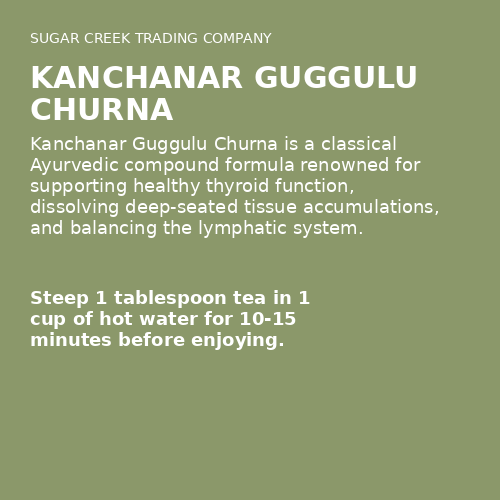
Classical Ayurvedic compound formula renowned for supporting healthy thyroid function, dissolving deep-seated tissue accumulations, and balancing the lymphatic system.
BOTANICAL IDENTIFICATION
Primary Botanicals: Bauhinia variegata L. (Kanchanar) + Commiphora wightii (Arn.) Bhandari (Guggulu)
Common Names: Kanchanar Guggulu, Kanchnar Guggul, Gandmala Kandan, Thyroid Support Churna
Families: Fabaceae (Kanchanar) and Burseraceae (Guggulu)
Form: Traditional multi-herb churna (fine powder blend)
Bauhinia variegata is a medium-sized deciduous tree reaching 10 to 15 meters in height, distinguished by its characteristic bilobed, camel-foot-shaped leaves and striking orchid-like flowers that range from white to deep magenta. Commiphora wightii is a small, thorny, drought-resistant tree native to the arid regions of Rajasthan and Gujarat, India, producing the oleo-gum resin known as guggulu from wounds made in its bark. Together, the bark of the kanchanar tree and the purified resin of guggulu form the core of this classical formula.
The traditional Kanchanar Guggulu formula, as described in the Sharangadhara Samhita, also incorporates a supporting cast of herbs and spices including Triphala (Amalaki, Haritaki, Bibhitaki), Trikatu (black pepper, long pepper, ginger), varuna bark, cardamom, and cinnamon. These supporting ingredients enhance the formula's bioavailability and broaden its therapeutic reach. Both primary plants are native to the Indian subcontinent, with Bauhinia variegata thriving in subtropical foothills and Commiphora wightii adapted to the dry, rocky soils of western India and Pakistan.
CULTURAL AND HISTORICAL USE
Kanchanar Guggulu is one of the most important classical formulations in Ayurvedic medicine, with textual references dating back over a thousand years. It appears prominently in the Sharangadhara Samhita (13th-14th century CE) and the Bhaishajya Ratnavali, where it is classified as a primary treatment for gandamala (cervical lymphadenopathy), granthi (cyst-like growths and tumors), apachi (scrofula), and arbuda (abnormal tissue proliferation). In the Ayurvedic framework, the formula is understood to penetrate and scrape away accumulated kapha dosha from deep tissue layers (mamsa and meda dhatus), restoring proper channel flow throughout the body.
The kanchanar tree itself holds deep cultural significance across South Asia. In Hindu tradition, it is associated with the deity Bauhinia and its flowers are used in temple offerings. The tree's bark has been used in folk medicine across India, Nepal, and Sri Lanka for swollen glands, skin conditions, and digestive complaints for centuries. Meanwhile, guggulu resin has an even more ancient history, referenced in the Atharvaveda (circa 1500 BCE) as a purifying and healing substance, and in the Sushruta Samhita as a remedy for obesity, joint inflammation, and lipid disorders.
The genius of the Kanchanar Guggulu formula lies in the synergistic pairing of kanchanar bark's lymphatic specificity with guggulu's deep tissue-penetrating, bioavailability-enhancing properties. This combination was designed by ancient Ayurvedic physicians to address conditions where abnormal tissue accumulation is driven by sluggish lymphatic and metabolic function, a concept that maps remarkably well onto modern understandings of thyroid dysfunction, benign growths, and lymphatic congestion.
KEY BIOACTIVE COMPOUNDS & BENEFITS
| Compound/Class | Location in Plant | Human Benefit | Role in Plant |
|---|---|---|---|
| Guggulsterones (Z and E) | Guggulu oleo-gum resin | Modulate thyroid hormone synthesis; activate farnesoid X receptor (FXR) to regulate lipid metabolism; anti-inflammatory | Wound-sealing resin defense compound |
| Flavonoids (kaempferol, quercetin glycosides) | Kanchanar bark and flowers | Antioxidant protection; support healthy cell proliferation regulation; lymphatic drainage support | UV protection and pathogen resistance |
| Tannins and phenolic compounds | Kanchanar bark | Astringent action on swollen tissues; antimicrobial; support tissue tone and integrity | Herbivore deterrence and bark protection |
| Gallic acid and ellagic acid (from Triphala) | Triphala fruit component | Potent antioxidant; support detoxification pathways; gentle laxative effect ensuring toxin elimination | Antimicrobial seed protection |
| Piperine (from Trikatu) | Black pepper and long pepper | Dramatically enhances bioavailability of guggulsterones and other active compounds; stimulates digestive fire (agni) | Insecticidal seed defense |
The therapeutic power of Kanchanar Guggulu churna arises from the orchestrated interaction between its components. Kanchanar bark provides the tissue-specific affinity for the lymphatic and glandular systems, while guggulsterones supply the deep-penetrating metabolic activation. The Triphala component ensures proper elimination of mobilized toxins, and the Trikatu spices act as bioenhancers, increasing the absorption and efficacy of the entire formula. This multi-layered design exemplifies the sophisticated pharmacological thinking embedded in classical Ayurvedic formulation science.
HOW IT WORKS IN THE BODY
Kanchanar Guggulu churna operates through multiple interconnected physiological pathways, with its primary actions centered on the endocrine, lymphatic, and metabolic systems.
Thyroid and Endocrine Support:
Guggulsterones have been shown to stimulate thyroid function by enhancing the activity of thyroid peroxidase, a key enzyme in the synthesis of T3 and T4 hormones. Research published in Planta Medica has demonstrated that guggulsterone E and Z can increase iodine uptake by the thyroid gland and improve the conversion of T4 to the more metabolically active T3. The kanchanar bark component contributes by reducing inflammatory congestion around thyroid tissue, supporting healthy glandular architecture.
Lymphatic Decongestion and Tissue Remodeling:
The flavonoids and tannins in kanchanar bark exert a specific decongestant action on the lymphatic system, helping to reduce swelling in lymph nodes and break up accumulated lymphatic stagnation. In Ayurvedic terms, this is described as the formula's ability to scrape away ama (metabolic waste) from the rasa and mamsa dhatus (plasma and muscle tissues). Modern research has identified anti-proliferative activity in Bauhinia variegata bark extracts, supporting the traditional use for abnormal growths and cysts.
Lipid Metabolism and Cholesterol Regulation:
Guggulsterones act as antagonists of the farnesoid X receptor (FXR) in the liver, which increases the conversion of cholesterol into bile acids and promotes their excretion. Multiple clinical studies, including a landmark trial published in Science (2002) by Urizar et al., have elucidated this mechanism, explaining guggulu's well-documented ability to support healthy cholesterol levels.
Anti-inflammatory Cascade:
Both kanchanar and guggulu independently inhibit the NF-kB inflammatory signaling pathway, suppress COX-2 enzyme activity, and reduce pro-inflammatory cytokine production. When combined, their anti-inflammatory effects are compounded, providing broad-spectrum support for chronic inflammatory conditions affecting glandular and connective tissues.
DOSE GUIDELINES
| Preparation Type | Typical Dose | Purpose |
|---|---|---|
| Churna (powder) in warm water | 3 to 5 grams (approximately 1 teaspoon), twice daily | General thyroid and lymphatic support |
| Churna mixed with honey | 3 grams, twice daily before meals | Enhanced kapha-reducing action; traditional method for glandular conditions |
| Decoction (simmered 10 minutes) | 3 to 5 grams powder in 200 ml water, reduced by half | Stronger therapeutic extraction for acute lymphatic congestion |
| Capsules (if encapsulated) | 500 mg, 2 to 4 capsules twice daily | Convenient supplementation for those who dislike the taste |
Kanchanar Guggulu is traditionally taken on an empty stomach with warm water to maximize absorption. In Ayurvedic practice, it is typically administered in cycles of 2 to 3 months, followed by a brief rest period, rather than as an indefinite daily supplement. For thyroid-related concerns, many practitioners recommend pairing it with a diet that reduces kapha-aggravating foods (excess dairy, wheat, sugar) to amplify results.
PREPARATION AND USES
As a churna (powder), this formula is most traditionally prepared by stirring the dose into a cup of warm water or warm milk and drinking it 30 minutes before meals. The taste is characteristically bitter and pungent with warming spice notes from the Trikatu component. Some practitioners recommend mixing the powder with a small amount of raw honey, which in Ayurveda is considered a yogavahi (carrier substance) that enhances penetration into deeper tissues and specifically targets kapha-type accumulations.
For those who find the taste challenging, the churna can be blended into warm herbal teas, mixed into ghee preparations, or encapsulated at home using a simple capsule-filling device. The powder can also be made into a paste with warm water for external application over swollen glands or thyroid area, though internal use is the primary traditional route. When preparing a decoction, simmer gently rather than boiling vigorously, as excessive heat can degrade the volatile guggulsterone compounds.
OPTIMAL CONTEXT FOR USE
This formula is especially well-suited for individuals experiencing:
Hypothyroid symptoms including sluggish metabolism, weight gain, fatigue, cold sensitivity, and brain fog, particularly when related to subclinical thyroid dysfunction
Lymphatic congestion manifesting as swollen lymph nodes, recurrent cysts, fibroids, lipomas, or goiter
Elevated cholesterol or lipid imbalances where dietary and lifestyle modifications need additional metabolic support
Kapha-type constitutions or imbalances characterized by heaviness, water retention, sluggish digestion, and tendency toward tissue accumulation
Polycystic ovarian syndrome (PCOS) where hormonal dysregulation intersects with metabolic and lymphatic stagnation
Kanchanar Guggulu pairs well with Ashwagandha for comprehensive thyroid support, with Punarnava for enhanced lymphatic drainage, and with Triphala (taken separately at night) for ensuring optimal elimination of mobilized metabolic waste.
SUSTAINABILITY AND ETHICAL HARVESTING
Bauhinia variegata is widely cultivated as an ornamental and medicinal tree throughout South and Southeast Asia and is not considered threatened. Its bark can be harvested sustainably through careful partial debarking techniques that allow the tree to heal and continue growing. However, Commiphora wightii faces significant conservation challenges. Due to decades of over-harvesting of its oleo-gum resin in the wild, guggulu has been classified as Critically Endangered on the IUCN Red List, and India has restricted its export in raw resin form.
Responsible sourcing of Kanchanar Guggulu requires attention to the guggulu component's origin. Reputable suppliers now source from cultivated plantations in Rajasthan and Gujarat where sustainable tapping methods are employed, allowing trees adequate recovery time between resin harvests. Supporting suppliers who participate in guggulu cultivation programs helps reduce pressure on wild populations and ensures the long-term availability of this important medicinal resin.
SAFETY AND CAUTIONS
Kanchanar Guggulu churna has a long history of safe use within the Ayurvedic tradition when taken at recommended doses and for appropriate durations.
Thyroid medication interactions: Because this formula actively supports thyroid function, individuals taking synthetic thyroid hormones (levothyroxine, liothyronine) or anti-thyroid medications must consult their healthcare provider before use. Concurrent use may alter thyroid hormone levels and require dose adjustments.
Blood-thinning medications: Guggulsterones may enhance the effects of anticoagulant and antiplatelet drugs (warfarin, aspirin, clopidogrel). Monitor INR levels closely if combining with blood thinners.
Pregnancy and nursing: This formula is traditionally contraindicated during pregnancy due to guggulu's potential uterine-stimulating properties. Nursing mothers should consult a qualified Ayurvedic practitioner before use.
Digestive sensitivity: The Trikatu (pepper and ginger) component may aggravate pitta-type conditions such as gastric ulcers, hyperacidity, or inflammatory bowel disease. Reduce dose or take with food if gastrointestinal discomfort occurs.
REFERENCES
Urizar, N. L., et al. "A natural product that lowers cholesterol as an antagonist ligand for FXR." Science, 296(5573), 2002, pp. 1703-1706.
Tripathi, Y. B., et al. "Thyroid stimulatory action of (Z)-guggulsterone: mechanism of action." Planta Medica, 54(4), 1988, pp. 271-277.
Yadav, V. R., et al. "Commiphora mukul -- an overview." Journal of Herbal Pharmacotherapy, 3(3), 2003, pp. 63-78.
Rajkapoor, B., et al. "Chemically characterized ethanolic extract of Bauhinia variegata Linn. bark: Antiproliferative activity." Journal of Pharmacology and Pharmacotherapeutics, 3(1), 2012, pp. 67-71.
FINAL NOTE
Kanchanar Guggulu Churna represents the pinnacle of Ayurvedic formulation science applied to glandular and metabolic health. Its elegant pairing of kanchanar bark's lymphatic specificity with guggulu's deep tissue-penetrating resin, amplified by time-tested bioenhancers, offers a sophisticated approach to conditions that modern medicine often addresses only with surgery or synthetic hormones. For those navigating thyroid imbalances, stubborn tissue accumulations, or systemic kapha congestion, this classical formula provides a profoundly intelligent botanical intervention rooted in over a millennium of clinical observation.
Condividere