Sugar Creek Trading Company
Kanchanar Herb
Kanchanar Herb
Impossibile caricare la disponibilità di ritiro
BAUHINIA VARIEGATA
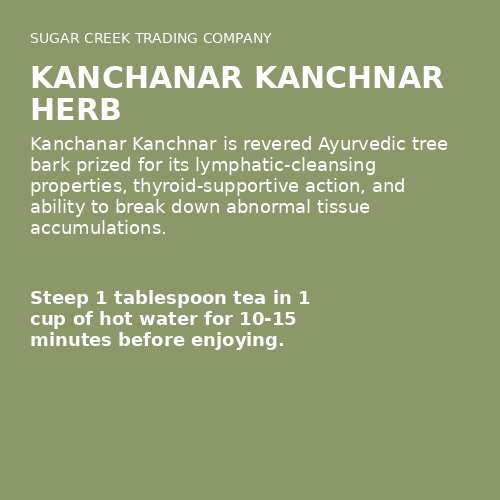
Revered Ayurvedic tree bark prized for its lymphatic-cleansing properties, thyroid-supportive action, and ability to break down abnormal tissue accumulations.
BOTANICAL IDENTIFICATION
Scientific Name: Bauhinia variegata L.
Common Names: Kanchanar, Kanchnar, mountain ebony, orchid tree, camel's foot tree, Buddhist bauhinia, rajapata
Family: Fabaceae (Legume family), subfamily Cercidoideae
Bauhinia variegata is a medium-sized deciduous tree typically reaching 10 to 15 meters in height with a spreading, irregular crown. Its most distinctive feature is the bilobed leaf, deeply cleft at the apex to resemble a camel's hoof or butterfly wings, with prominent palmate venation. The tree produces spectacular clusters of fragrant, orchid-like flowers in shades of white, pink, and magenta, each with five petals and prominent stamens. Flowering occurs from late winter through spring, often before the new leaves emerge, creating a striking display on bare branches. The fruit is a flat, woody pod 15 to 30 centimeters long containing 10 to 15 dark brown seeds.
Native to the Indian subcontinent, southern China, and mainland Southeast Asia, Bauhinia variegata thrives in subtropical and tropical climates at elevations up to 1,800 meters. It is adaptable to a wide range of soils, from sandy loam to heavy clay, and tolerates both drought and seasonal flooding. The tree is now widely cultivated as an ornamental throughout tropical and warm-temperate regions worldwide, including parts of the Americas, Africa, and Australia.
CULTURAL AND HISTORICAL USE
Kanchanar holds a distinguished place in the Ayurvedic pharmacopoeia as one of the primary herbs for conditions involving abnormal tissue growth and glandular dysfunction. The Charaka Samhita, one of the foundational texts of Ayurvedic medicine composed around 300 BCE, lists kanchanar bark as a key remedy for gandamala (cervical lymphadenopathy and scrofulous swellings), granthi (cystic growths), and arbuda (tumorous accumulations). The Bhavaprakasha Nighantu, a 16th-century materia medica, classifies it as grahi (absorbent), kaphahara (kapha-reducing), and kushthahara (beneficial for skin diseases). In the traditional Ayurvedic understanding, kanchanar has a special affinity for the rasa (plasma) and mamsa (muscle/flesh) tissue layers, where it works to dissolve and scrape away stagnant accumulations.
Beyond Ayurveda, kanchanar has deep roots in the folk medicine traditions of rural India, Nepal, and Bangladesh. Village healers have long used the bark decoction for goiter, swollen glands, and persistent skin ulcers. The flowers, buds, and young leaves are eaten as vegetables in many parts of India, particularly in the Himalayan foothills, where they are pickled, stir-fried, or added to lentil dishes. In the Kumaon and Garhwal regions of Uttarakhand, the flower buds are considered a seasonal delicacy and are believed to purify the blood when eaten regularly in spring.
The tree also carries cultural and spiritual significance in South Asian traditions. In Buddhist lore, it is said that Queen Maya grasped a branch of the kanchanar tree during the birth of Siddhartha Gautama. The bilobed leaves have been interpreted as a symbol of duality and unity, and the tree's abundant flowering is associated with renewal and transformation. In parts of Maharashtra and Karnataka, kanchanar bark is still used in traditional Ayurvedic practices during the spring season as a cleansing and rejuvenating tonic.
KEY BIOACTIVE COMPOUNDS & BENEFITS
| Compound/Class | Location in Plant | Human Benefit | Role in Plant |
|---|---|---|---|
| Flavonoids (kaempferol, quercetin, apigenin glycosides) | Bark, flowers, leaves | Antioxidant protection; anti-proliferative activity against abnormal cell growth; anti-inflammatory | UV radiation shielding and pollinator signaling |
| Tannins (condensed and hydrolyzable) | Stem bark | Astringent action that tones swollen tissues; antimicrobial; supports wound healing and tissue integrity | Herbivore deterrence and bark protection |
| Bauhiniastatin peptides | Bark and seeds | Demonstrated cytotoxic activity against certain abnormal cell lines; unique to Bauhinia species | Antimicrobial defense compounds |
| Beta-sitosterol and stigmasterol | Bark and leaves | Anti-inflammatory; support healthy hormonal balance; modulate immune response | Cell membrane structural components |
| Gallic acid and ellagic acid | Bark | Potent antioxidants; hepatoprotective; support detoxification and healthy cell signaling | Pathogen resistance and oxidative stress defense |
The phytochemical profile of kanchanar bark is characterized by an unusually high concentration of condensed tannins and flavonoid glycosides working in concert. The tannins provide the herb's distinctive astringent quality, which physically tightens and tones distended lymphatic and glandular tissue, while the flavonoids supply the antioxidant and anti-proliferative activity that addresses the underlying cellular dysregulation. This dual mechanism of structural toning combined with cellular normalization is what makes kanchanar such a specific remedy for glandular swellings and abnormal growths.
HOW IT WORKS IN THE BODY
Kanchanar bark works through several interconnected physiological pathways, with its most pronounced effects on the lymphatic, endocrine, and integumentary systems.
Lymphatic Drainage and Decongestion:
The condensed tannins in kanchanar bark exert a potent astringent action on lymphatic vessel walls, improving their contractile tone and facilitating the movement of lymph fluid. This addresses the fundamental stagnation that underlies many glandular swellings. Research by Rajkapoor et al. (2006) published in the Journal of Ethnopharmacology demonstrated significant anti-edema activity in Bauhinia variegata bark extracts, supporting the traditional observation that this herb reduces fluid accumulation and tissue swelling.
Thyroid and Endocrine Regulation:
While kanchanar does not contain iodine or directly stimulate thyroid hormone synthesis the way guggulu does, it supports thyroid health through a different mechanism. By reducing inflammatory congestion and lymphatic stagnation around the thyroid gland, kanchanar bark helps restore normal glandular architecture and blood flow. This decongestant action is particularly relevant in cases of goiter and thyroid nodules, where the physical swelling of the gland is as much a problem as any hormonal imbalance.
Anti-proliferative and Tissue-Normalizing Activity:
Multiple in vitro studies have demonstrated that Bauhinia variegata bark extracts possess significant cytotoxic activity against various abnormal cell lines. A study published in the Journal of Pharmacology and Pharmacotherapeutics (2012) showed that the ethanolic bark extract induced apoptosis (programmed cell death) in tumor cell lines while showing considerably less toxicity to normal cells. This selective activity supports the traditional Ayurvedic use for granthi (cysts) and arbuda (tumors).
Skin and Wound Healing:
The tannin-rich bark decoction has demonstrated wound-healing and antimicrobial properties. The astringent tannins promote tissue contraction and hemostasis, while flavonoids reduce local oxidative damage. Folk traditions of applying kanchanar bark paste to chronic skin ulcers and wounds are supported by studies showing enhanced collagen deposition and accelerated epithelialization in treated wound models.
DOSE GUIDELINES
| Preparation Type | Typical Dose | Purpose |
|---|---|---|
| Bark powder (churna) | 3 to 6 grams daily, divided into two doses | General lymphatic and glandular support |
| Bark decoction (kashaya) | 50 to 100 ml of reduced decoction, twice daily | Stronger therapeutic action for active glandular conditions |
| Tincture (1:5 in 45% ethanol) | 2 to 4 ml, three times daily | Convenient liquid extract for sustained use |
| External paste | Bark powder mixed with water to form paste | Topical application for swollen glands, skin conditions, wounds |
Kanchanar bark is best used as a medium-term therapeutic herb rather than a lifelong daily supplement, typically administered in courses of 6 to 12 weeks followed by a reassessment period. In Ayurvedic practice, it is often taken on an empty stomach with warm water or honey to enhance its penetrating, kapha-reducing qualities. For chronic conditions, combining internal and external use amplifies results.
PREPARATION AND USES
The most common traditional preparation is a bark decoction (kashaya). To prepare, add 10 to 15 grams of coarsely powdered bark to 400 ml of water and simmer gently over low heat until the volume is reduced to approximately 100 ml. Strain and drink warm. This concentrated decoction delivers the highest concentration of tannins and flavonoids and is the preferred method for active glandular conditions. For a milder daily preparation, simply steep 3 to 5 grams of the powder in hot water for 10 to 15 minutes as an infusion.
The dried powder can also be taken directly, stirred into warm water or mixed with raw honey, which serves as a traditional carrier substance (anupana) that enhances tissue penetration. For external use, the bark powder is mixed with water, sesame oil, or ghee to form a paste that can be applied directly over swollen lymph nodes, thyroid enlargement, or chronic skin ulcers. Some practitioners prepare a warm poultice by wrapping the moistened powder in muslin and applying it to affected areas. Kanchanar bark also tinctures well in a 1:5 ratio with 45-percent ethanol, producing a shelf-stable liquid extract that is convenient for travel or for those who dislike the astringent taste of the raw powder.
OPTIMAL CONTEXT FOR USE
This herb is especially well-suited for individuals experiencing:
Thyroid nodules, goiter, or benign thyroid enlargement where physical glandular swelling is a primary concern
Chronic lymphatic congestion presenting as swollen or tender lymph nodes, particularly in the cervical (neck) region
Cystic conditions including ovarian cysts, ganglion cysts, and lipomas where tissue accumulation reflects underlying metabolic stagnation
Sluggish kapha constitution with tendencies toward water retention, excess mucus production, weight gain, and slow digestion
Chronic skin conditions such as non-healing ulcers, fistulas, and inflammatory skin lesions that resist conventional treatment
Kanchanar pairs exceptionally well with guggulu resin for enhanced deep-tissue penetration (the classical Kanchanar Guggulu formula), with Punarnava for lymphatic and kidney drainage, with Manjistha for blood purification, and with Triphala for ensuring complete elimination of mobilized waste products.
SUSTAINABILITY AND ETHICAL HARVESTING
Bauhinia variegata is a widely distributed and commonly cultivated tree with no current conservation concerns. It is listed as Least Concern by the IUCN, and its popularity as an ornamental shade tree in parks, gardens, and roadsides across the tropics ensures abundant cultivated stock. The bark can be sustainably harvested through careful partial debarking techniques that remove strips of bark from one side of the tree at a time, allowing the cambium layer to regenerate. Mature trees tolerate careful bark harvesting well when performed during the dormant season.
In India, kanchanar is frequently planted along roadsides and in community forests, and bark collection from pruned branches is a common sustainable practice. The tree's fast growth rate, nitrogen-fixing root nodules (as a legume), and soil-improving qualities make it a valuable component of agroforestry systems. Supporting suppliers who source bark from managed plantations or sustainable forestry operations, rather than from wild-harvested old-growth trees, is always the preferred approach.
SAFETY AND CAUTIONS
Kanchanar bark has a long history of safe use in Ayurvedic medicine and as a food source across South Asia.
Legume family allergy: As a member of the Fabaceae, individuals with severe allergies to other leguminous plants should exercise caution and start with a small test dose.
Thyroid medication interactions: While kanchanar alone has a milder effect on thyroid function than the compound formula Kanchanar Guggulu, individuals on thyroid medications should consult their healthcare provider, as the herb may influence glandular function over time.
Pregnancy and nursing: There is insufficient modern safety data for use during pregnancy and lactation. Traditional sources suggest caution during pregnancy. Consult a qualified practitioner before use.
Constipation potential: The high tannin content can be astringent to the bowels in sensitive individuals. If constipation occurs, reduce the dose or combine with a mild laxative herb such as Triphala.
Blood sugar effects: Some research suggests Bauhinia variegata may have hypoglycemic activity. Individuals on diabetes medications should monitor blood glucose levels when starting this herb.
REFERENCES
Rajkapoor, B., et al. "Chemically characterized ethanolic extract of Bauhinia variegata Linn. bark: Antiproliferative activity." Journal of Pharmacology and Pharmacotherapeutics, 3(1), 2012, pp. 67-71.
Rajkapoor, B., et al. "Anti-inflammatory activity of Bauhinia variegata bark extract." Journal of Ethnopharmacology, 107(2), 2006, pp. 229-232.
Sharma, P. V. Dravyaguna Vijnana (Indian Materia Medica), Vol. II. Chaukhambha Bharati Academy, Varanasi, 2006.
Yadava, R. N., and Reddy, V. M. "Anti-inflammatory activity of a novel flavonol glycoside from Bauhinia variegata Linn." Natural Product Research, 17(3), 2003, pp. 165-169.
FINAL NOTE
Kanchanar stands as one of Ayurveda's most targeted and elegant single-herb remedies, offering a specificity for the lymphatic and glandular systems that few other botanicals can match. Its ability to simultaneously tone distended lymphatic tissue, support healthy thyroid architecture, and discourage abnormal cell proliferation makes it an invaluable tool for conditions that modern herbalism often struggles to address with a single plant. Whether used alone or as the backbone of the classical Kanchanar Guggulu formula, this ancient tree bark delivers a depth of glandular support that reflects centuries of careful clinical observation by Ayurvedic physicians.
Condividere