Sugar Creek Trading Company
Kava Kava Root
Kava Kava Root
Impossibile caricare la disponibilità di ritiro
PIPER METHYSTICUM
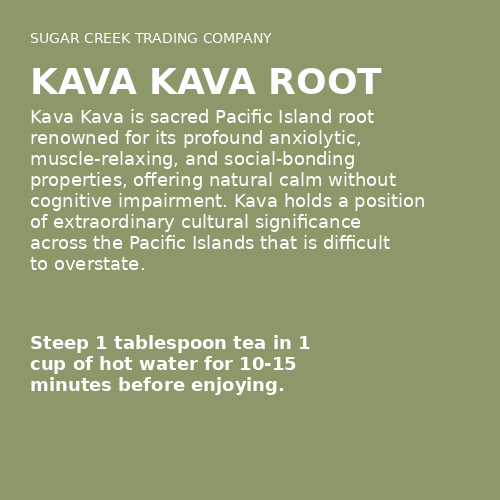
Sacred Pacific Island root renowned for its profound anxiolytic, muscle-relaxing, and social-bonding properties, offering natural calm without cognitive impairment.
BOTANICAL IDENTIFICATION
Scientific Name: Piper methysticum G. Forst.
Common Names: Kava kava, kava, awa (Hawaiian), yaqona (Fijian), sakau (Pohnpeian), malok (Vanuatu), grog (Fiji colloquial)
Family: Piperaceae (Pepper family)
Piper methysticum is a robust, erect, perennial shrub growing 2 to 5 meters tall with thick, succulent, jointed stems that are green and fleshy when young, becoming woody with age. The leaves are large, heart-shaped, and glossy, measuring 15 to 25 centimeters across, with prominent palmate venation. The plant produces small, inconspicuous flower spikes but is almost entirely sterile, rarely setting viable seed. This sterility is a key biological fact: kava has been propagated exclusively by vegetative cuttings for so long, likely 3,000 years or more, that it has lost the ability to reproduce sexually, making it one of the clearest examples of an ancient human-domesticated plant.
The medicinal part is the rootstock and lateral roots, which form a massive, knotted, woody stump that can weigh 5 to 10 kilograms or more in mature plants (harvested at 3 to 5 years of age). The fresh root is pale when cut, with a peppery, slightly numbing taste. Kava is native to the western Pacific Islands, with Vanuatu considered the center of origin and greatest cultivar diversity. It is cultivated throughout Polynesia, Melanesia, and Micronesia, including Fiji, Tonga, Samoa, Hawaii, and the Federated States of Micronesia, always in humid tropical conditions with rich volcanic or alluvial soil, partial shade, and abundant rainfall.
CULTURAL AND HISTORICAL USE
Kava holds a position of extraordinary cultural significance across the Pacific Islands that is difficult to overstate. It is not merely a medicinal or recreational plant but a sacred cultural institution central to governance, diplomacy, religion, and social cohesion for dozens of Pacific Island nations. Archaeological and linguistic evidence suggests that kava cultivation and ceremonial use began at least 3,000 years ago in Vanuatu, spreading eastward with the Austronesian migrations that populated Polynesia. In traditional Pacific Island societies, the kava ceremony is the formal framework through which disputes are settled, alliances are formed, chiefs are installed, guests are welcomed, and communication with ancestors and gods is facilitated.
In Fiji, the yaqona ceremony remains a daily practice in villages, and no significant meeting, celebration, or mourning period proceeds without it. In Tonga, kava is intimately connected to the royal court and has been part of the coronation ritual for centuries. In Samoa, the ava ceremony is the most formal expression of Samoan cultural protocol (fa'a Samoa). In Hawaii, awa was associated with the god Kane and was offered at healing temples (heiau) by kahuna la'au lapa'au (herbal healing priests). The Hawaiian tradition recognized over a dozen named cultivars, each with specific medicinal and ceremonial properties.
The traditional preparation method, unchanged for millennia in many communities, involves fresh kava root being chewed, pounded, or ground and then mixed with water, strained through plant fiber, and consumed as a cloudy, earthy beverage from a communal bowl. European explorers, beginning with Captain James Cook's voyages in the 1770s, documented kava ceremonies with fascination. Cook's naturalist Johann Georg Forster provided the first Western botanical description, giving the plant its species name methysticum, meaning "intoxicating," from the Greek. In modern times, kava bars have spread from Pacific Island diaspora communities to mainstream popularity in cities across the United States, Australia, and Europe, introducing the beverage to entirely new cultural contexts.
KEY BIOACTIVE COMPOUNDS & BENEFITS
| Compound/Class | Location in Plant | Human Benefit | Role in Plant |
|---|---|---|---|
| Kavain (kavalactone) | Root and rootstock | Primary anxiolytic; muscle relaxant; analgesic; produces calm focus without sedation at moderate doses | Antifungal defense compound |
| Dihydrokavain (DHK) | Root and rootstock | Anxiolytic and mild sedative; enhances GABA-A receptor activity; supports sleep onset at higher doses | Antimicrobial root defense |
| Methysticin and dihydromethysticin | Root and rootstock | Anti-inflammatory; anticonvulsant; neuroprotective; may inhibit MAO-B enzyme | Pathogen resistance compounds |
| Yangonin | Root and rootstock | Interacts with CB1 cannabinoid receptors; contributes to mood elevation and relaxation | Chemical defense metabolite |
| Desmethoxyyangonin | Root and rootstock | Supports dopaminergic pathways; contributes to social ease and motivation; may enhance cognitive function | Antimicrobial secondary metabolite |
The six major kavalactones, kavain, dihydrokavain, methysticin, dihydromethysticin, yangonin, and desmethoxyyangonin, typically comprise 3 to 20 percent of the dried root by weight, with the specific ratio varying by cultivar. This ratio, known as the chemotype, determines the character of the kava's effects. Cultivars high in kavain and yangonin tend to produce "heady" effects (uplifting, sociable, mentally clear), while those high in dihydromethysticin and dihydrokavain produce "heavy" effects (deeply sedating, body-relaxing). The traditional Pacific Island practice of maintaining and selecting named cultivars over thousands of years represents a sophisticated form of phytochemical breeding that modern science is only now fully appreciating.
HOW IT WORKS IN THE BODY
Kava's pharmacology is remarkably multifaceted, acting on several distinct neurochemical systems simultaneously, which explains its unique ability to reduce anxiety without impairing cognitive function.
GABAergic System Modulation:
Kavalactones, particularly dihydrokavain and dihydromethysticin, enhance the activity of GABA-A receptors, the primary inhibitory neurotransmitter system in the brain. However, unlike benzodiazepines (which bind directly to the GABA-A receptor's benzodiazepine site), kavalactones appear to modulate GABA activity through allosteric mechanisms and by affecting sodium and calcium ion channels. This distinction is critically important because it explains why kava produces anxiolytic effects comparable to benzodiazepines in clinical trials but does not produce the same degree of cognitive impairment, addiction liability, or withdrawal syndrome. A Cochrane systematic review by Pittler and Ernst (2003) confirmed kava's efficacy for anxiety treatment across multiple controlled trials.
Voltage-Gated Ion Channel Modulation:
Kavain and methysticin inhibit voltage-gated sodium and calcium channels in neuronal tissue, producing muscle-relaxant and analgesic effects similar in mechanism to some local anesthetics. This action accounts for the characteristic numbing sensation when kava is consumed and contributes to its effectiveness for muscle tension, pain relief, and the relaxed physical state that accompanies kava consumption.
Dopaminergic and Endocannabinoid Interactions:
Desmethoxyyangonin has been shown to inhibit monoamine oxidase B (MAO-B), which increases dopamine availability in the brain. Yangonin has demonstrated affinity for CB1 cannabinoid receptors. These interactions contribute to kava's mood-elevating, sociability-enhancing, and motivation-supporting effects, qualities that distinguish it from purely sedating substances and explain the social context in which it has been consumed for millennia.
Anti-inflammatory and Neuroprotective Pathways:
Methysticin and dihydromethysticin have demonstrated significant anti-inflammatory activity through inhibition of COX-2 and NF-kB pathways. Emerging research also suggests neuroprotective properties, with kavalactones reducing oxidative stress in neuronal tissue and potentially supporting long-term brain health. A study by Tang et al. (2011) in Phytotherapy Research demonstrated that kavain protected neurons against ischemic damage in animal models.
DOSE GUIDELINES
| Preparation Type | Typical Dose | Purpose |
|---|---|---|
| Traditional water preparation | 15 to 30 grams root powder kneaded in 250 to 500 ml water | Full-spectrum social and ceremonial use; most traditional method |
| Root powder (medium grind) | 2 to 4 grams stirred into water, 1 to 3 times daily | Moderate anxiolytic support and mild muscle relaxation |
| Standardized extract (capsules) | 100 to 250 mg kavalactones daily (divided doses) | Clinical-grade anxiety management; dose used in most clinical trials |
| Tincture (1:3 in 60% ethanol) | 3 to 5 ml, two to three times daily | Convenient liquid extract; rapid onset for acute anxiety or tension |
For anxiety management, clinical research has typically used 60 to 250 mg of kavalactones daily, divided into two to three doses. The traditional Polynesian method of water extraction is considered the safest and most time-tested preparation route. Kava's effects are cumulative with regular use: many people notice that its anxiolytic effects become more pronounced over the first one to two weeks of daily use, a phenomenon known in kava culture as "reverse tolerance." It is best taken in the evening or during relaxation time, as higher doses produce noticeable sedation.
PREPARATION AND USES
The traditional water preparation remains the gold standard for safety, efficacy, and cultural authenticity. Place 15 to 30 grams of dried root powder in a muslin strainer bag or fine mesh cloth, submerge in 500 ml of lukewarm water (not hot; heat can degrade some kavalactones), and knead, squeeze, and massage the bag for 10 to 15 minutes, pressing the milky liquid through the strainer. The resulting beverage should be opaque, tan to grayish, and slightly viscous. Drink the full portion within 20 to 30 minutes for best effect. Some practitioners add a small amount of coconut milk or lecithin to the straining water, as the kavalactones are partially lipid-soluble and fat content may enhance their extraction and absorption.
For those who prefer a simpler method, the dried root powder can be blended directly into a liquid using a blender method: combine 2 to 4 tablespoons of root powder with 500 ml water and a tablespoon of coconut oil, blend on high for 3 to 4 minutes, and strain through a fine mesh cloth. The root powder can also be encapsulated for convenience, though many kava enthusiasts argue that the oral mucosal contact from drinking the beverage is an important part of the experience and may enhance absorption. Kava should not be prepared with boiling water or alcohol exclusively, as the traditional water-based extraction selects for the desirable kavalactone profile while leaving behind heavier, less desirable compounds concentrated in the aerial parts and bark.
OPTIMAL CONTEXT FOR USE
This herb is especially well-suited for individuals experiencing:
Generalized anxiety and chronic worry where a natural alternative to benzodiazepines is sought, particularly for those who need to maintain mental clarity and cognitive function during the day
Social anxiety and performance anxiety where the combination of anxiolysis and enhanced sociability makes kava uniquely effective compared to purely sedating herbs
Muscle tension, stress-related pain, and bruxism where the muscle-relaxant and analgesic properties of kavalactones provide direct physical relief
Insomnia related to anxiety and racing thoughts, particularly when taken 1 to 2 hours before bed in moderate to higher doses
Transition away from benzodiazepine or alcohol dependence (under professional supervision) where kava may help manage withdrawal anxiety through overlapping but non-identical neurochemical pathways
Kava combines well with passionflower (Passiflora incarnata) for enhanced GABAergic anxiolysis, with ashwagandha for long-term stress resilience, with lemon balm for gentle daytime calm, and with valerian root for stronger sleep-promoting effects when insomnia is the primary concern.
SUSTAINABILITY AND ETHICAL HARVESTING
Piper methysticum does not exist in wild populations; it is an entirely human-cultivated and human-dependent species that has been maintained through vegetative propagation for thousands of years. This means that sustainability concerns relate not to wild harvest pressure but to the maintenance of cultivar diversity, fair trade practices, and the economic welfare of Pacific Island farming communities. Kava requires 3 to 5 years of growth before the rootstock reaches harvestable size, representing a significant long-term investment for farmers.
The global kava market is dominated by production from Vanuatu (the largest exporter and home to the greatest cultivar diversity), Fiji, Tonga, and Samoa. Supporting suppliers who source from these traditional growing regions, pay fair prices to smallholder farmers, and respect the cultural significance of the plant is essential. The distinction between noble kava cultivars (traditional, well-characterized varieties used ceremonially for centuries) and tudei (two-day) or wild kava varieties (which contain higher levels of undesirable flavokavains and dihydromethysticin) is critically important for both safety and quality. Reputable suppliers deal exclusively in noble kava varieties and can provide chemotype documentation.
SAFETY AND CAUTIONS
Noble kava root prepared as a traditional water extraction has a strong safety profile supported by thousands of years of daily use across the Pacific Islands. However, important nuances exist.
Hepatotoxicity concern: In the early 2000s, reports of liver damage associated with kava products led to bans or restrictions in several European countries and Canada. Subsequent investigations revealed that the majority of these cases involved products made from aerial parts or stem peelings (not root), extracted with acetone or ethanol solvents (not water), or derived from tudei (non-noble) cultivars. The World Health Organization's 2016 risk assessment concluded that traditionally prepared noble kava root beverages do not pose a significant liver risk for healthy individuals. Nevertheless, those with pre-existing liver conditions or taking hepatotoxic medications should avoid kava or use it only under medical supervision.
Alcohol interaction: Kava should not be combined with alcohol, as both substances affect GABAergic neurotransmission and their combined effects on the liver and central nervous system are compounded.
Central nervous system depressant interactions: Kava may potentiate the effects of benzodiazepines, barbiturates, and other sedative medications. Do not combine without medical guidance.
Dermopathy: Long-term heavy daily use (well above typical supplemental doses) can produce a reversible dry, scaly skin condition called kava dermopathy (kanikani), which resolves upon discontinuation. This is primarily seen in heavy ceremonial users in the Pacific Islands.
Pregnancy and nursing: Kava is traditionally avoided during pregnancy in most Pacific Island cultures. There is insufficient safety data for use during pregnancy or lactation. Avoid use during these periods.
Driving and machinery: Higher doses of kava can impair motor coordination and reaction time. Avoid driving or operating heavy machinery until you understand your individual response.
REFERENCES
Pittler, M. H., and Ernst, E. "Kava extract versus placebo for treating anxiety." Cochrane Database of Systematic Reviews, 1, 2003, Art. No.: CD003383.
Sarris, J., et al. "Kava in the treatment of generalized anxiety disorder: A double-blind, randomized, placebo-controlled study." Journal of Clinical Psychopharmacology, 33(5), 2013, pp. 643-648.
Lebot, V., Merlin, M., and Lindstrom, L. Kava: The Pacific Elixir -- The Definitive Guide to Its Ethnobotany, History, and Chemistry. Yale University Press, New Haven, CT, 1992.
Raduner, S., et al. "Alkylamides from Echinacea are a new class of cannabinomimetics." Journal of Biological Chemistry, 281(20), 2006. [Note: Yangonin CB1 affinity documented in: Ligresti, A., et al. "Kavalactones and the endocannabinoid system." Pharmacological Research, 66(2), 2012, pp. 163-169.]
FINAL NOTE
Kava kava root stands alone in the botanical world as perhaps the most effective natural anxiolytic available, backed by both millennia of Pacific Island ceremonial tradition and a robust body of modern clinical evidence. Its unique ability to dissolve anxiety and tension while preserving, and even enhancing, mental clarity and social engagement sets it apart from every sedative herb and pharmaceutical anxiolytic on the market. When sourced from noble cultivars and prepared with water in the traditional manner, kava offers a depth of nervous system support that reflects the wisdom of the Oceanic peoples who cultivated and refined this extraordinary plant across three thousand years of island civilization.
Condividere