Sugar Creek Trading Company
Kuraca
Kuraca
Impossibile caricare la disponibilità di ritiro
Croton lechleri
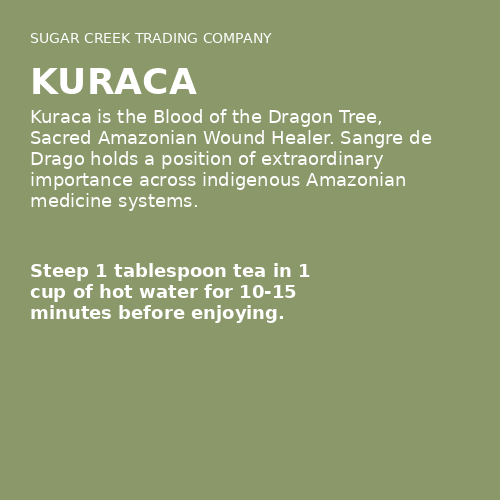
Kuraca — The Blood of the Dragon Tree, Sacred Amazonian Wound Healer
Botanical Identification
Common Names: Kuraca, Sangre de Drago, Sangre de Grado, Dragon's Blood, Blood of the Dragon
Latin Name: Croton lechleri Mull. Arg.
Family: Euphorbiaceae (Spurge family)
Parts Used: Latex (resin) harvested from the bark
Origin: Upper Amazon Basin — Peru, Ecuador, Colombia, Bolivia, and Brazil. Thrives in tropical lowland forests between 100 and 2,000 meters elevation. The tree grows rapidly, reaching 10 to 20 meters in height, and produces a deep crimson-red latex when the bark is scored.
Appearance: The fresh resin is a viscous, blood-red liquid that dries to a dark, glossy film upon contact with skin. It has a faintly astringent, earthy taste and virtually no aroma until applied topically, at which point a subtle resinous warmth becomes apparent.
Cultural and Historical Use
Sangre de Drago holds a position of extraordinary importance across indigenous Amazonian medicine systems. The Shuar, Achuar, Kichwa, and Shipibo-Conibo peoples have used the red latex for centuries as a first-response wound treatment — applied directly to cuts, burns, insect bites, and post-childbirth tissue. Peruvian curanderos refer to it as "liquid bandage from the forest."
Traditional applications extend well beyond wound care. Amazonian communities use the resin internally for gastric ulcers, diarrhea, and intestinal inflammation. Women in the Peruvian highlands use diluted sangre de drago as a vaginal wash after childbirth to promote tissue repair. The Kichwa people of Ecuador apply it to gum tissue after tooth extraction.
The name "Dragon's Blood" is shared with resins from several unrelated Old World trees (Dracaena, Daemonorops), but Croton lechleri is pharmacologically distinct. Its ethnobotanical profile was brought to Western attention by researchers like Dr. Rainer Bussmann and through the development of crofelemer (Mytesi), an FDA-approved pharmaceutical derived directly from this tree's latex.
Key Bioactive Compounds
| Compound | Class | Primary Action |
|---|---|---|
| Taspine | Alkaloid | Stimulates fibroblast migration and wound closure; anti-inflammatory |
| Proanthocyanidins (SP-303 / Crofelemer) | Oligomeric polyphenols | Regulates chloride ion secretion in intestinal cells; potent antidiarrheal |
| Catechins and Epicatechins | Flavonoids | Antioxidant protection; supports vascular integrity |
| Lignans (including 3',4-O-dimethylcedrusin) | Phenylpropanoids | Wound healing acceleration; collagen cross-linking support |
| Diterpenes | Terpenoids | Antimicrobial activity against gram-positive bacteria |
How It Works in the Body
Wound Healing and Tissue Repair: Taspine, the primary alkaloid, has been shown in laboratory studies to promote the migration of fibroblasts — the cells responsible for producing collagen and rebuilding tissue matrix. When applied topically, the resin forms a thin protective film that simultaneously shields the wound from pathogens and delivers taspine directly to damaged tissue. The lignan fraction accelerates collagen cross-linking, supporting scar formation and tensile strength.
Antidiarrheal Mechanism: The proanthocyanidin fraction (SP-303, later developed as crofelemer) inhibits two chloride ion channels in intestinal epithelial cells: the cystic fibrosis transmembrane conductance regulator (CFTR) and calcium-activated chloride channels (CaCC). By reducing chloride secretion into the intestinal lumen, it decreases the osmotic draw of water, directly addressing secretory diarrhea without slowing gut motility.
Anti-inflammatory Activity: Both taspine and the proanthocyanidin complex reduce the expression of pro-inflammatory cytokines and inhibit NF-kB activation in cell culture models. This dual action — controlling inflammation while promoting repair — explains its traditional effectiveness on burns and inflamed mucosal tissue.
Antimicrobial Properties: The diterpene and phenolic fractions demonstrate activity against Staphylococcus aureus, Bacillus subtilis, and Helicobacter pylori in vitro, supporting the traditional use for gastric complaints and infected wounds.
Dose Guidelines
| Application | Suggested Use | Notes |
|---|---|---|
| Topical (wounds, burns, bites) | Apply 2–5 drops directly to clean skin; allow to dry | Forms a protective film within 30–60 seconds. Reapply 2–3 times daily. |
| Internal (GI support) | 3–5 drops in a small glass of water, 1–3 times daily | Traditional dose for diarrhea and gastric inflammation. Short-term use preferred. |
| Oral rinse (gum/mouth tissue) | 2–3 drops in 1 oz warm water; swish and spit | Traditional use after dental procedures or for mouth sores. |
Preparation and Uses
- Direct Topical Application: The most common and straightforward use. Score or open the resin bottle, apply drops to the affected area, and rub gently. The latex turns white and forms a thin film as it interacts with skin proteins.
- Diluted Internal Dose: Add drops to water or juice. The resin disperses into a pale pink emulsion. Traditionally taken on an empty stomach for gastric complaints.
- Salve or Balm Base: Mix several drops into a carrier oil (coconut or olive) or beeswax-based balm for a slower-release topical preparation.
- Oral Hygiene Rinse: Dilute in warm water for mouth sores, gum inflammation, or post-extraction support.
Optimal Context for Use
- Cuts, scrapes, abrasions, and minor burns where a protective wound film is desired
- Insect bites and stings — traditional Amazonian first response
- Acute or traveler's diarrhea — secretory diarrhea in particular
- Gastric inflammation and mild ulcer-related discomfort (traditional use)
- Post-extraction dental care and canker sores
- Skin irritation from rashes, eczema flares, or friction wounds
Sustainability and Ethical Harvesting
Croton lechleri is a fast-growing pioneer species that colonizes forest gaps and disturbed areas. When harvested responsibly — scoring the bark rather than felling the tree — individual trees can produce latex for many years. However, overharvesting through deep cuts or ring-barking kills trees and degrades local populations.
Ethical sourcing prioritizes community-managed harvest systems in Peru and Ecuador, where indigenous knowledge guides sustainable tapping rotations. Organizations like the Amazon Conservation Association have worked to develop fair-trade latex collection programs. When purchasing, look for resin sourced from community cooperatives rather than industrial clear-cut operations.
Safety and Cautions
- Pregnancy and Nursing: Internal use is not recommended during pregnancy due to insufficient safety data. Topical use on small areas is generally considered acceptable in traditional practice.
- Drug Interactions: The resin may theoretically interact with anticoagulant medications due to its effects on tissue repair pathways. Consult a healthcare provider if taking blood thinners.
- Allergic Sensitivity: Euphorbiaceae family plants can cause contact dermatitis in sensitive individuals. Test a small area of skin before widespread topical use.
- Internal Duration: Traditional practitioners typically use internal doses for acute episodes (days to a few weeks), not as a long-term daily supplement.
- Quality Concerns: Authentic Croton lechleri resin should be deep crimson-red and turn white when rubbed into skin. Brown, thin, or watery products may be adulterated or oxidized.
This product has not been evaluated by the FDA. It is not intended to diagnose, treat, cure, or prevent any disease.
References
- Ubillas R, et al. "SP-303, an antiviral oligomeric proanthocyanidin from the latex of Croton lechleri (Sangre de Drago)." Phytomedicine. 1994;1(2):77-106.
- Vaisberg AJ, et al. "Taspine is the cicatrizant principle in Sangre de Grado extracted from Croton lechleri." Planta Medica. 1989;55(2):140-143.
- Jones K. "Review of Sangre de Drago (Croton lechleri) — a South American tree sap in the treatment of diarrhea, inflammation, insect bites, viral infections, and wounds." Journal of Alternative and Complementary Medicine. 2003;9(6):877-896.
- Cottreau J, et al. "Crofelemer for the treatment of secretory diarrhea." Expert Review of Gastroenterology and Hepatology. 2012;6(1):17-23.
- Bussmann RW, Sharon D. "Traditional medicinal plant use in Northern Peru: tracking two thousand years of healing culture." Journal of Ethnobiology and Ethnomedicine. 2006;2:47.
Final Note
Kuraca — Sangre de Drago — is one of the Amazon's most remarkable and well-documented medicinal resins. Its journey from indigenous wound care to an FDA-approved pharmaceutical (crofelemer/Mytesi) represents a rare validation of traditional knowledge by modern pharmacology. Whether applied to a fresh cut on the trail or taken internally for acute digestive distress, this blood-red latex carries centuries of Amazonian healing wisdom in every drop. Respect the source, respect the tree, and let the Dragon's Blood do its ancient work.
Condividere