Sugar Creek Trading Company
Lemon Balm
Lemon Balm
Impossibile caricare la disponibilità di ritiro
MELISSA OFFICINALIS
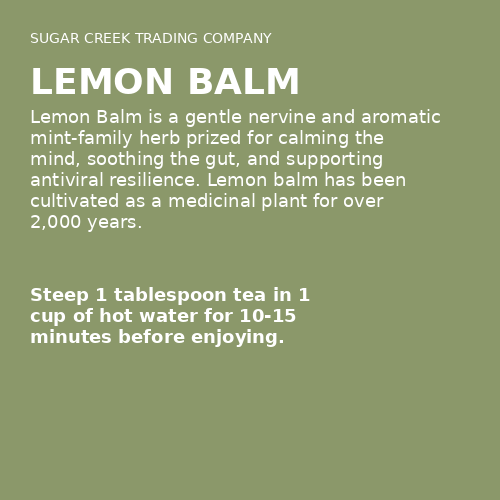
A gentle nervine and aromatic mint-family herb prized for calming the mind, soothing the gut, and supporting antiviral resilience.
BOTANICAL IDENTIFICATION
Scientific Name: Melissa officinalis L.
Common Names: Lemon Balm, Bee Balm, Sweet Balm, Melissa, Cure-All, Honey Plant, Dropsy Plant
Family: Lamiaceae (Mint family)
Lemon balm is a bushy, herbaceous perennial that grows 30 to 90 cm tall with square stems characteristic of the mint family. Its broadly ovate, crenate leaves are deeply veined and emit a strong lemon fragrance when crushed. Small, inconspicuous white to pale yellow flowers appear in loose axillary clusters from midsummer through early autumn and are intensely attractive to honeybees, which is the origin of its genus name Melissa, derived from the Greek word for "honeybee."
Native to southern Europe, the Mediterranean Basin, and western Asia, lemon balm has naturalized throughout temperate regions worldwide. It thrives in well-drained, moderately fertile soils in full sun to partial shade and readily self-seeds in garden settings, making it one of the most accessible medicinal herbs for home cultivation.
CULTURAL AND HISTORICAL USE
Lemon balm has been cultivated as a medicinal plant for over 2,000 years. The ancient Greeks dedicated it to the temple of Diana and used it medicinally to treat wounds, venomous bites, and melancholy. Dioscorides recorded its use in his first-century De Materia Medica, recommending it steeped in wine for scorpion stings and dog bites. The great Arab physician Avicenna (Ibn Sina) wrote in the 11th century that lemon balm "causeth the mind and heart to become merry," establishing its long-standing reputation as a mood-lifting herb. Paracelsus called it the "elixir of life" and believed it could completely revivify the body.
In European monastic medicine, Carmelite nuns produced "Carmelite water" (Eau de Melisse des Carmes) beginning in 1611, a lemon balm-based tonic that became one of the most popular herbal preparations in France and was used to treat nervous headache, neuralgia, and digestive complaints for centuries. In Traditional Chinese Medicine, while not a classical herb, lemon balm has been incorporated in modern integrative practice for its calming and digestive properties. In Ayurveda, it is considered cooling and is used to pacify excess Pitta, addressing heat-related irritability, insomnia, and inflammatory digestive conditions.
Throughout the Middle Ages and Renaissance, lemon balm was a staple of European apothecary gardens. Nicholas Culpeper, the 17th-century English herbalist, recommended it to "drive away all troublesome cares and thoughts out of the mind, arising from melancholy." Thomas Jefferson grew it at Monticello, and it was a fixture in colonial American kitchen gardens, used equally in cooking and as a household remedy for fevers, colds, and nervous tension.
KEY BIOACTIVE COMPOUNDS & BENEFITS
| Compound/Class | Location in Plant | Human Benefit | Role in Plant |
|---|---|---|---|
| Rosmarinic Acid | Leaves, stems | Potent antioxidant; anti-inflammatory; inhibits HSV attachment to host cells; supports cognitive function | UV protection and antimicrobial defense |
| Citral (geranial + neral) | Leaf essential oil glands | Antiviral activity against herpes simplex; sedative and anxiolytic effects; antimicrobial | Insect deterrent and antimicrobial volatile defense |
| Eugenol | Leaf essential oil | Analgesic; anti-inflammatory; antispasmodic for digestive smooth muscle | Herbivore deterrent compound |
| Flavonoids (luteolin, apigenin) | Leaves, flowers | Anxiolytic and neuroprotective; GABA-A receptor modulation; antioxidant | UV screening and pollinator signaling pigments |
| Tannins (condensed) | Leaves | Astringent action; antiviral barrier on mucous membranes; supports wound healing | Anti-herbivory and tissue repair |
Together, these compounds create a multi-targeted therapeutic profile: rosmarinic acid and citral deliver the herb's signature antiviral and calming actions, while flavonoids like luteolin and apigenin act on GABA receptors to ease anxiety without heavy sedation. The overall chemistry makes lemon balm one of the rare herbs that is simultaneously nervine, carminative, and antiviral, a combination particularly valuable for stress-related digestive complaints and recurrent viral conditions.
HOW IT WORKS IN THE BODY
Lemon balm acts primarily through the nervous system, the gastrointestinal tract, and the immune-viral interface, with overlapping mechanisms that reinforce its calming and protective effects.
Nervous System and Mood Regulation:
Rosmarinic acid inhibits GABA transaminase, the enzyme that degrades gamma-aminobutyric acid (GABA) in the brain. By slowing GABA breakdown, lemon balm effectively increases available GABA, the primary inhibitory neurotransmitter responsible for calming neural excitability. Flavonoids such as apigenin additionally bind to benzodiazepine receptor sites on GABA-A receptors, producing mild anxiolytic effects. A 2014 study published in Nutrients found that 300 mg of lemon balm extract significantly reduced anxiety and improved calmness and alertness in healthy volunteers under controlled stress conditions.
Digestive Support and Antispasmodic Action:
The volatile oils, particularly citral and eugenol, relax gastrointestinal smooth muscle through calcium channel modulation, reducing cramping and bloating. Lemon balm also stimulates bile flow (choleretic action), supporting fat digestion and overall hepatobiliary function. European Commission E monographs officially approve lemon balm for "nervous sleeping disorders and functional gastrointestinal complaints."
Antiviral Defense:
Rosmarinic acid and other hydroxycinnamic acid derivatives interfere with viral glycoprotein attachment to host cell receptors, particularly well-documented against herpes simplex virus types 1 and 2 (HSV-1 and HSV-2). A clinical trial published in Phytomedicine (2012) demonstrated that topical lemon balm cream significantly reduced healing time and symptom severity in recurrent herpes labialis compared to placebo.
DOSE GUIDELINES
| Preparation Type | Typical Dose | Purpose |
|---|---|---|
| Dried Leaf Tea (Infusion) | 1.5-4.5 g steeped in 150 mL hot water, 2-3 times daily | Anxiety, insomnia, digestive upset, general nervous tension |
| Tincture (1:5, 45% ethanol) | 2-6 mL, 3 times daily | Concentrated nervine and antiviral support |
| Standardized Extract (capsule) | 300-600 mg, 1-2 times daily | Cognitive support, sustained anxiety relief |
| Topical Cream (1% dried extract) | Apply to affected area 2-4 times daily | Cold sores (HSV-1), minor skin irritation |
Lemon balm is generally used as a long-term tonic nervine and can be taken daily for extended periods. For acute anxiety or insomnia, higher-end doses taken 30 to 60 minutes before bed or stressful events are most effective. For antiviral purposes, both internal and topical application used simultaneously tend to yield the best outcomes.
PREPARATION AND USES
The most traditional preparation is a simple hot infusion: steep 1 to 2 tablespoons of dried lemon balm leaf in just-boiled water for 10 to 15 minutes, covered, to preserve the volatile oils. The resulting tea is light, pleasantly lemony, and can be sweetened with honey. For a stronger medicinal brew, increase steeping time to 20 minutes. Lemon balm combines beautifully in tea blends with chamomile, passionflower, lavender, or valerian for enhanced relaxation and sleep support.
Tinctures offer a more concentrated form and are ideal for on-the-go use or when consistent daily dosing is preferred. In the kitchen, fresh lemon balm leaves add a bright citrus note to salads, fish dishes, fruit desserts, and herbal vinegars. The dried herb can be included in sachets and dream pillows for its calming aroma. For topical antiviral use, a strong decoction or infused oil can be applied directly to cold sores, or commercial creams standardized for rosmarinic acid content may be used.
OPTIMAL CONTEXT FOR USE
Lemon balm is especially well-suited for individuals experiencing:
Anxiety, restlessness, or nervous tension that manifests with digestive symptoms such as "nervous stomach," bloating, or cramping
Difficulty falling asleep or staying asleep, particularly when driven by an overactive mind or racing thoughts
Recurrent cold sores (HSV-1) or a desire for natural antiviral support alongside conventional treatment
Mild to moderate stress-related cognitive difficulties, including poor concentration and mental fatigue
Hyperthyroid symptoms or Graves' disease, where lemon balm's mild TSH-receptor-blocking activity may offer complementary support under medical supervision
Lemon balm works well as part of a broader calming protocol that may include adequate sleep hygiene, stress management practices, and complementary herbs like passionflower, valerian, or ashwagandha.
SUSTAINABILITY AND ETHICAL HARVESTING
Lemon balm is one of the most sustainable medicinal herbs available. It is overwhelmingly cultivated rather than wild-harvested, grows readily in a wide range of climates, and self-seeds prolifically. There are no conservation concerns for this species, and it is not listed on any threatened plant databases. Commercial cultivation is straightforward and requires minimal inputs, making it an environmentally low-impact crop.
Sugar Creek Trading Company sources lemon balm from established cultivated farms that practice sustainable agriculture. Home gardeners can easily grow their own supply from seed or transplant, harvesting leaves just before flowering when essential oil content peaks.
SAFETY AND CAUTIONS
Lemon balm is classified as Generally Recognized as Safe (GRAS) by the FDA and has an excellent safety profile across centuries of documented use.
Thyroid Medications: Lemon balm may inhibit TSH binding and reduce thyroid hormone levels. Individuals taking thyroid medications (levothyroxine, methimazole) should consult their healthcare provider before use.
Sedative Medications: Due to its calming effects, lemon balm may enhance the effects of sedative drugs, barbiturates, and benzodiazepines. Use caution if combining with prescription sedatives or sleep aids.
Pregnancy and Nursing: While traditionally considered safe, there is limited clinical data on high-dose use during pregnancy. Moderate tea consumption is generally regarded as acceptable, but concentrated extracts should be used only under professional guidance.
Glaucoma: Some evidence suggests lemon balm may increase intraocular pressure. Those with glaucoma should exercise caution.
REFERENCES
Kennedy, D.O., et al. "Modulation of mood and cognitive performance following acute administration of Melissa officinalis (lemon balm)." Pharmacology, Biochemistry and Behavior, 72(4), 2002, pp. 953-964.
Schnitzler, P., et al. "Melissa officinalis oil affects infectivity of enveloped herpesviruses." Phytomedicine, 15(9), 2008, pp. 734-740.
Cases, J., et al. "Pilot trial of Melissa officinalis L. leaf extract in the treatment of volunteers suffering from mild-to-moderate anxiety disorders." Mediterranean Journal of Nutrition and Metabolism, 4(3), 2011, pp. 211-218.
European Medicines Agency. "Assessment report on Melissa officinalis L., folium." EMA/HMPC/196746/2012.
Blumenthal, M., et al. The Complete German Commission E Monographs: Therapeutic Guide to Herbal Medicines. American Botanical Council, 1998.
FINAL NOTE
Lemon balm embodies the best of what gentle, time-tested herbal medicine can offer: effective enough to produce measurable changes in anxiety, sleep, and viral resilience, yet mild enough for daily use by nearly anyone. Its bright lemon fragrance and pleasant flavor make it one of the most approachable medicinal herbs, equally at home in a therapeutic protocol as in a cup of afternoon tea. Few plants balance accessibility and genuine clinical efficacy as gracefully as Melissa officinalis.
Condividere