Sugar Creek Trading Company
Lion's Mane Mushroom
Lion's Mane Mushroom
Impossibile caricare la disponibilità di ritiro
HERICIUM ERINACEUS
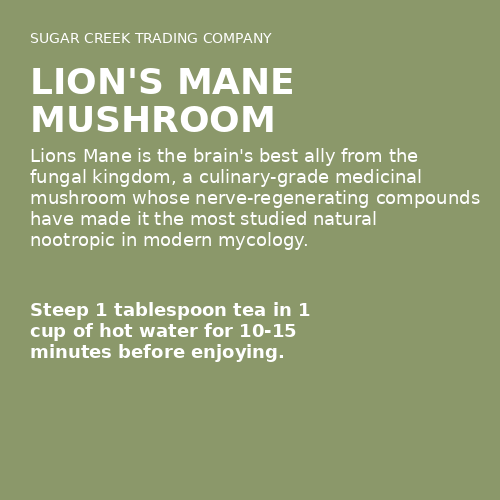
A striking medicinal mushroom with no botanical equal, uniquely capable of stimulating nerve growth factor synthesis and supporting brain health, cognitive function, and nervous system repair.
BOTANICAL IDENTIFICATION
Scientific Name: Hericium erinaceus (Bull.) Pers.
Common Names: Lion's Mane Mushroom, Bearded Tooth Mushroom, Hedgehog Mushroom, Pom Pom Mushroom, Yamabushitake (Japanese), Hou Tou Gu (Chinese), Bearded Hedgehog Fungus
Family: Hericiaceae (Kingdom Fungi)
Lion's Mane is a large, conspicuous saprotrophic and weakly parasitic fungus that produces fruiting bodies unlike any other mushroom. Rather than a traditional cap-and-stem structure, the fruiting body is a single, globular or irregularly shaped mass ranging from 5 to 40 centimeters across, covered entirely in long, soft, cascading spines (teeth) that hang downward like a white waterfall or, as the common name suggests, a lion's shaggy mane. Young specimens are pure white and firm; as the mushroom matures, it yellows and eventually browns. The spines, which are the spore-producing surfaces, can extend 1 to 5 centimeters in length. The flesh is white, firm, and has a mild, slightly sweet taste and a texture often compared to lobster or crab meat when cooked.
Hericium erinaceus is found throughout temperate forests of North America, Europe, and Asia, growing on wounds, knotholes, and dead sections of living or recently dead hardwood trees, with a strong preference for oak, beech, maple, and walnut. It fruits in late summer through autumn. Once considered rare in the wild, it has become one of the most successfully cultivated gourmet and medicinal mushrooms in the world, with commercial production now widespread in China, Japan, the United States, and Europe using hardwood sawdust-based substrate systems.
CULTURAL AND HISTORICAL USE
Lion's Mane mushroom has a documented history of use in Traditional Chinese Medicine spanning at least several centuries. The Ben Cao Gang Mu (Compendium of Materia Medica, 1578) by Li Shizhen references Hericium species, and Chinese medical practitioners have long prescribed hou tou gu for ailments of the stomach and digestive tract, particularly chronic gastritis and stomach ulcers. In the TCM framework, Lion's Mane is considered sweet in taste and neutral in temperature, with an affinity for the spleen, stomach, heart, and kidney meridians. It was classified as a tonic for the five internal organs and was believed to promote good digestion, general vigor, and strength.
In Japan, the mushroom is called yamabushitake, meaning "mountain monk mushroom," named after the Yamabushi Buddhist monks who practiced ascetic meditation in remote mountain forests. The association with monks and contemplative practice is fitting, given the mushroom's now-established effects on cognitive function and mental clarity. Japanese and Chinese Buddhist monasteries included Lion's Mane in their medicinal and culinary traditions, and it was served as a delicacy at imperial banquets in China. In traditional Japanese folk medicine, it was used for neurological conditions and digestive weakness.
Western scientific interest in Lion's Mane exploded in the 1990s when Japanese mycologist Dr. Hirokazu Kawagishi and his team isolated the hericenones and erinacines, compounds that were shown to cross the blood-brain barrier and stimulate the production of nerve growth factor (NGF) in the brain. This discovery transformed Lion's Mane from a traditional medicinal food into one of the most actively researched natural substances for neurological health and neurodegenerative disease. It is now the subject of hundreds of published studies and has become one of the most sought-after medicinal mushrooms worldwide.
KEY BIOACTIVE COMPOUNDS & BENEFITS
| Compound/Class | Location in Mushroom | Human Benefit | Role in Fungus |
|---|---|---|---|
| Hericenones (C, D, E, F, G, H) | Fruiting body | Stimulate nerve growth factor (NGF) synthesis in the brain; neuroprotective | Possible chemical defense and signaling molecules |
| Erinacines (A, B, C, and others) | Mycelium (and to a lesser extent fruiting body) | Cross blood-brain barrier; potent NGF inducers; neuroprotective and neuroregenerative | Diterpenoid secondary metabolites likely involved in ecological competition |
| Beta-glucans (beta-1,3/1,6-D-glucans) | Cell walls of fruiting body and mycelium | Immunomodulating; activate macrophages, dendritic cells, and natural killer cells | Structural polysaccharides of fungal cell walls |
| Polysaccharides (heteroglucans, galactoxyloglucans) | Fruiting body | Antioxidant, gastroprotective, anti-tumor (in animal models) | Structural components and energy storage |
| Ergosterol and ergothioneine | Fruiting body and mycelium | Antioxidant; ergosterol is a vitamin D2 precursor; ergothioneine protects mitochondria | Membrane integrity and oxidative stress protection |
Lion's Mane is pharmacologically unique among medicinal mushrooms because of the hericenones and erinacines, two classes of compounds found in no other known organism that specifically stimulate the body's own production of nerve growth factor. This NGF-inducing activity, combined with the robust immunomodulating effects of the beta-glucan fraction and the broad antioxidant support from polysaccharides and ergothioneine, creates a medicinal profile that bridges neurological, immune, and metabolic health in a way that no other single natural substance currently replicates.
HOW IT WORKS IN THE BODY
Lion's Mane mushroom exerts its effects through several distinct and well-researched mechanisms, with its neurological actions being the most scientifically remarkable.
Nerve Growth Factor (NGF) Stimulation and Neuroregeneration:
The hericenones and erinacines are small molecules that cross the blood-brain barrier and stimulate astrocytes and other glial cells to increase their production of NGF, a protein essential for the growth, maintenance, and survival of neurons. NGF supports the myelination of nerve fibers (the insulating sheath that enables rapid signal transmission), promotes axonal growth, and protects neurons from damage caused by oxidative stress, inflammation, and amyloid plaque accumulation. Declining NGF levels are associated with age-related cognitive decline and neurodegenerative conditions including Alzheimer's disease. By boosting endogenous NGF production, Lion's Mane supports the brain's own repair and maintenance machinery rather than introducing an external compound.
Cognitive Enhancement and Memory Support:
A landmark double-blind, placebo-controlled clinical trial published in Phytotherapy Research (Mori et al., 2009) demonstrated that Japanese adults aged 50-80 with mild cognitive impairment showed significant improvements in cognitive function scores after 16 weeks of Lion's Mane supplementation compared to placebo. Notably, cognitive scores declined again four weeks after supplementation was discontinued, suggesting the effect depends on ongoing consumption. Additional studies have shown improvements in recognition memory, spatial memory, and processing speed in both animal models and human subjects.
Neuroprotection Against Neurodegeneration:
In preclinical research, Lion's Mane extracts have demonstrated protective effects against amyloid-beta-induced neurotoxicity (relevant to Alzheimer's disease), reduced hippocampal inflammation, and promoted remyelination of damaged nerve fibers (relevant to multiple sclerosis and peripheral neuropathy). The erinacines have shown particular promise in animal models of Parkinson's disease, where they reduced dopaminergic neuron loss and improved motor function.
Immune Modulation via Beta-Glucans:
The beta-glucan polysaccharides in Lion's Mane activate the innate immune system through binding to dectin-1 and complement receptor 3 on macrophages and dendritic cells. This triggers a cascade of immune signaling that enhances pathogen surveillance and clearance without promoting excessive inflammation. Studies have also shown anti-tumor activity of Lion's Mane polysaccharides in animal models, mediated through enhanced natural killer cell activity and macrophage cytotoxicity.
Gastroprotective and Digestive Support:
Lion's Mane has demonstrated significant gastroprotective effects in studies, reducing gastric mucosal damage induced by ethanol and other irritants. The polysaccharide fraction appears to protect and promote healing of the stomach lining, consistent with the mushroom's traditional TCM use for stomach and digestive complaints. Research has also shown inhibition of Helicobacter pylori growth in laboratory studies.
DOSE GUIDELINES
| Preparation Type | Typical Dose | Purpose |
|---|---|---|
| Dried mushroom powder | 3-5 grams daily, mixed into coffee, tea, smoothies, or food | General cognitive support, immune enhancement, and neuroprotection |
| Hot water decoction | 2-3 teaspoons dried mushroom simmered in 2 cups water for 20-30 minutes; 1-2 cups daily | Full extraction of polysaccharides and beta-glucans; immune and digestive support |
| Dual extract tincture (water + alcohol) | 2-4 mL, two to three times daily | Comprehensive extraction of both water-soluble (beta-glucans) and alcohol-soluble (hericenones) compounds |
| Capsules (fruiting body extract) | 500-3,000 mg daily (standardized to beta-glucans) | Convenient standardized supplementation; clinical trial dosing |
Lion's Mane delivers its most significant cognitive and neurological benefits with consistent, long-term use. The Mori et al. clinical trial used 16 weeks of daily supplementation to achieve measurable cognitive improvement, and benefits were lost after discontinuation. For brain health and neuroprotection, plan on at least 8 to 12 weeks of daily use to evaluate effects. For immune support and digestive benefits, effects may be noticeable sooner. A dual extraction method (both hot water and alcohol) captures the widest range of bioactive compounds.
PREPARATION AND USES
Dried Lion's Mane mushroom can be prepared in several ways depending on the desired therapeutic focus. For a simple decoction that extracts the water-soluble polysaccharides and beta-glucans, simmer two to three teaspoons of dried mushroom pieces in two cups of water for 20 to 30 minutes at a low boil, strain, and drink. This produces a mild, slightly savory broth with an almost imperceptible sweetness. For a more complete extraction that also captures the alcohol-soluble hericenones, prepare a dual-extract tincture: first simmer the mushroom in water as above, then macerate a second batch in high-proof alcohol (60-70%) for 4 to 6 weeks, and combine the two extractions.
Many people prefer to grind dried Lion's Mane into a fine powder using a coffee grinder or blender and add it directly to coffee, tea, hot chocolate, smoothies, or soups. The mild, slightly umami flavor blends easily into most beverages and foods without significantly altering taste. Lion's Mane powder can also be added to oatmeal, stirred into nut butter, or incorporated into energy balls and baked goods. For culinary use, rehydrate dried pieces in warm water for 20 minutes, then sear in butter or oil until golden and slightly crispy at the edges, producing a texture and flavor remarkably similar to seared crab or lobster meat. Lion's Mane combines well with other medicinal mushrooms such as reishi, chaga, and cordyceps in comprehensive immune and adaptogenic formulas.
OPTIMAL CONTEXT FOR USE
Lion's Mane mushroom is especially well-suited for individuals experiencing:
Age-related cognitive decline, brain fog, memory difficulties, or concerns about long-term brain health, where the unique NGF-stimulating properties can support neuronal maintenance and repair
Nerve damage or peripheral neuropathy, including numbness, tingling, or pain in the extremities, where Lion's Mane's nerve-regenerating properties may support recovery
Mild to moderate anxiety or depression, where emerging research suggests benefits through nerve growth factor modulation, hippocampal neurogenesis, and anti-inflammatory effects in the brain
Digestive complaints including chronic gastritis, stomach sensitivity, or Helicobacter pylori concerns, consistent with its traditional TCM use as a stomach-healing medicinal food
The need for comprehensive immune support, particularly during cold and flu season or periods of increased immune demand, where the beta-glucan fraction activates innate immune defenses
Lion's Mane pairs synergistically with omega-3 fatty acids for comprehensive brain nutrition, with reishi mushroom for balanced immune modulation, with cordyceps for energy and cognitive performance, and with turmeric and rosemary for enhanced neuroprotective antioxidant coverage.
SUSTAINABILITY AND ETHICAL HARVESTING
Wild Hericium erinaceus has experienced population declines in parts of its range due to habitat loss, particularly the reduction of old-growth hardwood forests that provide its preferred substrate. The species is listed as a protected species in several European countries, including the United Kingdom, where it is illegal to collect from the wild without a license. In Germany and several other European nations, it is on regional red lists of threatened fungal species.
Fortunately, Lion's Mane is one of the most successfully cultivated medicinal mushrooms in the world, and virtually all commercially available product comes from cultivation rather than wild harvest. It grows readily on sterilized hardwood sawdust substrates, producing multiple flushes of fruiting bodies under controlled conditions. The cultivation process is environmentally low-impact, and spent mushroom substrate can be composted. Purchasing cultivated Lion's Mane actively supports conservation by eliminating market demand for wild-collected specimens. Consumers should look for products clearly labeled as cultivated and should never purchase wild-collected Lion's Mane, particularly of European origin.
SAFETY AND CAUTIONS
Lion's Mane mushroom has an excellent safety profile in both traditional use and modern clinical research, with no serious adverse effects reported in published clinical trials. The following precautions should be noted:
Individuals with known allergies to mushrooms or other fungi should exercise caution and introduce Lion's Mane gradually. Allergic reactions, including skin rash and respiratory symptoms, are rare but possible.
Due to its immunomodulating beta-glucan content, individuals on immunosuppressive medications (including post-transplant drugs) should consult their healthcare provider before use, as immune stimulation may be contraindicated.
Lion's Mane may have mild anticoagulant and antiplatelet effects. Individuals on blood-thinning medications (warfarin, heparin, aspirin) or with bleeding disorders should consult a healthcare provider and monitor clotting parameters.
There is limited safety data specifically for use during pregnancy and breastfeeding. While no adverse effects have been reported, pregnant and nursing women should consult a qualified practitioner before use.
REFERENCES
Mori, K., Inatomi, S., Ouchi, K., Azumi, Y., & Tuchida, T. (2009). "Improving effects of the mushroom Yamabushitake (Hericium erinaceus) on mild cognitive impairment: a double-blind placebo-controlled clinical trial." Phytotherapy Research, 23(3), 367-372.
Kawagishi, H., Zhuang, C., & Shnidman, E. (2008). "The anti-dementia effect of Lion's Mane mushroom and its clinical application." Townsend Letter for Doctors and Patients, 249, 54-57.
Friedman, M. (2015). "Chemistry, Nutrition, and Health-Promoting Properties of Hericium erinaceus (Lion's Mane) Mushroom Fruiting Bodies and Mycelia and Their Bioactive Compounds." Journal of Agricultural and Food Chemistry, 63(32), 7108-7123.
FINAL NOTE
Lion's Mane stands alone in the natural world as the only known organism whose compounds specifically stimulate the human brain to produce more of its own nerve growth factor. In an era of rising concern about neurodegenerative disease and cognitive decline, this remarkable fungus offers something that no pharmaceutical drug currently replicates: the ability to support the brain's own regenerative capacity from within. Whether used as a daily wellness tonic, a culinary delicacy, or a targeted neurological support, Lion's Mane represents one of the most compelling intersections of traditional wisdom and modern neuroscience in the entire medicinal mushroom kingdom.
Condividere