Sugar Creek Trading Company
Maidenhair Fern Leaf
Maidenhair Fern Leaf
Impossibile caricare la disponibilità di ritiro
ADIANTUM CAPILLUS-VENERIS
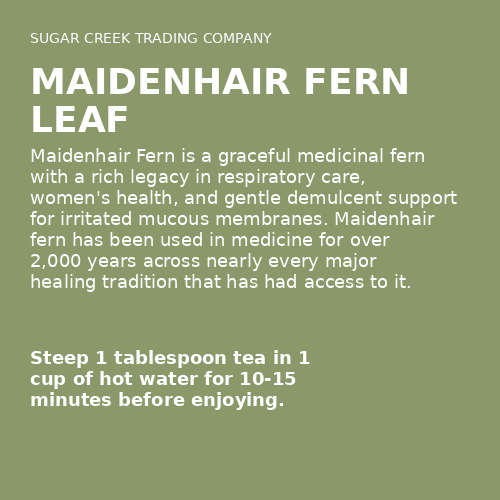
A graceful medicinal fern with a rich legacy in respiratory care, women's health, and gentle demulcent support for irritated mucous membranes.
BOTANICAL IDENTIFICATION
Scientific Name: Adiantum capillus-veneris L.
Common Names: Maidenhair Fern, Venus Hair Fern, Southern Maidenhair, True Maidenhair, Capillaire, Hansraj (Hindi/Urdu), Parsiavoshan (Persian), Barshaiyashan
Family: Pteridaceae (Maidenhair Fern family)
Adiantum capillus-veneris is a delicate, evergreen to semi-evergreen fern growing 15 to 40 cm tall from slender, creeping, dark brown rhizomes. The fronds are bipinnate to tripinnate, carried on wiry, glossy black to dark purple stipes (stalks) that are characteristically smooth and polished. The individual pinnules are fan-shaped to wedge-shaped, thin-textured, light green, and approximately 1 to 2 cm across, with the spore-producing sori tucked beneath the reflexed margins of the pinnule tips, forming false indusia. The common name "maidenhair" references the fine, dark, hair-like stipes, while "capillus-veneris" translates directly to "hair of Venus."
This species enjoys one of the broadest distributions of any fern, found across tropical and warm-temperate regions of every continent except Antarctica. It grows naturally on moist limestone rocks, cave entrances, waterfall spray zones, well walls, and shaded cliff faces, favoring alkaline substrates with consistent moisture and humidity. It is common throughout the Mediterranean basin, the southern United States, Mexico, Central and South America, sub-Saharan Africa, the Indian subcontinent, and East Asia. Its preference for lime-rich substrates is a useful field identification characteristic.
CULTURAL AND HISTORICAL USE
Maidenhair fern has been used in medicine for over 2,000 years across nearly every major healing tradition that has had access to it. Dioscorides described it in De Materia Medica (circa 70 CE) as a remedy for asthma, coughs, and difficulty breathing, and recommended it to promote menstruation and dissolve kidney stones. Pliny the Elder noted its use for hair loss and scalp conditions, connecting the plant's fine, dark stalks to its purported ability to strengthen human hair through the Doctrine of Signatures. Theophrastus mentioned it even earlier in his botanical writings. The Latin species name itself, "capillus-veneris" (hair of Venus), encodes the ancient association between this plant and the goddess of beauty, linking it to women's health, hair care, and the feminine principle in Greco-Roman herbal philosophy.
In the Unani (Greco-Arabic) medical tradition, Parsiavoshan (maidenhair fern) holds significant importance and is still widely prescribed today across South Asia and the Middle East. Unani practitioners classify it as having cold and dry qualities in the second degree and prescribe it for coughs, pleurisy, asthma, hepatic congestion, and splenic enlargement. Avicenna (Ibn Sina) documented it in the Canon of Medicine for chest complaints and as a hair tonic. In Ayurvedic medicine, Hansraj is used for similar respiratory indications and is also valued for its diuretic and febrifuge properties. It appears in formulations for bronchitis, liver complaints, and skin conditions.
European herbalism maintained a strong tradition of maidenhair fern use, particularly in France, where "sirop de capillaire" (capillaire syrup) was a famous cough remedy and fashionable beverage from the 17th through 19th centuries. Made by infusing maidenhair fronds in sugar syrup with orange flower water, capillaire was dispensed by apothecaries and served in coffeehouses as both medicine and refreshment. The Eclectics in American herbal medicine used maidenhair fern for chronic coughs, bronchial irritation, and nasal congestion, valuing its gentle demulcent and expectorant qualities.
KEY BIOACTIVE COMPOUNDS & BENEFITS
| Compound/Class | Location in Plant | Human Benefit | Role in Plant |
|---|---|---|---|
| Triterpenoids (adiantone, isoadiantone, filicene) | Fronds and rhizome | Anti-inflammatory, antimicrobial, hepatoprotective activity | Defense compounds against microbial pathogens and herbivores |
| Flavonoids (rutin, quercetin, kaempferol, astragalin, nicotiflorin) | Fronds (pinnules and rachis) | Antioxidant protection, capillary strengthening, anti-inflammatory effects | UV screening and defense against oxidative damage |
| Phenolic acids (gallic acid, chlorogenic acid, caffeic acid) | Fronds | Antioxidant activity, antimicrobial effects, anti-inflammatory support | Antimicrobial defense and structural reinforcement |
| Mucilage and polysaccharides | Frond tissue | Demulcent coating of irritated respiratory and digestive mucosa | Water retention and desiccation protection |
| Tannins (proanthocyanidins) | Fronds and stipes | Astringent action, tissue toning, antimicrobial activity | Herbivore deterrent and wound-sealing compounds |
The therapeutic profile of maidenhair fern arises from the combined action of its triterpenoid, flavonoid, and mucilaginous fractions. The triterpenoids, particularly adiantone and isoadiantone, are distinctive to the Adiantum genus and drive the plant's anti-inflammatory and hepatoprotective effects. The flavonoid-rich profile provides broad antioxidant support and capillary-protective action, while the mucilage component delivers the gentle demulcent quality that makes this fern so effective for soothing irritated respiratory and urinary membranes. This combination of demulcent, anti-inflammatory, and mild expectorant actions defines the plant's clinical niche.
HOW IT WORKS IN THE BODY
Maidenhair fern operates primarily as a gentle, soothing respiratory and mucosal remedy, with supporting actions on the liver, urinary system, and vascular tissue.
Respiratory Demulcent and Expectorant Action:
The mucilaginous polysaccharides in maidenhair fern coat irritated mucous membranes of the bronchi, trachea, and pharynx, reducing the sensation of dryness and tickle that triggers unproductive coughing. Simultaneously, the triterpenoid and flavonoid compounds exert mild expectorant effects by promoting productive mucus secretion and ciliary clearance, helping to move trapped mucus out of the lower airways. This dual demulcent-expectorant action makes it particularly suited to dry, irritable, non-productive coughs rather than wet, congested conditions.
Anti-inflammatory and Antioxidant Activity:
Adiantone and related triterpenoids inhibit inflammatory mediators including prostaglandin E2 and nitric oxide production in macrophages. The flavonoid fraction, rich in rutin and quercetin, provides synergistic antioxidant protection by scavenging free radicals and chelating pro-oxidant metal ions. Rutin in particular strengthens capillary walls and reduces vascular permeability, which contributes to the plant's traditional use for excessive menstrual bleeding and nosebleeds.
Hepatoprotective Effects:
Preclinical studies have demonstrated that Adiantum capillus-veneris extracts reduce liver enzyme elevation (ALT, AST) and hepatic lipid peroxidation in models of chemically induced liver injury. The mechanism involves upregulation of hepatic glutathione and superoxide dismutase activity, enhancing the liver's endogenous antioxidant defenses. This supports the Unani and Ayurvedic use of the fern for liver congestion and hepatic insufficiency.
Diuretic and Urinary Support:
Maidenhair fern has demonstrated mild diuretic activity in pharmacological studies, increasing urine volume without significant electrolyte depletion. Combined with its anti-inflammatory and demulcent properties, this makes it useful for urinary tract irritation and as a supportive herb in kidney stone formulas, consistent with its use by Dioscorides and Unani physicians for urinary complaints.
DOSE GUIDELINES
| Preparation Type | Typical Dose | Purpose |
|---|---|---|
| Infusion (dried fronds) | 2-4 g steeped in 250 mL hot water for 10-15 minutes, 2-3 times daily | Respiratory demulcent, cough relief, general tonic |
| Syrup (capillaire) | 10-15 mL (2-3 teaspoons), 2-3 times daily | Soothing cough syrup, pleasant-tasting respiratory remedy |
| Tincture (1:5, 40% ethanol) | 2-4 mL, 2-3 times daily | Convenient liquid preparation for respiratory and liver support |
| Powdered frond | 1-3 g daily in divided doses | Encapsulated or mixed into honey for cough and bronchial support |
Maidenhair fern is gentle enough for extended use over several weeks during respiratory illness or as a seasonal support herb. It is not a strong-acting plant and is best understood as a mild, soothing remedy that works through gentle, persistent action rather than dramatic acute effects. In Unani medicine, it is often prescribed for 2 to 6 weeks as part of compound formulations. Its mildness makes it one of the few medicinal ferns traditionally considered appropriate for children (in reduced doses) and the elderly.
PREPARATION AND USES
The dried fronds are most commonly prepared as a simple infusion, steeping 2 to 4 grams in just-boiled water for 10 to 15 minutes. The resulting tea has a mild, slightly sweet, and faintly herbaceous flavor without significant bitterness. The historic French preparation, sirop de capillaire, is made by infusing a generous handful of fresh or dried maidenhair fronds in a hot sugar syrup, then straining and adding a few drops of orange flower water. This syrup served as both a cough remedy and a flavoring for beverages and was one of the most popular medicinal syrups in European apothecaries for over 200 years.
In Unani and Ayurvedic practice, maidenhair fern is often combined into compound preparations. A common Unani formula pairs it with licorice root, violet flowers, and jujube fruit for chest complaints. In Western herbalism, it blends well with marshmallow root, mullein leaf, and thyme for comprehensive respiratory support. Externally, a strong infusion or decoction can be used as a hair rinse, connecting to the ancient association between this fern and hair health. The fronds can also be prepared as a poultice for minor skin irritation, though this application is less common today.
OPTIMAL CONTEXT FOR USE
Maidenhair fern leaf is especially well-suited for individuals experiencing:
Dry, irritable, non-productive coughs or chronic bronchial irritation, where soothing demulcent action is needed rather than heavy expectorant stimulation
Chronic mild respiratory complaints including ticklish throat, post-nasal drip irritation, or dry air-induced upper airway discomfort
Mild liver congestion or sluggish hepatic function, particularly as an adjunct to other liver-supporting herbs
Urinary tract irritation or mild inflammatory conditions of the kidneys and bladder, as part of a comprehensive herbal formula
Interest in traditional Unani, Ayurvedic, or historic European herbal preparations and formulas
Maidenhair fern is a team player rather than a solo performer. It excels in formulas where its gentle demulcent, anti-inflammatory, and mild expectorant qualities complement stronger-acting herbs. For respiratory support, combine with mullein, marshmallow root, or licorice root. For liver support, it pairs well with milk thistle, dandelion root, or chicory. For hair care, combine the infusion with rosemary and nettle as a strengthening rinse.
SUSTAINABILITY AND ETHICAL HARVESTING
Adiantum capillus-veneris is one of the most widely distributed ferns in the world, occurring naturally across six continents in tropical and warm-temperate zones. It is not globally threatened and is listed as Least Concern by the IUCN in most regions where it has been assessed. However, localized populations can be vulnerable to habitat disturbance, particularly in areas where limestone caves, springs, and moist cliff habitats are impacted by development or water table changes.
The plant is easily cultivated in greenhouse and shade-garden settings, making cultivated sourcing feasible. For the herbal trade, most commercial maidenhair fern is wild-harvested in South Asia and the Middle East, where it grows abundantly in suitable habitats. Sustainable harvesting involves taking only fronds (not uprooting rhizomes) and rotating collection sites to allow regrowth. Sugar Creek Trading Company sources maidenhair fern leaf with attention to quality and sustainable harvesting practices.
SAFETY AND CAUTIONS
Maidenhair fern has a long history of safe use and is generally considered one of the gentler medicinal plants. No significant toxicity has been reported at traditional doses.
Individuals with known allergies to ferns or spore-bearing plants should introduce maidenhair fern cautiously. Fern spores can occasionally trigger allergic responses in sensitive individuals, though this is more relevant to fresh plants than dried herb preparations.
Due to its traditional use as an emmenagogue (promoting menstruation), maidenhair fern should be avoided during pregnancy, particularly in the first trimester. This caution is based on traditional reports rather than confirmed pharmacological data, but the precautionary principle applies.
May interact with anticoagulant medications due to its flavonoid content (particularly rutin), which affects capillary permeability and platelet function. Consult a healthcare provider if taking blood-thinning medications.
Not a substitute for professional medical evaluation of persistent cough, respiratory difficulty, or liver disease. Chronic respiratory symptoms warrant proper diagnosis.
REFERENCES
Ibraheim, Z.Z., Ahmed, A.S., & Gouda, Y.G. "Phytochemical and Biological Studies of Adiantum capillus-veneris L." Saudi Pharmaceutical Journal, 2011; 19(2): 65-74.
Mahboubi, M. "Adiantum capillus-veneris L.: A Review of Its Ethnopharmacology, Phytochemistry, and Pharmacology." Journal of Herbmed Pharmacology, 2019; 8(2): 81-89.
Al-Snafi, A.E. "The Chemical Constituents and Pharmacological Effects of Adiantum capillus-veneris - A Review." Asian Journal of Pharmaceutical Science and Technology, 2015; 5(2): 106-111.
Grieve, M. A Modern Herbal. Dover Publications, 1971 (reprint of 1931 edition). Entry on Maidenhair.
FINAL NOTE
Maidenhair fern is the herbalist's whisper where many plants are a shout. Its strength lies in gentle, persistent, soothing action on irritated tissues, particularly the respiratory mucosa, where it brings comfort without overstimulation. From the apothecary shelves of 18th-century Paris to the Unani clinics of modern Lahore, this delicate fern has earned its place through quiet reliability rather than dramatic potency. For dry coughs, bronchial irritation, and the need for a mild, elegant respiratory remedy, few plants match the refined gentleness of Venus's own hair.
Condividere