Sugar Creek Trading Company
Neem Leaf
Neem Leaf
Impossibile caricare la disponibilità di ritiro
AZADIRACHTA INDICA
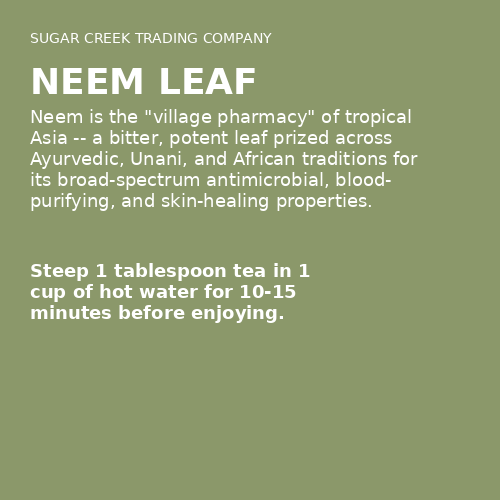
The "village pharmacy" of tropical Asia -- a bitter, potent leaf prized across Ayurvedic, Unani, and African traditions for its broad-spectrum antimicrobial, blood-purifying, and skin-healing properties.
BOTANICAL IDENTIFICATION
Scientific Name: Azadirachta indica A. Juss.
Common Names: Neem, Nimba, Margosa, Indian Lilac, Nim, Arishtha, Vempu, Dogonyaro
Family: Meliaceae (Mahogany family)
Neem is a fast-growing, evergreen to semi-deciduous tree that commonly reaches 15 to 25 meters in height, with a broad, spreading crown that can span 20 meters in diameter. The leaves are pinnately compound, bearing 8 to 19 serrated, lanceolate leaflets that are bright green on the upper surface and lighter beneath. Small, white, fragrant flowers appear in axillary panicles and give way to smooth, olive-shaped drupes that turn golden-yellow when ripe. Every part of the tree -- bark, leaves, flowers, fruit, seed, and root -- has documented medicinal applications, but the leaf is the most widely used and accessible.
Native to the Indian subcontinent and the dry forests of Myanmar, neem thrives in tropical and subtropical climates with annual temperatures between 21 and 32 degrees Celsius. It tolerates poor, sandy, and lateritic soils and is remarkably drought-resistant once established, making it one of the most widely planted trees across sub-Saharan Africa, Southeast Asia, and Central America, where it has been introduced for reforestation, shade, and medicine.
CULTURAL AND HISTORICAL USE
In Ayurvedic medicine, neem is classified as one of the most important tikta (bitter) herbs, with cold, dry, and light qualities that make it the supreme remedy for pitta (heat) and kapha (congestion) conditions. The ancient text Sushruta Samhita (circa 600 BCE) describes neem leaf as a blood purifier (raktashodhaka) and skin medicine of the first order. Traditional Ayurvedic practitioners prescribed neem leaf decoctions for skin eruptions, fever, intestinal parasites, and inflammatory conditions. The Sanskrit name "Arishtha," meaning "reliever of sickness," reflects the reverence afforded to this tree. Neem twigs have been used as natural toothbrushes (datun) across India for centuries, valued for their antimicrobial effect on oral flora.
In Unani medicine, neem leaf was employed under the name "Neem" or "Azad Darakht" (free tree) as a musaffi-e-khoon (blood cleanser) and a remedy for skin diseases, ulcers, and febrile conditions. African traditional medicine systems, particularly in West Africa where the tree is called "dogonyaro," adopted neem rapidly after its introduction and use the leaf tea for malaria symptoms, fever, and digestive complaints. In Nigerian and Ghanaian folk medicine, neem leaf baths are given to treat measles, chickenpox, and other eruptive diseases.
Neem's significance extends beyond medicine into agriculture and daily life. Indian farmers have used neem leaf and seed preparations as natural pesticides for centuries, a practice now validated by modern organic agriculture. The tree is considered sacred in Hindu culture, associated with the goddess Durga, and neem branches are hung at doorways during festivals to ward off disease and evil spirits. In the 20th century, neem became a subject of intense scientific interest, with over 500 published studies on azadirachtin (from the seed) alone, and growing research on the leaf's immunomodulatory and hepatoprotective properties.
KEY BIOACTIVE COMPOUNDS & BENEFITS
| Compound/Class | Location in Plant | Human Benefit | Role in Plant |
|---|---|---|---|
| Nimbin and Nimbidin (limonoids) | Leaves and seed oil | Anti-inflammatory, antipyretic, antifungal, antihistaminic | Insect antifeedant and antimicrobial defense |
| Quercetin and other flavonoid glycosides | Leaves | Antioxidant, anti-inflammatory, capillary-stabilizing | UV protection and pollinator attraction |
| Gedunin (tetranortriterpenoid) | Leaves and bark | Antimalarial, antifungal, anticancer (in vitro) | Chemical defense against pathogens |
| Polysaccharides and galactomannan | Leaves | Immunostimulant; enhances macrophage and NK cell activity | Cell wall structural components |
| Catechins and gallic acid (tannins) | Leaves | Astringent, antimicrobial, wound-healing support | Herbivore deterrent and antifungal defense |
The limonoid compounds -- particularly nimbin, nimbidin, and gedunin -- define neem leaf's therapeutic identity. These highly oxygenated triterpenoids are responsible for the leaf's intense bitterness and its broad-spectrum activity against bacteria, fungi, viruses, and parasites. Combined with the flavonoid and tannin fractions, neem leaf provides a multi-layered antimicrobial and anti-inflammatory profile that explains its effectiveness across such a wide range of traditional applications.
HOW IT WORKS IN THE BODY
Neem leaf exerts its effects through several interconnected pathways, with particular strength in immune modulation, dermatological support, and metabolic regulation.
Antimicrobial and Antiparasitic Activity:
The limonoids and tannins in neem leaf demonstrate in vitro activity against a wide range of Gram-positive and Gram-negative bacteria (including Staphylococcus aureus, Escherichia coli, and Streptococcus mutans), dermatophyte fungi (Trichophyton, Candida species), and protozoan parasites (Plasmodium falciparum). Nimbidin has been shown to inhibit bacterial cell wall synthesis and disrupt fungal membrane integrity. Gedunin's antimalarial activity appears to involve inhibition of the parasite's Hsp90 protein, a mechanism distinct from conventional antimalarials.
Immune Modulation:
Neem leaf polysaccharides and limonoids stimulate both cell-mediated and humoral immunity. Animal studies have demonstrated enhanced macrophage phagocytic activity, increased natural killer cell function, and upregulated lymphocyte proliferation following neem leaf administration. At the same time, nimbidin and quercetin inhibit pro-inflammatory mediators such as prostaglandins, COX-2, and NF-kB, creating a balanced immune response that fights infection without excessive inflammation.
Blood Sugar and Metabolic Regulation:
Neem leaf has demonstrated hypoglycemic activity in multiple animal models and several human studies. The proposed mechanisms include enhancement of peripheral glucose uptake, increased glycogen synthesis in the liver, and improved insulin receptor sensitivity. Flavonoid compounds in the leaf also inhibit alpha-glucosidase activity in the intestine, slowing carbohydrate absorption and reducing postprandial glucose spikes.
Dermatological and Blood-Purifying Effects:
The traditional classification of neem as a blood purifier aligns with modern understanding of its hepatoprotective and detoxification-supporting properties. Neem leaf extracts have been shown to increase glutathione levels and enhance hepatic detoxification enzyme activity. Topically and internally, the combination of antimicrobial, anti-inflammatory, and bitter cholagogue properties makes neem uniquely effective for skin conditions driven by infection, inflammation, or toxic burden.
DOSE GUIDELINES
| Preparation Type | Typical Dose | Purpose |
|---|---|---|
| Dried leaf infusion | 1-2 teaspoons per cup of boiling water, steeped 10-15 minutes; 1-2 cups daily | Blood purification, skin support, general immune tonic |
| Leaf powder (capsules or stirred into water) | 1-3 grams daily, divided into 2-3 doses | Metabolic and blood sugar support; ongoing detoxification |
| Tincture (1:5, 50% ethanol) | 2-4 mL, two to three times daily | Concentrated antimicrobial and anti-inflammatory support |
| Topical wash (strong decoction) | Handful of leaves simmered in 1 liter of water for 20 minutes; applied externally | Skin infections, wounds, fungal conditions, scalp health |
Neem is intensely bitter, and its strong cooling energy means it is best used in defined courses rather than indefinitely. Traditional Ayurvedic practice recommends cycles of 2 to 6 weeks followed by a rest period, particularly for internal use. For skin conditions, both internal and external use simultaneously tends to produce the most noticeable results. If the bitterness is difficult to tolerate, encapsulation or mixing with honey can make the dose more palatable.
PREPARATION AND USES
The dried leaf offered here is suitable for a full range of herbal preparations. For a standard infusion, pour boiling water over 1 to 2 teaspoons of the dried leaf, cover, and steep for 10 to 15 minutes. The resulting tea will be distinctly bitter -- this is expected and is itself a therapeutic action, stimulating digestive secretions and liver function. Add honey or combine with peppermint or licorice root to soften the flavor. For a stronger decoction for topical use, simmer a generous handful of leaf in water for 20 minutes, strain, cool, and use as a skin wash, hair rinse, or compress.
Neem leaf powder can be filled into capsules at home for those who prefer to bypass the taste entirely, or stirred into a small amount of warm water and taken quickly. In Ayurvedic practice, neem leaf is frequently combined with turmeric for skin conditions, with guduchi (Tinospora cordifolia) for immune support, or with bitter melon for blood sugar management. Externally, neem leaf powder can be mixed with water, aloe gel, or bentonite clay to create poultices and face masks for acne, eczema, and fungal infections.
OPTIMAL CONTEXT FOR USE
Neem leaf is especially well-suited for individuals experiencing:
Chronic or recurring skin conditions such as acne, eczema, psoriasis, boils, or fungal infections, where internal blood purification and external antimicrobial action are both needed
Frequent infections or compromised immunity, particularly bacterial or fungal in nature, where broad-spectrum antimicrobial support is desired without disrupting beneficial gut flora
Blood sugar dysregulation, including prediabetic patterns or metabolic syndrome, as a complementary approach alongside dietary changes
Seasonal cleansing or detoxification protocols, where bitter herbs are used to stimulate liver function and clear accumulated metabolic waste
Oral health concerns such as gingivitis, periodontitis, or recurrent mouth sores, where neem's traditional oral care applications have modern validation
Neem combines well with turmeric and manjistha for comprehensive skin protocols, with triphala for digestive and detoxification support, and with holy basil for broad-spectrum immune and metabolic resilience.
SUSTAINABILITY AND ETHICAL HARVESTING
Neem is one of the most sustainable medicinal trees on earth. A mature neem tree produces abundant leaf biomass annually, and leaf harvesting does not harm the tree when done responsibly. The tree itself is aggressively cultivated worldwide -- there are an estimated 25 million neem trees in India alone, with millions more planted across Africa, Central America, and Southeast Asia as part of reforestation and agroforestry programs. Neem is not listed as threatened by CITES or IUCN; on the contrary, it is actively promoted by the United Nations and international development agencies as a solution for sustainable agriculture and rural healthcare.
The primary ethical consideration with neem is not scarcity but biopiracy. In the 1990s, several multinational corporations attempted to patent neem-derived products, prompting a landmark legal battle led by Indian scientist Vandana Shiva and the European Patent Office that upheld traditional knowledge rights. Sourcing neem from established Indian and African producers supports the communities that have cultivated this tree's knowledge for millennia.
SAFETY AND CAUTIONS
Neem leaf is considered safe for most adults when used at recommended doses for defined periods. However, the following precautions apply:
Neem is very cold and bitter in energetic terms. Individuals with cold, weak digestion (Ayurvedic vata constitution) or those who are underweight or depleted should use neem cautiously and in smaller doses, preferably combined with warming herbs like ginger.
Pregnant women must avoid neem leaf, as it has demonstrated anti-implantation and abortifacient properties in animal studies. Nursing mothers should also avoid internal use.
Neem may lower blood sugar levels. Individuals taking insulin or oral hypoglycemic medications should monitor blood glucose closely and consult their healthcare provider before adding neem to their regimen.
Neem may potentiate the effects of immunosuppressant medications due to its immunomodulatory activity. Individuals with autoimmune conditions should use under professional guidance.
Very high doses or prolonged use beyond recommended cycles may cause nausea, vomiting, or liver stress. Adhere to traditional dosing guidelines and cycle on and off.
REFERENCES
Subapriya, R. & Nagini, S. (2005). "Medicinal properties of neem leaves: A review." Current Medicinal Chemistry -- Anti-Cancer Agents, 5(2), 149-156.
Biswas, K., Chattopadhyay, I., Banerjee, R.K., & Bandyopadhyay, U. (2002). "Biological activities and medicinal properties of neem (Azadirachta indica)." Current Science, 82(11), 1336-1345.
Alzohairy, M.A. (2016). "Therapeutics role of Azadirachta indica (Neem) and their active constituents in diseases prevention and treatment." Evidence-Based Complementary and Alternative Medicine, 2016, 7382506.
FINAL NOTE
Neem leaf is one of tropical herbalism's most versatile and well-validated medicines, a tree so useful that the Indian Parliament passed the Neem Tree Protection Act to safeguard its heritage. Its bitter taste is the taste of purification -- of blood, skin, and metabolism cleansed from the inside out. In dried leaf form, it offers the complete phytochemical profile that has made neem a cornerstone of healing across three continents for over two thousand years.
Condividere