Sugar Creek Trading Company
Oatstraw
Oatstraw
Impossibile caricare la disponibilità di ritiro
Avena sativa
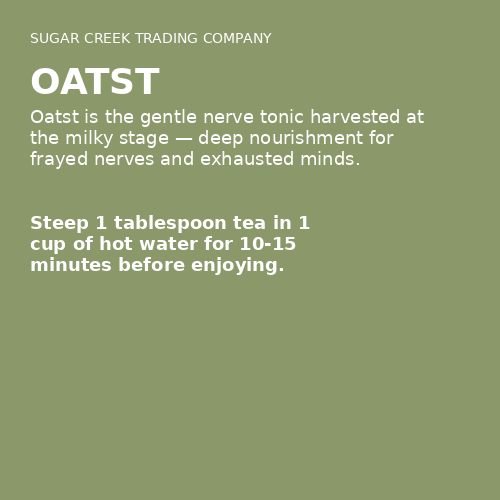
The gentle nerve tonic harvested at the milky stage — deep nourishment for frayed nerves and exhausted minds.
Botanical Identification
- Common Name: Oatstraw (Milky Oats, Oat Tops, Green Oat Herb)
- Latin Name: Avena sativa L.
- Family: Poaceae (Grass family)
- Parts Used: Aerial parts (stems, leaves, and unripe seed heads), harvested during the milky stage when the immature grain exudes a white latex when squeezed
- Native Range: Mediterranean region and the Fertile Crescent; now cultivated worldwide
- Growth Habit: Annual grass growing 60-120 cm tall with hollow stems, flat leaf blades, and loose panicle inflorescences bearing pendulous spikelets
Cultural and Historical Use
Oats have been cultivated for at least 3,000 years, though their medicinal use as oatstraw — specifically the green, milky aerial parts — is a more recent distinction in Western herbalism. European folk healers prescribed oatstraw baths for rheumatic pain, skin conditions, and nervous exhaustion. The phrase "sowing wild oats" reflects the ancient association between Avena and vitality. In the Eclectic medical tradition of 19th-century North America, oat preparations were considered premier remedies for nervous debility, morphine withdrawal, and sexual neurasthenia. Nicholas Culpeper classified oats as moistening and nourishing. In Ayurvedic frameworks, oatstraw aligns with a vata-pacifying profile — grounding, moistening, and restorative. The distinction between oatstraw (dried stems and leaves) and milky oat tops (fresh, latex-rich seed heads) is important: both are nervines, but milky oats are considered more potent for acute nervous system support, while dried oatstraw provides sustained mineral nourishment over time.
Key Bioactive Compounds
| Compound | Class | Primary Action |
|---|---|---|
| Avenanthramides | Polyphenols (unique to Avena) | Antioxidant, anti-inflammatory, anti-itch; inhibit NF-kB and histamine release |
| Saponins (avenacosides A & B) | Steroidal saponins | May support hormone balance; potential testosterone bioavailability effects |
| Silicic acid (soluble silica) | Mineral compound | Supports connective tissue, hair, skin, and nail integrity |
| Beta-glucans | Polysaccharides | Immune modulation, cholesterol reduction, prebiotic effects |
| Flavonoids (vitexin, isovitexin) | Flavone glycosides | Anxiolytic, neuroprotective |
| Minerals (calcium, magnesium, iron, zinc, manganese) | Trace and macro minerals | Nutritive support for nervous system and musculoskeletal health |
How It Works in the Body
Oatstraw operates primarily as a trophorestorative — a class of herbs that slowly rebuild and restore function to depleted organ systems, in this case the nervous system. Unlike sedative herbs that dull neural activity, oatstraw nourishes the myelin sheath and provides the mineral cofactors (calcium, magnesium, silica, zinc) required for healthy nerve impulse conduction. Avenanthramides, compounds unique to the Avena genus, exert measurable anti-inflammatory effects by inhibiting pro-inflammatory cytokines and suppressing NF-kB activation. In the cardiovascular system, beta-glucans bind bile acids in the intestine, promoting cholesterol clearance. The saponin fraction, particularly avenacosides, may influence sex hormone-binding globulin (SHBG), potentially increasing free testosterone availability — a mechanism of interest in both traditional vitality formulas and modern sports nutrition. The overall profile is one of slow, cumulative restoration rather than acute symptomatic relief, making oatstraw ideal for long-term use.
Dose Guidelines
| Form | Typical Dose | Notes |
|---|---|---|
| Dried oatstraw infusion (long steep) | 30-40 grams per quart of water | Steep 4 hours to overnight for full mineral extraction; strain and drink throughout the day |
| Standard tea | 2-4 grams in 8 oz hot water | Steep 10-15 minutes; lighter mineral extraction than long infusion |
| Tincture (dried herb, 1:5) | 3-5 mL, three times daily | Convenient but less mineral-rich than infusion |
| Bath | 100-200 grams steeped in bath water | Traditional use for skin irritation, eczema, and nervous tension |
| Capsules / powder | 1-3 grams daily | Useful for travel or convenience; take with meals |
Preparation and Uses
- Overnight nourishing infusion: Place 30-40 grams of dried oatstraw in a quart jar. Fill with boiling water, cap tightly, and let steep for 4-8 hours or overnight. Strain and drink at room temperature or gently reheated. This method, popularized by herbalist Susun Weed, extracts the full mineral and polysaccharide content.
- Gentle daily tea: Use 2-4 grams per cup for a lighter preparation. Suitable for daily sipping, especially when blended with chamomile, lemon balm, or lavender.
- Oatstraw bath: Simmer 100-200 grams in a large pot of water for 20 minutes. Strain the liquid into a warm bath. Soak for 20-30 minutes. Excellent for dry, itchy skin and overall nervous system calming.
- Blending: Oatstraw combines beautifully with nettle leaf (mineral synergy), skullcap (nervous system), and red clover (hormonal support) in long infusion blends.
Optimal Context for Use
Oatstraw is best understood as a long-game herb. Its benefits accumulate over weeks and months of consistent use rather than producing immediate shifts. It is ideal for individuals experiencing chronic stress, burnout, nervous exhaustion, difficulty concentrating, or the depleted feeling that follows prolonged illness or overwork. It is particularly well-suited for people who feel "wired but tired" — overstimulated yet unable to truly rest. The mineral richness makes it valuable for anyone with increased nutrient demands: athletes, breastfeeding mothers, those recovering from surgery, or anyone with a history of poor dietary mineral intake. As a daily beverage, the overnight infusion replaces nutrient-poor drinks with something genuinely restorative.
Sustainability and Ethical Harvesting
Oats are one of the most widely cultivated cereal crops on the planet, making supply concerns minimal. However, oatstraw harvested at the milky stage requires intentional timing — the grain must be collected before it matures and dries, which means the field is not harvested for grain. This creates a modest economic tension for farmers, though demand for high-quality oatstraw has created a viable niche market. Organically grown oatstraw avoids pesticide and herbicide contamination, which is particularly important for an herb consumed in large quantities as a long infusion. Supporting domestic organic oat farms strengthens local agricultural resilience.
Safety and Cautions
- Gluten sensitivity: While oats are inherently gluten-free, they are frequently cross-contaminated with wheat, barley, or rye during processing. Those with celiac disease or severe gluten intolerance should source certified gluten-free oatstraw or confirm the supplier's processing practices.
- Allergies: Rare, but individuals with grass pollen allergies may occasionally react to oatstraw. Discontinue if any allergic symptoms occur.
- Drug interactions: No significant drug interactions are documented at normal doses. The high fiber and mineral content could theoretically affect absorption of certain medications if taken simultaneously — space doses by at least one hour.
- Pregnancy and breastfeeding: Generally considered safe and nutritive during pregnancy and lactation. Widely used by midwives and herbalists in prenatal tea blends.
- Overall safety profile: Oatstraw is one of the safest herbs in the Western materia medica. It is classified as a food-grade herb with no known toxicity at standard doses.
References
- Sur, R., et al. (2008). Avenanthramides, polyphenols from oats, exhibit anti-inflammatory and anti-itch activity. Archives of Dermatological Research, 300(10), 569-574.
- Meydani, M. (2009). Potential health benefits of avenanthramides of oats. Nutrition Reviews, 67(12), 731-735.
- Berry, N.M., et al. (2011). Acute effects of an Avena sativa herb extract on responses to the Stroop Color-Word test. Journal of Alternative and Complementary Medicine, 17(7), 635-637.
- Hoffmann, D. (2003). Medical Herbalism: The Science and Practice of Herbal Medicine. Healing Arts Press.
- Weed, S. (1989). Healing Wise. Ash Tree Publishing.
- European Medicines Agency. (2008). Assessment Report on Avena sativa L., herba. EMA/HMPC.
Final Note
Oatstraw is not flashy. It will not produce a dramatic shift after one cup. What it will do, taken consistently over time, is quietly rebuild the mineral and nervous system reserves that modern life steadily drains. It is the herbalist's equivalent of a long, patient investment — modest inputs, compounding returns. This product is sold as a botanical specimen and herbal supplement. It is not intended to diagnose, treat, cure, or prevent any disease. Consult a qualified healthcare provider before use if you are pregnant, nursing, taking medications, or managing a medical condition.
Condividere