Sugar Creek Trading Company
Oolong Se Chung Special Tea
Oolong Se Chung Special Tea
Impossibile caricare la disponibilità di ritiro
CAMELLIA SINENSIS (OOLONG PROCESSING)
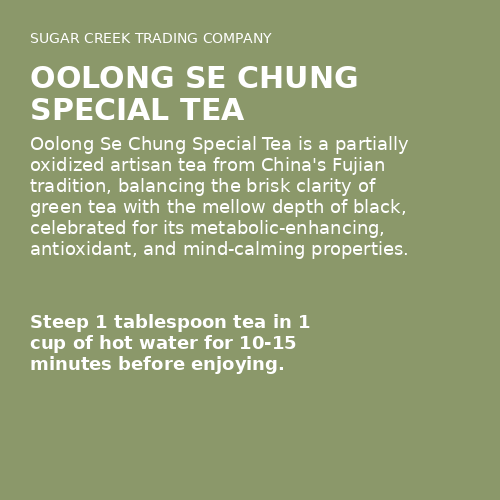
A partially oxidized artisan tea from China's Fujian tradition, balancing the brisk clarity of green tea with the mellow depth of black, celebrated for its metabolic-enhancing, antioxidant, and mind-calming properties.
BOTANICAL IDENTIFICATION
Scientific Name: Camellia sinensis (L.) Kuntze
Common Names: Oolong Se Chung Special, Se Chung Oolong, Se Zhong Oolong, Blue-Green Tea, Wu Long Cha (Chinese), Semi-Fermented Tea
Family: Theaceae (Tea family)
Camellia sinensis is an evergreen shrub or small tree that can reach 15 meters in the wild but is typically pruned to waist height in cultivation. It produces dark green, leathery, elliptical leaves with serrated margins and small, fragrant white flowers with prominent yellow stamens. The Se Chung designation refers to a style of oolong processing originating in China's Fujian Province, where leaves undergo partial oxidation (typically 20-50%), producing a tea that sits between green and black in both color and flavor profile.
Camellia sinensis is native to the borderlands of southwestern China, northeastern India, and northern Myanmar. Se Chung oolong teas are traditionally produced in Fujian and Guangdong provinces, where the combination of mountainous terrain, subtropical climate, mineral-rich soils, and centuries of artisanal processing knowledge creates teas of distinctive character. The Se Chung Special grade indicates a carefully processed leaf with balanced oxidation and a clean, complex cup.
CULTURAL AND HISTORICAL USE
Tea has been consumed in China for at least 3,000 years, with legendary origins attributed to Emperor Shen Nung around 2737 BCE. Oolong tea emerged as a distinct category during the late Ming Dynasty (circa 16th-17th century) in Fujian Province, where tea masters developed the partial oxidation technique to create flavors and aromas unattainable through either green or fully oxidized processing. The word "oolong" (wu long) translates to "black dragon," a reference to the dark, twisted appearance of traditionally processed leaves. Se Chung oolong represents one of the classic Fujian styles, prized for its accessibility, balanced flavor, and smooth finish.
In Traditional Chinese Medicine, tea is classified as a bitter, sweet, and cooling herb that clears the head, brightens the eyes, resolves phlegm, promotes urination, and aids digestion. Oolong tea occupies a unique position in TCM because its partial oxidation gives it a more neutral thermal nature than either cooling green tea or warming black tea, making it suitable for a wider range of constitutional types. Chinese tea culture regards oolong as the connoisseur's tea, the category that most fully reveals the terroir, cultivar, and craftsmanship behind each production.
Oolong tea became a major export commodity during the 18th and 19th centuries, with Se Chung varieties shipped to Europe and America through the ports of Amoy (Xiamen) and Canton (Guangzhou). British and Dutch traders prized these teas for their complex flavor profile, and oolong remained among the most popular tea styles in the Western world until the early 20th century, when black tea came to dominate. Today, oolong tea is experiencing a global renaissance driven by growing appreciation for artisanal teas and by research highlighting its distinctive metabolic and cognitive benefits.
KEY BIOACTIVE COMPOUNDS & BENEFITS
| Compound/Class | Location in Plant | Human Benefit | Role in Plant |
|---|---|---|---|
| Catechins (EGCG, EGC, ECG) and partially oxidized polyphenols | Leaf mesophyll | Potent antioxidant, anti-inflammatory, cardioprotective, and anticancer activity | UV-protective and antimicrobial phenolic compounds in leaf tissue |
| Theaflavins and thearubigins (partial) | Formed during oxidation | Cholesterol reduction, anti-inflammatory, and gut health support | Polymerized polyphenols created during enzymatic browning of damaged leaves |
| L-Theanine | Leaf tissue | Promotes calm alertness, reduces anxiety, enhances alpha brain wave activity | Non-protein amino acid involved in nitrogen metabolism and pest resistance |
| Caffeine | Leaf tissue | Mental alertness, focus, physical performance enhancement, metabolic stimulation | Purine alkaloid that deters herbivorous insects and inhibits competing seedlings |
| Oolong tea polymerized polyphenols (OTPPs) | Formed during partial oxidation | Unique fat metabolism enhancement, pancreatic lipase inhibition, weight management support | Complex polyphenol polymers unique to the semi-oxidized processing method |
The distinctive therapeutic profile of oolong tea arises from its partial oxidation, which creates a polyphenol spectrum unavailable in either green or black tea. Oolong retains significant catechin content (including EGCG) from the unoxidized fraction while simultaneously generating theaflavins, thearubigins, and unique oolong tea polymerized polyphenols from the oxidized fraction. This hybrid chemistry, combined with preserved L-theanine and moderate caffeine, produces a tea with broad-spectrum antioxidant activity, enhanced metabolic effects, and a uniquely balanced stimulant profile that promotes focused calm rather than jittery alertness.
HOW IT WORKS IN THE BODY
Oolong tea acts through multiple synergistic pathways, with particular strength in metabolic regulation, cognitive enhancement, antioxidant defense, and cardiovascular support.
Metabolic Enhancement and Fat Metabolism:
Oolong tea has demonstrated a distinctive ability to increase energy expenditure and fat oxidation that, in some studies, exceeds the effects of equivalent doses of either green or black tea. The oolong-specific polymerized polyphenols (OTPPs) inhibit pancreatic lipase, reducing dietary fat absorption, while caffeine and catechins synergistically stimulate thermogenesis and lipolysis through catecholamine-mediated pathways. A notable study published in the journal Nutrients found that oolong tea increased fat oxidation during sleep, suggesting a sustained metabolic effect beyond acute stimulation.
Cognitive Function and Calm Alertness:
The combination of L-theanine and caffeine in oolong tea creates a well-documented synergistic effect on cognitive performance. L-theanine crosses the blood-brain barrier and promotes alpha brain wave production, associated with a state of relaxed attentiveness. When paired with caffeine, this produces enhanced focus, reaction time, and working memory without the anxiety, jitteriness, or crash associated with caffeine alone. Oolong's moderate caffeine content (roughly 30-50 mg per cup) provides a gentler, more sustained stimulation than coffee.
Antioxidant and Cardiovascular Protection:
Oolong's mixed polyphenol profile scavenges free radicals, inhibits LDL oxidation, improves endothelial function, and reduces inflammatory markers. Long-term observational studies from China and Japan have associated regular oolong tea consumption with reduced risk of cardiovascular disease, stroke, and type 2 diabetes. The polyphenols also support healthy blood sugar regulation by improving insulin sensitivity and modulating postprandial glucose spikes.
Oral and Gut Health:
Oolong polyphenols inhibit the growth of Streptococcus mutans and other cariogenic bacteria, supporting dental health. In the gut, they promote the growth of beneficial Bifidobacterium and Lactobacillus species while suppressing pathogenic organisms, contributing to a healthier microbiome composition.
DOSE GUIDELINES
| Preparation Type | Typical Dose | Purpose |
|---|---|---|
| Loose leaf infusion | 2-3 g (1-1.5 teaspoons) per 8 oz water, steeped 3-5 minutes at 185-205°F | Daily antioxidant, cognitive, and metabolic support |
| Multiple infusions (Gongfu style) | 5-7 g in a small vessel, multiple short steeps (30 seconds to 2 minutes) | Full extraction of polyphenol spectrum; connoisseur preparation |
| Daily consumption | 2-4 cups throughout the day | Sustained metabolic enhancement, cardiovascular protection, cognitive support |
Oolong tea is best enjoyed as a daily beverage consumed consistently over time. The metabolic and cardiovascular benefits observed in clinical studies typically correspond to 2-4 cups per day. Se Chung oolong is particularly well-suited for multiple infusions, with each successive steep revealing different flavor notes and extracting different polyphenol fractions. Water temperature is important: water that is too hot will scorch the leaves and produce bitterness, while water that is too cool will underextract. A temperature of 190-200°F is ideal for Se Chung style oolong.
PREPARATION AND USES
To prepare Se Chung oolong, bring fresh, filtered water to approximately 190-200°F (just below a full boil, with small bubbles forming). Place 2-3 grams of loose leaf tea in a cup, small teapot, or gaiwan and pour the water over the leaves. Steep for 3-5 minutes for a single infusion, adjusting time to taste. The leaves can be resteeped 2-4 times, with each infusion revealing a slightly different flavor profile. For the traditional Gongfu method, use a higher leaf-to-water ratio in a small clay or porcelain vessel with multiple short steeps of 30 seconds to 2 minutes.
Se Chung oolong produces a golden to amber liquor with a smooth, slightly floral character, a hint of nuttiness, and a clean, mildly sweet finish. It lacks the grassiness of green tea and the astringency of many black teas, making it an excellent entry point for those new to loose-leaf tea. Oolong can also be cold-brewed overnight in the refrigerator for a refreshing, low-bitterness iced tea, or used as the base for blended tea beverages. In culinary applications, brewed oolong can be used to poach fruit, flavor rice, or create tea-smoked preparations.
OPTIMAL CONTEXT FOR USE
Oolong Se Chung Special Tea is especially well-suited for individuals seeking:
A daily tea that supports metabolic health, fat metabolism, and healthy weight management as part of an active lifestyle
Focused mental clarity and sustained, calm energy without the jitteriness or crash of coffee
Long-term cardiovascular and antioxidant protection through a pleasurable daily ritual
A transition from coffee or energy drinks to a healthier, more balanced source of caffeine and cognitive support
An introduction to high-quality loose-leaf oolong tea with a smooth, approachable flavor profile
Oolong pairs beautifully with a mindful morning or afternoon ritual and complements a whole-foods diet rich in vegetables, healthy fats, and lean proteins. It can be enjoyed alongside other adaptogenic herbs and can serve as a gentle daily anchor for metabolic and cognitive wellness.
SUSTAINABILITY AND ETHICAL HARVESTING
Camellia sinensis is one of the most widely cultivated beverage crops in the world, and its production is entirely agricultural with no reliance on wild harvesting. Sustainability in tea production centers on labor practices, pesticide use, soil health, and the economic viability of smallholder tea farmers who produce the majority of the world's tea. Se Chung oolong, traditionally produced in Fujian Province, is often crafted by small family operations that maintain centuries-old processing techniques.
The environmental footprint of tea production varies considerably between conventional estates using heavy agrochemical inputs and smaller operations practicing integrated or organic management. Shade-grown and organically managed tea gardens support greater biodiversity and produce leaves with higher L-theanine content. Sugar Creek Trading Company is committed to sourcing oolong tea that reflects both the artisanal tradition of Fujian tea making and responsible agricultural stewardship.
SAFETY AND CAUTIONS
Oolong tea has an extraordinarily long safety record as a daily beverage consumed by billions of people over thousands of years. It is widely considered safe for regular consumption by healthy adults.
Oolong tea contains caffeine (approximately 30-50 mg per cup). Individuals sensitive to caffeine may experience insomnia, restlessness, increased heart rate, or anxiety, particularly if consumed in large quantities or late in the day. Pregnant individuals are generally advised to limit total caffeine intake to 200 mg per day.
Tea polyphenols can reduce the absorption of non-heme iron from plant foods. Individuals with iron deficiency should avoid drinking tea with meals and instead consume it between meals.
Excessive tea consumption (more than 5-6 cups daily over extended periods) may contribute to fluoride accumulation from tea leaves, though Se Chung grades made from younger leaves typically have lower fluoride content than coarse, mature-leaf teas.
Oolong tea may interact with stimulant medications, MAO inhibitors, and certain cardiac drugs due to its caffeine content. Consult a healthcare provider if taking these medications.
REFERENCES
Hursel, R., Viechtbauer, W., & Westerterp-Plantenga, M.S. "The Effects of Catechin Rich Teas and Caffeine on Energy Expenditure and Fat Oxidation: A Meta-Analysis." Obesity Reviews, 2011; 12(7): e573-e581.
Zhang, S., Takano, J., Murayama, N., et al. "Subacute Ingestion of Caffeine and Oolong Tea Increases Fat Oxidation without Affecting Energy Expenditure and Sleep Architecture." Nutrients, 2020; 12(12): 3671.
Rumpler, W., Seale, J., Clevidence, B., et al. "Oolong Tea Increases Metabolic Rate and Fat Oxidation in Men." The Journal of Nutrition, 2001; 131(11): 2848-2852.
Yang, C.S., & Landau, J.M. "Effects of Tea Consumption on Nutrition and Health." The Journal of Nutrition, 2000; 130(10): 2409-2412.
FINAL NOTE
Se Chung Special Oolong represents the golden middle path of the tea world, a partially oxidized tea that captures the best qualities of both green and black tea in a single cup. Its unique polymerized polyphenols, balanced caffeine-theanine ratio, and smooth, complex flavor make it both a connoisseur's pleasure and a practical daily tool for metabolic health, mental clarity, and long-term cardiovascular protection. For those seeking a tea that is as rewarding to drink as it is beneficial to the body, Se Chung oolong is an exceptional choice.
Condividere